Skip to content
Truehost Logo
Websites
Truehost.com Truehost Cloud Truehost Kenya Truehost Nigeria Truehost South Africa Truehost India Truehost UK Truehost Canada
Contact us
Policies
Data Privacy Policy Domain Name and Services Dispute Resolution Policy Abuse Policy File Migration Policy
Coupons

client area

8
  • How to create add funds invoice from truehost client area.
  • How To Move A Website From One Truehost Account To Another Truehost Account
  • How to Power OFF, Powe ON and Reboot a VPS from client area.
  • How to Acess your Virtualizor Account from Truehost Client area
  • How to change VPS Password from Truehost Client Area
  • How to Access VPS via VNC from Truehost Client Area
  • How to set a VPS to rescure mode from Truehost Client area
  • How to Re-install a Tcloud VPS Operating System (OS) from Truehost Client Area

Managed Applications

3
  • Managing Truehost Vaultwarden
  • OpenClaw Hosting Walkthrough
  • Working with Managed VPN

Truehost Reseller Panel

18
  • Hosting Client Management: Adding and Managing Clients in the Truehost Reseller Panel
  • Automatic Suspension and Termination
  • Setting Up Outgoing Email in the Truehost Reseller Panel
  • Setting Up Support Tickets in the Truehost Reseller Panel
  • Turning Support Emails into Tickets
  • Managing Your Clients’ Domains in the Truehost Reseller Panel
  • Keeping Your Truehost Reseller Panel Balance Topped Up
  • Domain Transfers
  • Troubleshooting a Failed Registration in Truehost Reseller Panel
  • Domain Renewals and Reminders
  • Truehost Domains Reseller API
  • How to Add Custom Nameservers in Truehost Reseller Panel
  • How to Set Up Payment Methods in the Truehost Reseller Panel
  • How to Set Up Domain Pricing in the Truehost Reseller Panel
  • Connect to WHMCS: Move Your Customers to the Truehost Reseller Panel
  • What You Need To Set Up Your Truehost Reseller Panel
  • How to White Label the Truehost Reseller Panel Client Area and Admin
  • How to Create Hosting Packages on The Truehost Reseller Panel

Cloud

4
  • How to Enable Ports, Whitelist, and Blacklist IPs in CSF Firewall (ConfigServer Security & Firewall)
  • How to set up Hostname SSL on CWP
  • How to import/export a MariaDB/MySQL database on Cyberpanel
  • How to resize a VPS Disk space

Cloud servers in Kenya

224
  • How to Install and Configure ModSecurity in WHM
  • How to Configure Hostname and Default Nameservers in WHM
  • How to Migrate cPanel Accounts Between cPanel Servers Using WHM
  • How to install a PHP extension in WHM
  • How to remove a DNS zone from WHM
  • How to Suspend / Unsuspend cPanel Accounts Within WHM
  • How to Assign A dedicated IP to a Cpanel Account on WHM
  • How to Add an IP Adress to a Cpanel Server From WHM
  • How to Set Up A DNS Clusters in WHM
  • How to Set Document Root outside public_html for Addon Domain OR Sub Domain
  • How to Create a Backup Job in WHM With Jetbackup
  • How to Add A backup Destination in Jetbackup on A cPnel Server
  • How to Migrate Email Accounts Between cPanel Servers
  • How to enable Shell Access for a Cpanerl Accout
  • How to Automate Updates for cPanel and System Software via WHM
  • How to Schedule cPanel Backups in WHM
  • How to Enable Two-Factor Authentication for WHM Access
  • How to Set Up Custom Branding for Reseller Accounts in WHM
  • How to change cPanel Account Ownership from WHM
  • How to Use MultiPHP in WHM to Change your Server’s PHP Version
  • How to Convert an existing account to Reseller Accounts in WHM
  • How to create and Managing Reseller Accounts in WHM
  • How to Create a cPanel account within WHM
  • How to Add a Remote MySQL Access Host in Webuzo
  • How to Configure Apache as a Reverse Proxy with mod_proxy
  • How to Set Up a Reverse Proxy with Nginx on AlmaLinux 9
  • How to Install and Configure NGINX on CWP
  • How to Monitor Server Health with Nagios
  • How to Forward Ports With Iptables On A Linux Server
  • How to Configure and Manage MySQL Databases in Webuzo
  • How to Whitelist an IP with CSF
  • How To Open Ports On Ubuntu
  • How to Transfer files from a Linux Server to Windows Server using WinSCP
  • How to Configure Firewalld for Enhanced Server Security
  • How to Create a Container in Proxmox
  • How to Backup and Restore Virtual Machines (VMs) in Proxmox
  • How to Create Virtual Machines in Proxmox
  • How to Install and Use Proxmox for Virtualization
  • How to Create & Manage FTP in Webuzo With Enduser Access
  • How to Change File Permissions in Webuzo File Manager
  • How to Install and Configure HAProxy for Load Balancing on Almalinux
  • How to Update a CyberPanel Server
  • How to Create Additional admin User Accounts in CyberPanel
  • How to Disable Two-Factor Authentication in CyberPanel
  • How to Enable Two-Factor Authentication in CyberPanel
  • Implementing Firewall and Security Measures in CyberPanel
  • How to Install WordPress on Webuzo
  • How to Change the PHP Version in the Webuzo Panel
  • How to Install an SSL Certificate in Webuzo
  • How to Create a Self-signed SSL Certificate in Webuzo
  • How to Generate a Certificate Signing Request (CSR) on Webuzo
  • How to Add Subdomain in Webuzo With Enduser Access
  • How to Add a Domain in Webuzo With Enduser Access
  • How to Enable/Disable ModSecurity in Webuzo
  • How to Add Domain and Nameservers in Webuzo For Root Users
  • How to Add Domain Alias in Webuzo With Enduser Access
  • How to Add or Edit DNS Records in Webuzo Panel
  • How To Change The Root Password Of Webuzo Control Panel
  • How to Delete Email Accounts in Webuzo Panel
  • How to Add an Email Account in the Webuzo Panel
  • How to Access Admin Panel in Webuzo
  • How to add a User on Webuzo Admin Panel
  • How to Access User Panel in Webuzo
  • How to Access VNC using Remmina
  • How to Schedule Backups: Local or SFTP on Cyberpanel
  • How to Delete Backup Destinations on Cyberpanel
  • How to Check for installed PHP extensions via ssh on a VPS server
  • How to Add Destination for Scheduled Local/SFTP Remote Backups on Cyberpanel
  • How to Create and Restore CyberPanel Backups
  • How to Set Up Nameservers in Control Web Panel
  • How to check resources usage in DirectAdmin
  • How to generate CSR for SSL in DirectAdmin
  • How to install an SSL Certificate on DirectAdmin
  • How to Increase File Upload Limit in DirectAdmin
  • How to manage user packages in DirectAdmin
  • How to disable/enable php_functions on DirectAdmin
  • How to change the PHP version in DirectAdmin
  • How to create autoresponder in DirectAdmin
  • How to create an FTP account in DirectAdmin
  • How to create a MySQL Database in DirectAdmin
  • How to Suspend/Unsuspend domains in DirectAdmin
  • How to create a subdomain in DirectAdmin
  • How to check the website statistics in DirectAdmin
  • How to add a custom suspension message in DirectAdmin
  • How to change Email Account Password in DirectAdmin
  • How to Create an Email Account in DirectAdmin
  • How to set up Cron Jobs in DirectAdmin
  • How to create a backup in DirectAdmin
  • How to Add and Manage DNS Records in DirectAdmin
  • How to change MX Records in DirectAdmin
  • How to Set Up Website Redirection Rules in DirectAdmin
  • How to Create/Restore an Admin Backup with DirectAdmin
  • How to Create Additional Administrator User In DirectAdmin
  • How to set Up Reseller Accounts in DirectAdmin
  • Installing DirectAdmin on a Cloud Server: Step-by-Step Guide
  • Setting Up and Managing Reseller Accounts in CWP
  • How to copy files from a Windows Server to Linux Server using rSync
  • How to Transfer files from a Windows Server to Linux Server using Command Line (CMD)
  • How to Transfer files from a Windows Server to Linux Server using WinSCP
  • How to Remotely Access Windows Server (RDP) from Linux using Command Line/terminal
  • How to Remotely Access Windows Server (RDP) from Linux using Remmina
  • Understanding how to use the wall command in Linux
  • How to Schedule Server Downtime Notifications with Wall Command
  • Introduction to Linux File System Structure: What Every User Should Know
  • Setting Up and Using Swap Space on Linux Servers
  • How to Use SCP for Secure File Transfers Between Linux Servers
  • How to Compress and Decompress Files Using tar and gzip
  • How to Set Up Syslog for Centralized Logging
  • Installing and Configuring Kubernetes on a Linux Server
  • How to Install and Configure Nginx as a Web Server
  • Installing and Using Docker on a Linux Server
  • Setting Up a LAMP Stack (Linux, Apache, MySQL, PHP) on Almalinux
  • How to Set Up Samba for File Sharing on Linux Servers
  • How to Set Up Network File System (NFS) on a Linux Server
  • How to Configure a Load Balancer on Nginx
  • How to Install and Configure Apache Tomcat on Linux – Almalinux
  • Setting Up a LAMP Stack (Linux, Apache, MySQL, PHP) on Ubuntu
  • Setting Up a LEMP Stack (Linux, Nginx, MySQL, PHP) on Almalinux
  • Automating Server Backups Using rsync and cron
  • How to Optimize Linux Server Swap Usage
  • Using Memcached for Database Performance Optimization
  • How to Use SSH Tunneling for Secure Remote Access
  • How to Install and Configure Redis on Linux Servers
  • How to Secure MySQL/MariaDB with SSL Encryption
  • Optimizing MySQL Performance with Tuning Tools
  • How to Set Up and Use an SSH Jumphost.
  • How to Use Prometheus and Grafana for Server Monitoring
  • Installing and Configuring ELK Stack (Elasticsearch, Logstash, Kibana)
  • How to Set Up a Git Server on Linux
  • How to Install and Configure OpenVPN on a Linux Server
  • How to Install and Configure Apache Tomcat on Linux – Ubuntu
  • Setting Up a LEMP Stack (Linux, Nginx, MySQL, PHP) on Ubuntu 22.04
  • How to Use Fail2Ban to Protect Apache and Nginx from Brute-Force Attacks
  • How to Find Large Files and Directories on a Linux Server
  • How to Configure Apache Redirects with .htaccess Files
  • How to Restrict SSH Access to Specific IPs Using hosts.allow and hosts.deny
  • How to Install ClamAV for Malware Scanning on Ubuntu
  • How to Install ClamAV for Malware Scanning on Amlalinux
  • How to Identify and Kill a Running Process in Linux
  • How to Monitor CPU and Memory Usage in Linux
  • How to Check Disk Usage with df and du Commands
  • Getting Started with Linux Aliases: Simplify Your Commands
  • Understanding and Managing System Logs in Linux
  • Managing Users and Groups on a Linux Server: Best Practices
  • Introduction to Linux Package Managers: Apt vs. Yum
  • How to Set Up a Basic Firewall with Uncomplicated Firewall (UFW)
  • Top 10 Essential Linux Commands for Server Management
  • Understanding Linux File Permissions: What Every Administrator Should Know
  • Setting Up Your First Linux Server: A Step-by-Step Guide
  • Configuring DKIM and SPF for Email Security
  • How to Configure SMTP Relays on a Linux Server
  • How to Configure a Mail Server with Dovecot and Postfix on Almalinux
  • How To Install MariaDB on Ubuntu 22.04
  • How to adjust max_vars_input on CWP
  • How to adjust max_vars_input on Plesk Windows
  • How to manually install moodle on plesk windows
  • How to change System PHP in Plesk Windows
  • How to Install and enable PHP handles on Plesk – Windows
  • How to change PHP version / handler for a single domain Plesk – Windows/Linux
  • How to Back Up MySQL Databases Automatically with Cron
  • How to Set Up Postfix as a Mail Server on Ubuntu
  • Why You May Not Want To Run Your Own Mail Server
  • First Server Setup with Ubuntu
  • What is an Intrusion Detection System (IDS)?
  • Practices for Server Security Hardening
  • How to install Softaculous On Control Web Panel (CWP)
  • How to Install Moodle Manually on Your Server (CWP, Cyberpanel)
  • How to Secure a Linux Server with Fail2Ban
  • Fail2Ban Configuration Documentation: jail.local and fail2ban.local
  • How to Power OFF, Powe ON and Reboot a VPS from client area.
  • How to Acess your Virtualizor Account from Truehost Client area
  • How to set a VPS to rescure mode from Truehost Client area
  • How to Access VPS via VNC from Truehost Client Area
  • How to change VPS Password from Truehost Client Area
  • How to Re-install a Tcloud VPS Operating System (OS) from Truehost Client Area
  • How to disable Two-Factor Authentication (2FA) on Cyberpanel login.
  • How to Disable InnoDB in MariaDB
  • How to Disable InnoDB in MySQL
  • How To Configure the Apache Web Server on an Almalinux
  • How to Install MariaDB on Almalinux 9
  • How to prevent frequent SSH and SCP disconnect
  • How to Install MariaDB on Almalinux 8
  • How to Install phpMyAdmin client on Almalinux 9
  • How to Install phpMyAdmin client on Almalinux 8
  • How to Change the Time Zone on Ubuntu Server
  • How To Configure the Apache Web Server on an Ubuntu/Debian
  • Wget Command Examples to Download Files in Linux
  • How to Check Bandwidth Usage from WHM Panel
  • How to Configure SSH Key for a User
  • How to disable root ssh with password but enable via ssh keys
  • How to change SSH port to a custom port
  • How to Run Sudo Commands Without Password
  • How to create a sudo user on your server
  • How to manually deploy WordPress on Control Web Panel (CWP) User Panel
  • How to manually deploy WordPress on Control Web Panel(CWP) Admin Panel
  • How to disable root ssh completely
  • How to import/export a database on Control Web Panel (CWP)
  • How to create a database in Control Web Panel (CWP)
  • How to Create a Hosting Package on CentOS Web Panel(CWP)
  • How to adjust PHP INI settings on CentOS Web Panel (CWP)
  • How to change the PHP version in Control Web Panel (CWP)
  • How to Install and Enable CSF Firewall on CentOS Web Panel (CWP)
  • How to Manage Existing Emails on CentOS Web Panel (CWP)
  • How to Create Email Accounts on CentOS Web Panel (CWP)
  • How to Create an Addon Domain/Subdomain on a CWP cPanel
  • How to Configure CWP server for Email use
  • How to change a CWP user account password
  • How to Create a User Account (Domain Account) on CWP (CentOS Web Panel)
  • How to Access CWP (Main WHM Panel)
  • How to Access CWP (User’s cPanel)
  • How to set up Hostname SSL on CWP
  • How to change SSH passwords for root and non-root user
  • How to set up a hostname SSL On Cyberpanel
  • How to import/export a MariaDB/MySQL database on Cyberpanel
  • How to Create and Manage Databases on Cyberpanel
  • How to Install CyberPanel – Ubuntu and Almalinux
  • How to adjust PHP INI settings on Cyberpanel (e.g., Upload Limit, post_max_size, display_errors)
  • How to properly Install Control Web Panel(CWP) on Almalinux/CentOS
  • How to Manage Existing Email Accounts on Cyberpanel
  • How to Create and Access Email Accounts on CyberPanel
  • How to Configure Cyberpanel server for Email use
  • How to create a domain and subdomain on Cyberpanel
  • How to Access A Server via SSH/Terminal

Cloudflare

7
  • How to Point Custom Domain to Blogger using Cloudflare DNS?
  • How to Change A record for your domain at Cloudflare
  • How to Update MX records at Cloudflare
  • How to Remove Cloudflare Proxy
  • How to Add a Domain to Cloudflare
  • Activating CloudFlare
  • Configuring CloudFlare

Cpanel

36
  • How to deploy website on cPanel using git version control
  • How to Connect Your Webmail to thunderbird
  • Deploy Websites with Git on cPanel: A Step-by-Step Guide
  • How to Create a Staging Site for WordPress on cPanel
  • How to clone WordPress on cPanel
  • How to enable wordpress security features using softaculous
  • How to deploy Nextjs on cPanel
  • Understanding Resource Usage on Shared Hosting
  • How to Deploy a React App on cPanel: A Step-by-Step Guide
  • ERROR LOADING DATAChild failed to make LIVEAPI connection to cPanel
  • How to Convert an existing account to Reseller Accounts in WHM
  • How to resolve the domain already exists error when adding addon domain
  • How to install free SSL on cPanel using AUTO SSL
  • How to change SSH passwords for root and non-root user
  • How To create a subdomain on Jupiter theme Cpanel
  • [OUTDATED] How To Create a Subdomain in cPanel
  • How to manually Transfer and Restore a Cpanel account using Jetbackup
  • How to restore emails from Jetbackup5
  • How to view cPanel Error logs
  • How to kill Python or Nodejs processes on cpanel
  • How to resolve error 403 on cPanel
  • How to enable 2FA on cPanel
  • How to resolve “Missing temporary folder” for websites on cPanel server.
  • How to Restore Specific Files in cPanel Using Jetbackup5
  • How to Restore Specific Files in cPanel Using Jetbackup5
  • How to force https redirect on your domain
  • Enabling GZIP Compression on Cpanel Websites
  • [Resolved]. How to fix or address Request Timeout Error on cpanel
  • How To Install A Premium SSL Certificate in Cpanel
  • How to fix AWStats not Updating
  • How to Upload A Website To The Cpanel
  • How to back up website from cpanel
  • How to easily build your website on Truehost cpanel
  • How To Install Your Ssl Certificate On Truehost Cpanel
  • How to increase the upload size for wordpress

Jetbackup 5

2
  • How to manually Transfer and Restore a Cpanel account using Jetbackup
  • How to Restore Specific Files in cPanel Using Jetbackup5

dedicated servers

219
  • CentOS Web Panel (CWP) Security Vulnerability – Remediation Guide
  • How to Install and Configure ModSecurity in WHM
  • How to Configure Hostname and Default Nameservers in WHM
  • How to Migrate cPanel Accounts Between cPanel Servers Using WHM
  • How to install a PHP extension in WHM
  • How to remove a DNS zone from WHM
  • How to Suspend / Unsuspend cPanel Accounts Within WHM
  • How to Assign A dedicated IP to a Cpanel Account on WHM
  • How to Add an IP Adress to a Cpanel Server From WHM
  • How to Set Up A DNS Clusters in WHM
  • How to Set Document Root outside public_html for Addon Domain OR Sub Domain
  • How to Create a Backup Job in WHM With Jetbackup
  • How to Add A backup Destination in Jetbackup on A cPnel Server
  • How to Migrate Email Accounts Between cPanel Servers
  • How to enable Shell Access for a Cpanerl Accout
  • How to Automate Updates for cPanel and System Software via WHM
  • How to Schedule cPanel Backups in WHM
  • How to Enable Two-Factor Authentication for WHM Access
  • How to Set Up Custom Branding for Reseller Accounts in WHM
  • How to change cPanel Account Ownership from WHM
  • How to Use MultiPHP in WHM to Change your Server’s PHP Version
  • How to Convert an existing account to Reseller Accounts in WHM
  • How to create and Managing Reseller Accounts in WHM
  • How to Create a cPanel account within WHM
  • How to Add a Remote MySQL Access Host in Webuzo
  • How to Configure Apache as a Reverse Proxy with mod_proxy
  • How to Set Up a Reverse Proxy with Nginx on AlmaLinux 9
  • How to Install and Configure NGINX on CWP
  • How to Monitor Server Health with Nagios
  • How to Forward Ports With Iptables On A Linux Server
  • How to Configure and Manage MySQL Databases in Webuzo
  • How to Whitelist an IP with CSF
  • How To Open Ports On Ubuntu
  • How to Transfer files from a Linux Server to Windows Server using WinSCP
  • How to Configure Firewalld for Enhanced Server Security
  • How to Create a Container in Proxmox
  • How to Backup and Restore Virtual Machines (VMs) in Proxmox
  • How to Create Virtual Machines in Proxmox
  • How to Install and Use Proxmox for Virtualization
  • How to Create & Manage FTP in Webuzo With Enduser Access
  • How to Change File Permissions in Webuzo File Manager
  • How to Install and Configure HAProxy for Load Balancing on Almalinux
  • How to Update a CyberPanel Server
  • How to Create Additional admin User Accounts in CyberPanel
  • How to Disable Two-Factor Authentication in CyberPanel
  • How to Enable Two-Factor Authentication in CyberPanel
  • Implementing Firewall and Security Measures in CyberPanel
  • How to Install WordPress on Webuzo
  • How to Change the PHP Version in the Webuzo Panel
  • How to Install an SSL Certificate in Webuzo
  • How to Create a Self-signed SSL Certificate in Webuzo
  • How to Generate a Certificate Signing Request (CSR) on Webuzo
  • How to Add Subdomain in Webuzo With Enduser Access
  • How to Add a Domain in Webuzo With Enduser Access
  • How to Enable/Disable ModSecurity in Webuzo
  • How to Add Domain and Nameservers in Webuzo For Root Users
  • How to Add Domain Alias in Webuzo With Enduser Access
  • How to Add or Edit DNS Records in Webuzo Panel
  • How To Change The Root Password Of Webuzo Control Panel
  • How to Delete Email Accounts in Webuzo Panel
  • How to Add an Email Account in the Webuzo Panel
  • How to Access Admin Panel in Webuzo
  • How to add a User on Webuzo Admin Panel
  • How to Access User Panel in Webuzo
  • How to Access VNC using Remmina
  • How to Schedule Backups: Local or SFTP on Cyberpanel
  • How to Delete Backup Destinations on Cyberpanel
  • How to Check for installed PHP extensions via ssh on a VPS server
  • How to Add Destination for Scheduled Local/SFTP Remote Backups on Cyberpanel
  • How to Create and Restore CyberPanel Backups
  • How to Set Up Nameservers in Control Web Panel
  • How to check resources usage in DirectAdmin
  • How to generate CSR for SSL in DirectAdmin
  • How to install an SSL Certificate on DirectAdmin
  • How to Increase File Upload Limit in DirectAdmin
  • How to manage user packages in DirectAdmin
  • How to disable/enable php_functions on DirectAdmin
  • How to change the PHP version in DirectAdmin
  • How to create autoresponder in DirectAdmin
  • How to create an FTP account in DirectAdmin
  • How to create a MySQL Database in DirectAdmin
  • How to Suspend/Unsuspend domains in DirectAdmin
  • How to create a subdomain in DirectAdmin
  • How to check the website statistics in DirectAdmin
  • How to add a custom suspension message in DirectAdmin
  • How to change Email Account Password in DirectAdmin
  • How to Create an Email Account in DirectAdmin
  • How to set up Cron Jobs in DirectAdmin
  • How to create a backup in DirectAdmin
  • How to Add and Manage DNS Records in DirectAdmin
  • How to change MX Records in DirectAdmin
  • How to Set Up Website Redirection Rules in DirectAdmin
  • How to Create/Restore an Admin Backup with DirectAdmin
  • How to Create Additional Administrator User In DirectAdmin
  • How to set Up Reseller Accounts in DirectAdmin
  • Installing DirectAdmin on a Cloud Server: Step-by-Step Guide
  • Setting Up and Managing Reseller Accounts in CWP
  • How to copy files from a Windows Server to Linux Server using rSync
  • How to Transfer files from a Windows Server to Linux Server using Command Line (CMD)
  • How to Transfer files from a Windows Server to Linux Server using WinSCP
  • How to Remotely Access Windows Server (RDP) from Linux using Command Line/terminal
  • How to Remotely Access Windows Server (RDP) from Linux using Remmina
  • Understanding how to use the wall command in Linux
  • How to Schedule Server Downtime Notifications with Wall Command
  • Introduction to Linux File System Structure: What Every User Should Know
  • Setting Up and Using Swap Space on Linux Servers
  • How to Use SCP for Secure File Transfers Between Linux Servers
  • How to Compress and Decompress Files Using tar and gzip
  • How to Set Up Syslog for Centralized Logging
  • Installing and Configuring Kubernetes on a Linux Server
  • How to Install and Configure Nginx as a Web Server
  • Installing and Using Docker on a Linux Server
  • Setting Up a LAMP Stack (Linux, Apache, MySQL, PHP) on Almalinux
  • How to Set Up Samba for File Sharing on Linux Servers
  • How to Set Up Network File System (NFS) on a Linux Server
  • How to Configure a Load Balancer on Nginx
  • How to Install and Configure Apache Tomcat on Linux – Almalinux
  • Setting Up a LAMP Stack (Linux, Apache, MySQL, PHP) on Ubuntu
  • Setting Up a LEMP Stack (Linux, Nginx, MySQL, PHP) on Almalinux
  • Automating Server Backups Using rsync and cron
  • How to Optimize Linux Server Swap Usage
  • Using Memcached for Database Performance Optimization
  • How to Use SSH Tunneling for Secure Remote Access
  • How to Install and Configure Redis on Linux Servers
  • How to Secure MySQL/MariaDB with SSL Encryption
  • Optimizing MySQL Performance with Tuning Tools
  • How to Set Up and Use an SSH Jumphost.
  • How to Use Prometheus and Grafana for Server Monitoring
  • Installing and Configuring ELK Stack (Elasticsearch, Logstash, Kibana)
  • How to Set Up a Git Server on Linux
  • How to Install and Configure OpenVPN on a Linux Server
  • How to Install and Configure Apache Tomcat on Linux – Ubuntu
  • Setting Up a LEMP Stack (Linux, Nginx, MySQL, PHP) on Ubuntu 22.04
  • How to Use Fail2Ban to Protect Apache and Nginx from Brute-Force Attacks
  • How to Find Large Files and Directories on a Linux Server
  • How to Configure Apache Redirects with .htaccess Files
  • How to Restrict SSH Access to Specific IPs Using hosts.allow and hosts.deny
  • How to Install ClamAV for Malware Scanning on Ubuntu
  • How to Install ClamAV for Malware Scanning on Amlalinux
  • How to Identify and Kill a Running Process in Linux
  • How to Monitor CPU and Memory Usage in Linux
  • How to Check Disk Usage with df and du Commands
  • Getting Started with Linux Aliases: Simplify Your Commands
  • Understanding and Managing System Logs in Linux
  • Managing Users and Groups on a Linux Server: Best Practices
  • Introduction to Linux Package Managers: Apt vs. Yum
  • How to Set Up a Basic Firewall with Uncomplicated Firewall (UFW)
  • Top 10 Essential Linux Commands for Server Management
  • Understanding Linux File Permissions: What Every Administrator Should Know
  • Setting Up Your First Linux Server: A Step-by-Step Guide
  • Configuring DKIM and SPF for Email Security
  • How to Configure SMTP Relays on a Linux Server
  • How to Configure a Mail Server with Dovecot and Postfix on Almalinux
  • How To Install MariaDB on Ubuntu 22.04
  • How to adjust max_vars_input on CWP
  • How to adjust max_vars_input on Plesk Windows
  • How to manually install moodle on plesk windows
  • How to change System PHP in Plesk Windows
  • How to Install and enable PHP handles on Plesk – Windows
  • How to change PHP version / handler for a single domain Plesk – Windows/Linux
  • How to Back Up MySQL Databases Automatically with Cron
  • How to Set Up Postfix as a Mail Server on Ubuntu
  • Why You May Not Want To Run Your Own Mail Server
  • First Server Setup with Ubuntu
  • What is an Intrusion Detection System (IDS)?
  • Practices for Server Security Hardening
  • How to install Softaculous On Control Web Panel (CWP)
  • How to Install Moodle Manually on Your Server (CWP, Cyberpanel)
  • How to Secure a Linux Server with Fail2Ban
  • Fail2Ban Configuration Documentation: jail.local and fail2ban.local
  • How to change VPS Password from Truehost Client Area
  • How to disable Two-Factor Authentication (2FA) on Cyberpanel login.
  • How to Disable InnoDB in MariaDB
  • How to Disable InnoDB in MySQL
  • How To Configure the Apache Web Server on an Almalinux
  • How to Install MariaDB on Almalinux 9
  • How to prevent frequent SSH and SCP disconnect
  • How to Install MariaDB on Almalinux 8
  • How to Install phpMyAdmin client on Almalinux 9
  • How to Install phpMyAdmin client on Almalinux 8
  • How to Change the Time Zone on Ubuntu Server
  • How To Configure the Apache Web Server on an Ubuntu/Debian
  • Wget Command Examples to Download Files in Linux
  • How to Check Bandwidth Usage from WHM Panel
  • How to Configure SSH Key for a User
  • How to disable root ssh with password but enable via ssh keys
  • How to change SSH port to a custom port
  • How to Run Sudo Commands Without Password
  • How to create a sudo user on your server
  • How to manually deploy WordPress on Control Web Panel (CWP) User Panel
  • How to manually deploy WordPress on Control Web Panel(CWP) Admin Panel
  • How to disable root ssh completely
  • How to import/export a database on Control Web Panel (CWP)
  • How to create a database in Control Web Panel (CWP)
  • How to Create a Hosting Package on CentOS Web Panel(CWP)
  • How to adjust PHP INI settings on CentOS Web Panel (CWP)
  • How to change the PHP version in Control Web Panel (CWP)
  • How to Install and Enable CSF Firewall on CentOS Web Panel (CWP)
  • How to Manage Existing Emails on CentOS Web Panel (CWP)
  • How to Create Email Accounts on CentOS Web Panel (CWP)
  • How to Create an Addon Domain/Subdomain on a CWP cPanel
  • How to Configure CWP server for Email use
  • How to change a CWP user account password
  • How to Create a User Account (Domain Account) on CWP (CentOS Web Panel)
  • How to Access CWP (Main WHM Panel)
  • How to Access CWP (User’s cPanel)
  • How to set up Hostname SSL on CWP
  • How to change SSH passwords for root and non-root user
  • How to manually deploy WordPress on Cyberpanel
  • How to set up a hostname SSL On Cyberpanel
  • How to import/export a MariaDB/MySQL database on Cyberpanel
  • How to Install CyberPanel – Ubuntu and Almalinux
  • How to adjust PHP INI settings on Cyberpanel (e.g., Upload Limit, post_max_size, display_errors)
  • How to properly Install Control Web Panel(CWP) on Almalinux/CentOS
  • How to Manage Existing Email Accounts on Cyberpanel
  • How to Create and Access Email Accounts on CyberPanel
  • How to Configure Cyberpanel server for Email use
  • How to create a domain and subdomain on Cyberpanel
  • How to Access A Server via SSH/Terminal

Domains

454
  • How to add google text verification code on cPanel and Olitt
  • How to resolve “An issue was encountered while updating the domain nameservers”
  • CO.UK and .UK domain transfers
  • How to Assign domains to Reseller
  • How to activate Truehost Domain reseller API module
  • The Truehost Domain Reseller API Documentation
  • How to Create a User Account (Domain Account) on CWP (CentOS Web Panel)
  • How to register a domain name at in Kenya.
  • How to connect your domain to shopify from olitt.
  • How To Connect Your Olitt Site To A Domain.
  • How to Lock or Unlock a domain name
  • How To Renew Your Domain In Truehost

Emails

77
  • How to Install Roundcube On CyberPanel
  • How to Connect Your Webmail to thunderbird
  • Configuring DKIM and SPF for Email Security
  • How to Configure SMTP Relays on a Linux Server
  • How To Send Mass Mail At Truehost Cloud
  • How to Set Up Postfix as a Mail Server on Ubuntu
  • Why You May Not Want To Run Your Own Mail Server
  • How to Manage Existing Emails on CentOS Web Panel (CWP)
  • How to Create Email Accounts on CentOS Web Panel (CWP)
  • How to Configure CWP server for Email use
  • How to Manage Existing Email Accounts on Cyberpanel
  • How to Create and Access Email Accounts on CyberPanel
  • How to Configure Cyberpanel server for Email use
  • How to Repair a misconfigured Outlook Account.
  • How to set a recovery email address in Cloudoon Mail
  • How to create no-reply emails on the Cpanel
  • A Fix for Joomla 3 Not Sending Emails
  • How To Check Email Headers For cPanel Emails
  • How To Check Email Headers For Truehost Business Email
  • Truehost Business Email Limitations
  • How To Create A Forwarder In Truehost Business Email
  • How To Set Up Email Aliases In Truehost Business Email
  • What Are The Official Truehost Email Addresses
  • How To Migrate Emails From Gmail To Truehost Business Email
  • How To Check Which Email Is Spamming From My Account
  • Emails and Messages After .com Domain Registration
  • How to Migrate Emails from cPanel to Cloudoon Mail
  • How to Automatically Configure Your Email on Outlook.
  • How to Configure Cloudoon Mail to Gmail
  • Private Email Server
  • How To Configure Emails On Phone Or Tablet
  • How to review emails sent to you in the client area.
  • How To Configure Emails On Your Iphone
  • How to set up an email account on Cpanel
  • Accessing your email
  • Configuring Webmail with Gmail

Guides

2
  • Managing Truehost Vaultwarden
  • How to Access a Server in Rescue Mode and Retrieve Backups

Hosting

3
  • How to Identify a Website Framework by Looking at Its File Structure

MySQL

9
  • How to fix Access denied for user ‘root’@’localhost’ error
  • Subprocess exited with error when installing mysqlclient.
  • How To Install MariaDB on Ubuntu 22.04
  • How to Back Up MySQL Databases Automatically with Cron
  • How to Install phpMyAdmin client on Almalinux 9
  • How to import/export a database on Control Web Panel (CWP)
  • How to create a database in Control Web Panel (CWP)
  • How to import/export a MariaDB/MySQL database on Cyberpanel
  • How to Create and Manage Databases on Cyberpanel

Plesk

23
  • How to deploy website using Plesk git version control
  • How to deploy laravel on Plesk
  • How to change a database user password in Plesk
  • What Versions of .NET does Truehost Support?
  • How to enable dotNET Core Error logging Plesk
  • How to create domain redirects on Plesk
  • How to Create and Restore backups on Plesk
  • How to adjust max_vars_input on Plesk Windows
  • How to manually install moodle on plesk windows
  • How to change System PHP in Plesk Windows
  • How to Install and enable PHP handles on Plesk – Windows
  • How to change PHP version / handler for a single domain Plesk – Windows/Linux
  • How to deploy Node.js app on Plesk Windows
  • How to connect remotely to MSSQL database using DBeaver.
  • How to connect to MSSQL database using Microsoft SQL Server Management Studio (SSMS)
  • How to install FREE SSL on Plesk
  • How to upload a dotnet website on Plesk – Windows server
  • Overview of the Plesk control panel
  • How to add a DMARC record in Plesk
  • How to install wordpress on a subdomain on Plesk.
  • How to create a sub-domain on Plesk
  • HOW TO CHANGE THE IDLE TIMEOUT OF A IIS APPLICATION POOL ON PLESK.
  • How to install Lets Encrypt in Plesk

Security

16
  • Managing Truehost Vaultwarden
  • CentOS Web Panel (CWP) Security Vulnerability – Remediation Guide
  • How to Access a Server in Rescue Mode and Retrieve Backups
  • How to Install and Configure ModSecurity in WHM
  • How To Open Ports On Ubuntu
  • How to Disable Two-Factor Authentication in CyberPanel
  • How to Enable Two-Factor Authentication in CyberPanel
  • How to Install an SSL Certificate in Webuzo
  • How to Create a Self-signed SSL Certificate in Webuzo
  • How to Generate a Certificate Signing Request (CSR) on Webuzo
  • How to Enable/Disable ModSecurity in Webuzo
  • How to Delete Email Accounts in Webuzo Panel
  • How to Configure a Mail Server with Dovecot and Postfix on Almalinux
  • What is an Intrusion Detection System (IDS)?
  • Practices for Server Security Hardening
  • How to Install and Enable CSF Firewall on CentOS Web Panel (CWP)

SEO

1

SSL

37
  • How to Install an SSL Certificate in Webuzo
  • How to Create a Self-signed SSL Certificate in Webuzo
  • How to Generate a Certificate Signing Request (CSR) on Webuzo
  • How to set up Hostname SSL on CWP
  • How to set up a hostname SSL On Cyberpanel
  • What to do if your website still shows insecure after SSL Installation
  • SSL Certificate installation procedure
  • How to install Let’s Encrypt in your Truehost cPanel
  • How to install Let’s Encrypt SSL on PLESK or Windows Hosting
  • How to install a wildcard SSL Oon CPANEL
  • How To Install A Premium SSL Certificate in Cpanel
  • How to install Lets Encrypt in Plesk
  • Can I buy SSL Certificate from you?
  • How To Install Your Ssl Certificate On Truehost Cpanel

WordPress

150
  • How to Create a Staging Site for WordPress on cPanel
  • How to clone WordPress on cPanel
  • How to enable wordpress security features using softaculous
  • How-to-fix-woocommerce-checkout-error
  • How to install wordpress on Fastpanel
  • How to enable Ajax on WooCommerce
  • How to check WooCommerce Error logs
  • How to manually reset admin password for wordpress dashboard in cyberpanel
  • How to manually deploy WordPress on Cyberpanel
  • How to fix Missing Add new Plugin button – WordPress
  • How To Point A Domain To Google Sites
  • How To Clear Litespeed Cache
  • My Website Shows OLITT Landing Page; What Do I Do Next?
  • How To Resolve ‘Your Website Redirected Too Many Times’ SSL Error
  • How To Secure Webmail Link In Windows Plesk Hosting
  • How To Set Up LEMP Stack On Ubuntu 20.04
  • How To Know If My VPS Has Been Hacked
  • How to resolve upload error in CyberPanel
  • How to Start MySQL While in Rescue Mode
  • How To Enable ‘allow_url_fopen()’ For PHP In cPanel
  • How To Force HTTP to HTTPS redirect In CodeIgniter
  • How To Enable allow_url_fopen() For PHP In Cyberpanel
  • Enhancing Security: A Guide To Add SSH Keys to GitHub/GitLab
  • How To Force HTTP To HTTPS Redirect In Prestashop
  • Unlocking Ecommerce Success: A Comprehensive Guide to Getting Started with Our Ecommerce Package
  • How to Create a Website on CloudPanel
  • Choose the Appropriate Backup Restoration Method
  • How to remove “site not secure” when using Elementor
  • Cpanel versus Plesk
  • What to do if your website still shows insecure after SSL Installation
  • Add-ons in the Truehost cPanel
  • Website hacking
  • WORDPRESS NOT DIRECTING PROPERLY
  • How to configure WordPress to use SMTP to send emails
  • How To Install WordPress Using Softaculous
  • Changing the WordPress auto-save interval
  • how to manually install WordPress Themes in Truehost account
  • Updating WordPress
  • How To resest The Administrator Password in WordPress
  • How to fix broken image links in wordpress
  • WordPress plugins
  • Dissapearing WordPress PLugins
  • How To Install and configure Google XML sitemaps in WordPress
  • Debugging In WordPress
  • Configuring Cron jobs For wordpress
  • Configuring date and time settings in WordPress
  • Why add CAPTCHA Protection to Your WordPress
  • Administering WordPress through a Command line Interface
  • How To install and Configure Postie email In WordPress
  • Password protected Pages in WordPress
  • Configuring The wordpress Permalink Structure
  • Migrating an Existing WordPress Site To Truehost
  • Changing The WordPress language
  • Enabling and Customizing Maintenance mode in WordPress
  • ‘Schedule Maintenance’ Message in WordPress
  • Optimizing WordPress Trash Settings
  • Adding External RSS Feeds To Your WordPress Site
  • How To Enable Pingbacks and Trackbacks in WordPress
  • Installing and Configuring The Disqus Comment System Plugin in WordPress
  • Changing a wordPress Account Username
  • Troubleshooting Blank Pages in WordPress
  • Optimizing WordPress with W3 Total Cache and Gtmetrix
  • Ways To Enhance WordPress Security
  • Disabling plugins in WordPress
  • Updating WordPress Database Configuration Settings
  • How To Determine The WordPress Version
  • How To install WordPress Using Softaculous
  • Managing WordPress Comments
  • How to Install WordPress on add on Domain
  • How To Create a Contact Form In WordPress
  • How To login To WordPress Dashboard in Truehost
  • How to move your wordpress blog to a hosting plan
  • How to Correct the HTTP Upload Error in WordPress
  • How to use Content Delivery Networks in WordPress.
  • How to move a site from Joomla to WordPress
  • How to configure dates and time zones in wordpress.
  • How to add captcha protection in WordPress
  • How to Enable and Disable ping-back and trackback in WordPress.
  • How to change WordPress users account Username
  • How to Disable Automatic WordPress cron Job
  • Configuring a custom Cron job in WordPress Using the Cpanel
  • Configuring a custom Cron job in WordPress Using Command line.
  • How to schedule publishing in WordPress posts.
  • How to change WordPress language
  • How to change WordPress language using a Plugin
  • How to Configure WordPress to Use Temporary URL
  • How to restore original WordPress URL
  • How to install WordPress in Plesk
  • Remove https redirection from your WordPress website
  • Vulnerability types with WordPress plugins
  • How to speed up your wordpress site
  • How to create sitemap in WordPress
  • Adjusting the PHP Memory Limit for WordPress
  • How to move WordPress from one URL to another URL
  • Sitemap in WordPress
  • How to Fix “Are You Sure You Want to Do This” Error in WordPress
  • How to reset your WordPress admin password
  • How To Secure A WordPress Site
  • How to Fix “Missing a Temporary Folder” Error in WordPress
  • How to Move Your Blog from WordPress.com to Truehost
  • How To Fix Broken Permalinks In WordPress (404 Error – Page Not Found)
  • How To Move Your Blog From Blogger To WordPress
  • How to move WordPress installation from a folder to public_html
  • How to remove a WordPress installation.
  • How to create multiple admin users in WordPress
  • How to secure WordPress with .htaccess file
  • How to Install WordPress using SSH in Cpanel.
  • How to deactivate WordPress plugins from the cPanel
  • How to Upload a WordPress website to Plesk
  • How to Login to WordPress Dashboard using Softaculous
  • HOW TO CHANGE YOUR WORDPRESS WP-ADMIN PASSWORD USING SOFTACULOUS
  • How to activate a theme in WordPress
  • How to Install WordPress on LAMPP
  • How to Install WordPress on CWP
  • How to Install WordPress on Plesk (Windows)
  • How to Configure WordPress SMTP using WP Mail SMTP
  • How to migrate a WordPress website from Cpanel to cyber panel
  • How To Access the WordPress Dashboard
  • How to Disable a Plugin in WordPress from File Manager
  • How to Upload a WordPress Theme/Plugin using File Manager
  • How to Backup a WordPress Site in cPanel
  • How To Update Your WordPress Installation
  • How to connect Google Analytics with your WordPress website
  • How to set yo Easy WP SMTP plugin in WordPress
  • How To Know If My WordPress Website Is Compromised
  • How To Install WordPress Manually
  • How to upload a WordPress themes/plugins using FileZilla (ftp)
  • How To Remove The Address Footer In WordPress
  • How To Fix Error 403 Forbidden Error On WordPress
  • How To Identify Overload Causes On WordPress Websites
  • How To Force HTTP To HTTPS Redirect On WordPress
  • 7 Best Practices To Secure The WordPress Admin Dashboard
  • How to change WordPress URL using a plugin
  • How To Update Your WordPress Password Using WP-CLI
  • How To Change WordPress Theme Via PhpMyAdmin
  • How To Create A WordPress Staging Environment Using Softaculous
  • Create a WordPress site on CloudPanel.
  • Manage WordPress Database on CloudPanel
  • How to Migrate WordPress site from cPanel to E-commerce Lite Hosting
  • How to Install WordPress on CyberPanel
  • How to increase the upload size for wordpress
  • Troubleshooting wordpress error in CPANEL:
  • How to remove the branding on wordpress footer
  • Locked out of WordPress – Here’s the Fix
  • How to Correct the HTTP Upload Error in WordPress
  • How to Clean Up a WordPress Website
  • How to login to word press via softaculous
  • How to Import WordPress installation to softaculous
  • How To Install WordPress Locally And On Cpanel Online

Getting Started

1
  • Managing Truehost Vaultwarden

Cpanel

38
  • How to deploy website on cPanel using git version control
  • How to Connect Your Webmail to thunderbird
  • Deploy Websites with Git on cPanel: A Step-by-Step Guide
  • How to Create a Staging Site for WordPress on cPanel
  • How to clone WordPress on cPanel
  • How to enable wordpress security features using softaculous
  • How to deploy Nextjs on cPanel
  • Understanding Resource Usage on Shared Hosting
  • How to Deploy a React App on cPanel: A Step-by-Step Guide
  • How to push changes to your code on cpanel using github actions and FTP.
  • How to Increase Python App Max Children Limit on cPanel
  • How to configure SMTP on Sitepad.
  • ERROR LOADING DATAChild failed to make LIVEAPI connection to cPanel
  • How to Install and Configure ModSecurity in WHM
  • How to Configure Hostname and Default Nameservers in WHM
  • How to Migrate cPanel Accounts Between cPanel Servers Using WHM
  • How to install a PHP extension in WHM
  • How to remove a DNS zone from WHM
  • How to Suspend / Unsuspend cPanel Accounts Within WHM
  • How to Assign A dedicated IP to a Cpanel Account on WHM
  • How to Add an IP Adress to a Cpanel Server From WHM
  • How to Set Up A DNS Clusters in WHM
  • How to Set Document Root outside public_html for Addon Domain OR Sub Domain
  • How to Create a Backup Job in WHM With Jetbackup
  • How to Add A backup Destination in Jetbackup on A cPnel Server
  • How to enable Shell Access for a Cpanerl Accout
  • How to Automate Updates for cPanel and System Software via WHM
  • How to Schedule cPanel Backups in WHM
  • How to Convert an existing account to Reseller Accounts in WHM
  • How to Check for installed PHP extensions via ssh on a VPS server
  • Composer detected issues in your platform
  • Failed building wheel for mysqlclient on cPanel
  • How to resolve the domain already exists error when adding addon domain
  • How to install free SSL on cPanel using AUTO SSL
  • How to Access CWP (User’s cPanel)
  • How to change SSH passwords for root and non-root user
  • How to fix TOO_MANY_REDIRECTS error
  • cPanel overview at truehost

Servers

238
  • How to Access a Server in Rescue Mode and Retrieve Backups
  • How to deploy website using git on a VPS server.
  • How to Set Up a Website on a VPS with Nginx
  • How to resolve Remote Desktop License Servers Error.
  • How to set up Two Step Authentication in DirectAdmin
  • How to Install and Configure ModSecurity in WHM
  • How to Configure Hostname and Default Nameservers in WHM
  • How to Migrate cPanel Accounts Between cPanel Servers Using WHM
  • How to install a PHP extension in WHM
  • How to remove a DNS zone from WHM
  • How to Suspend / Unsuspend cPanel Accounts Within WHM
  • How to Assign A dedicated IP to a Cpanel Account on WHM
  • How to Add an IP Adress to a Cpanel Server From WHM
  • How to Set Up A DNS Clusters in WHM
  • How to Set Document Root outside public_html for Addon Domain OR Sub Domain
  • How to Create a Backup Job in WHM With Jetbackup
  • How to Add A backup Destination in Jetbackup on A cPnel Server
  • How to Migrate Email Accounts Between cPanel Servers
  • How to enable Shell Access for a Cpanerl Accout
  • How to Automate Updates for cPanel and System Software via WHM
  • How to Schedule cPanel Backups in WHM
  • How to Enable Two-Factor Authentication for WHM Access
  • How to Set Up Custom Branding for Reseller Accounts in WHM
  • How to change cPanel Account Ownership from WHM
  • How to Use MultiPHP in WHM to Change your Server’s PHP Version
  • How to Convert an existing account to Reseller Accounts in WHM
  • How to create and Managing Reseller Accounts in WHM
  • How to Create a cPanel account within WHM
  • How to Add a Remote MySQL Access Host in Webuzo
  • How to Configure Apache as a Reverse Proxy with mod_proxy
  • How to Set Up a Reverse Proxy with Nginx on AlmaLinux 9
  • How to fix Access denied for user ‘root’@’localhost’ error
  • How to Install and Configure NGINX on CWP
  • How to Monitor Server Health with Nagios
  • How to Forward Ports With Iptables On A Linux Server
  • How to Configure and Manage MySQL Databases in Webuzo
  • How to Whitelist an IP with CSF
  • How To Open Ports On Ubuntu
  • How to Transfer files from a Linux Server to Windows Server using WinSCP
  • How to Configure Firewalld for Enhanced Server Security
  • How to Create a Container in Proxmox
  • How to Backup and Restore Virtual Machines (VMs) in Proxmox
  • How to Create Virtual Machines in Proxmox
  • How to Install and Use Proxmox for Virtualization
  • How to Create & Manage FTP in Webuzo With Enduser Access
  • How to Change File Permissions in Webuzo File Manager
  • How to Install and Configure HAProxy for Load Balancing on Almalinux
  • How to Update a CyberPanel Server
  • How to Create Additional admin User Accounts in CyberPanel
  • How to Disable Two-Factor Authentication in CyberPanel
  • How to Enable Two-Factor Authentication in CyberPanel
  • Implementing Firewall and Security Measures in CyberPanel
  • How to Install WordPress on Webuzo
  • How to Change the PHP Version in the Webuzo Panel
  • How to Install an SSL Certificate in Webuzo
  • How to Create a Self-signed SSL Certificate in Webuzo
  • How to Generate a Certificate Signing Request (CSR) on Webuzo
  • Subprocess exited with error when installing mysqlclient.
  • How to Add Subdomain in Webuzo With Enduser Access
  • How to Add a Domain in Webuzo With Enduser Access
  • How to Enable/Disable ModSecurity in Webuzo
  • How to Add Domain and Nameservers in Webuzo For Root Users
  • How to Add Domain Alias in Webuzo With Enduser Access
  • How to Add or Edit DNS Records in Webuzo Panel
  • How To Change The Root Password Of Webuzo Control Panel
  • How to Delete Email Accounts in Webuzo Panel
  • How to Add an Email Account in the Webuzo Panel
  • How to Access Admin Panel in Webuzo
  • How to add a User on Webuzo Admin Panel
  • How to Access User Panel in Webuzo
  • How to Access VNC using Remmina
  • How to Schedule Backups: Local or SFTP on Cyberpanel
  • How to Delete Backup Destinations on Cyberpanel
  • How to Check for installed PHP extensions via ssh on a VPS server
  • How to Add Destination for Scheduled Local/SFTP Remote Backups on Cyberpanel
  • How to Create and Restore CyberPanel Backups
  • How to Set Up Nameservers in Control Web Panel
  • How to check resources usage in DirectAdmin
  • How to generate CSR for SSL in DirectAdmin
  • How to install an SSL Certificate on DirectAdmin
  • How to Increase File Upload Limit in DirectAdmin
  • How to manage user packages in DirectAdmin
  • How to disable/enable php_functions on DirectAdmin
  • How to change the PHP version in DirectAdmin
  • How to create autoresponder in DirectAdmin
  • How to create an FTP account in DirectAdmin
  • How to create a MySQL Database in DirectAdmin
  • How to Suspend/Unsuspend domains in DirectAdmin
  • How to create a subdomain in DirectAdmin
  • How to check the website statistics in DirectAdmin
  • How to add a custom suspension message in DirectAdmin
  • How to change Email Account Password in DirectAdmin
  • How to Create an Email Account in DirectAdmin
  • How to set up Cron Jobs in DirectAdmin
  • How to create a backup in DirectAdmin
  • How to Add and Manage DNS Records in DirectAdmin
  • How to change MX Records in DirectAdmin
  • How to Set Up Website Redirection Rules in DirectAdmin
  • How to Create/Restore an Admin Backup with DirectAdmin
  • How to Create Additional Administrator User In DirectAdmin
  • How to set Up Reseller Accounts in DirectAdmin
  • Installing DirectAdmin on a Cloud Server: Step-by-Step Guide
  • Setting Up and Managing Reseller Accounts in CWP
  • How to copy files from a Windows Server to Linux Server using rSync
  • How to Transfer files from a Windows Server to Linux Server using Command Line (CMD)
  • How to Transfer files from a Windows Server to Linux Server using WinSCP
  • How to Remotely Access Windows Server (RDP) from Linux using Command Line/terminal
  • How to Remotely Access Windows Server (RDP) from Linux using Remmina
  • Understanding how to use the wall command in Linux
  • How to Schedule Server Downtime Notifications with Wall Command
  • Introduction to Linux File System Structure: What Every User Should Know
  • Setting Up and Using Swap Space on Linux Servers
  • How to Use SCP for Secure File Transfers Between Linux Servers
  • How to Compress and Decompress Files Using tar and gzip
  • How to Set Up Syslog for Centralized Logging
  • Installing and Configuring Kubernetes on a Linux Server
  • How to Install and Configure Nginx as a Web Server
  • Installing and Using Docker on a Linux Server
  • Setting Up a LAMP Stack (Linux, Apache, MySQL, PHP) on Almalinux
  • How to Set Up Samba for File Sharing on Linux Servers
  • How to Set Up Network File System (NFS) on a Linux Server
  • How to Configure a Load Balancer on Nginx
  • How to Install and Configure Apache Tomcat on Linux – Almalinux
  • Setting Up a LAMP Stack (Linux, Apache, MySQL, PHP) on Ubuntu
  • Setting Up a LEMP Stack (Linux, Nginx, MySQL, PHP) on Almalinux
  • Automating Server Backups Using rsync and cron
  • How to Optimize Linux Server Swap Usage
  • Using Memcached for Database Performance Optimization
  • How to Use SSH Tunneling for Secure Remote Access
  • How to Install and Configure Redis on Linux Servers
  • How to Secure MySQL/MariaDB with SSL Encryption
  • Optimizing MySQL Performance with Tuning Tools
  • How to Set Up and Use an SSH Jumphost.
  • How to Use Prometheus and Grafana for Server Monitoring
  • Installing and Configuring ELK Stack (Elasticsearch, Logstash, Kibana)
  • How to Set Up a Git Server on Linux
  • How to Install and Configure OpenVPN on a Linux Server
  • How to Install and Configure Apache Tomcat on Linux – Ubuntu
  • Setting Up a LEMP Stack (Linux, Nginx, MySQL, PHP) on Ubuntu 22.04
  • How to Use Fail2Ban to Protect Apache and Nginx from Brute-Force Attacks
  • How to Find Large Files and Directories on a Linux Server
  • How to Configure Apache Redirects with .htaccess Files
  • How to Restrict SSH Access to Specific IPs Using hosts.allow and hosts.deny
  • How to Install ClamAV for Malware Scanning on Ubuntu
  • How to Install ClamAV for Malware Scanning on Amlalinux
  • How to Identify and Kill a Running Process in Linux
  • How to Monitor CPU and Memory Usage in Linux
  • How to Check Disk Usage with df and du Commands
  • Getting Started with Linux Aliases: Simplify Your Commands
  • Understanding and Managing System Logs in Linux
  • Managing Users and Groups on a Linux Server: Best Practices
  • Introduction to Linux Package Managers: Apt vs. Yum
  • How to Set Up a Basic Firewall with Uncomplicated Firewall (UFW)
  • Top 10 Essential Linux Commands for Server Management
  • Understanding Linux File Permissions: What Every Administrator Should Know
  • Setting Up Your First Linux Server: A Step-by-Step Guide
  • Configuring DKIM and SPF for Email Security
  • How to Configure SMTP Relays on a Linux Server
  • How to Configure a Mail Server with Dovecot and Postfix on Almalinux
  • How To Install MariaDB on Ubuntu 22.04
  • How to adjust max_vars_input on CWP
  • How to adjust max_vars_input on Plesk Windows
  • How to manually install moodle on plesk windows
  • How to change System PHP in Plesk Windows
  • How to change PHP version / handler for a single domain Plesk – Windows/Linux
  • How to Back Up MySQL Databases Automatically with Cron
  • How to Set Up Postfix as a Mail Server on Ubuntu
  • Why You May Not Want To Run Your Own Mail Server
  • First Server Setup with Ubuntu
  • How to Install CWP on CentOS Linux 8/Alma Linux 8
  • Truehost VPS Test IP Addresses
  • What is an Intrusion Detection System (IDS)?
  • Practices for Server Security Hardening
  • How to install Softaculous On Control Web Panel (CWP)
  • How to Install Moodle Manually on Your Server (CWP, Cyberpanel)
  • How to Secure a Linux Server with Fail2Ban
  • Fail2Ban Configuration Documentation: jail.local and fail2ban.local
  • How to Power OFF, Powe ON and Reboot a VPS from client area.
  • How to Acess your Virtualizor Account from Truehost Client area
  • How to set a VPS to rescure mode from Truehost Client area
  • How to Access VPS via VNC from Truehost Client Area
  • How to change VPS Password from Truehost Client Area
  • How to Re-install a Tcloud VPS Operating System (OS) from Truehost Client Area
  • How to disable Two-Factor Authentication (2FA) on Cyberpanel login.
  • How to Disable InnoDB in MariaDB
  • How to Disable InnoDB in MySQL
  • How To Configure the Apache Web Server on an Almalinux
  • How to Install MariaDB on Almalinux 9
  • How to prevent frequent SSH and SCP disconnect
  • How To Host A nodejs Application On Ubuntu 20.04
  • How to enable OpenSSH Client on Windows
  • How to resolve Warning Remote host Identification has changed on Windows powershell
  • How to use Termius for SSH access on Windows/Linux
  • How to Install MariaDB on Almalinux 8
  • How to Install phpMyAdmin client on Almalinux 9
  • How to Install phpMyAdmin client on Almalinux 8
  • How to Change the Time Zone on Ubuntu Server
  • How To Configure the Apache Web Server on an Ubuntu/Debian
  • Wget Command Examples to Download Files in Linux
  • How to Check Bandwidth Usage from WHM Panel
  • How to Configure SSH Key for a User
  • How to disable root ssh with password but enable via ssh keys
  • How to change SSH port to a custom port
  • How to Run Sudo Commands Without Password
  • How to create a sudo user on your server
  • How to manually deploy WordPress on Control Web Panel (CWP) User Panel
  • How to manually deploy WordPress on Control Web Panel(CWP) Admin Panel
  • How to disable root ssh completely
  • How to import/export a database on Control Web Panel (CWP)
  • How to create a database in Control Web Panel (CWP)
  • How to Create a Hosting Package on CentOS Web Panel(CWP)
  • How to adjust PHP INI settings on CentOS Web Panel (CWP)
  • How to change the PHP version in Control Web Panel (CWP)
  • How to Install and Enable CSF Firewall on CentOS Web Panel (CWP)
  • How to Manage Existing Emails on CentOS Web Panel (CWP)
  • How to Create Email Accounts on CentOS Web Panel (CWP)
  • How to Create an Addon Domain/Subdomain on a CWP cPanel
  • How to Configure CWP server for Email use
  • How to change a CWP user account password
  • How to Create a User Account (Domain Account) on CWP (CentOS Web Panel)
  • How to Access CWP (Main WHM Panel)
  • How to change SSH passwords for root and non-root user
  • How to manually deploy WordPress on Cyberpanel
  • How to set up a hostname SSL On Cyberpanel
  • How to Create and Manage Databases on Cyberpanel
  • How to properly Install Control Web Panel(CWP) on Almalinux/CentOS
  • How to Manage Existing Email Accounts on Cyberpanel
  • How to Create and Access Email Accounts on CyberPanel
  • How to Configure Cyberpanel server for Email use
  • How to create a domain and subdomain on Cyberpanel
  • How to Access Cyberpanel
  • How to Access A Server via SSH/Terminal
  • How to reset Cyberpanel password via Terminal/SSH
  • Overview of Truehost Virtualizor for VPS.
  • How to resolve – Can’t connect to local server through socket ‘/run/mysqld/mysqld.sock’ (2)
  • How to install cpanel/WHM on a VPS
  • Control panels supported for VPS and Dedicated Servers.
  • How to Activate and use rescue mode on a VPS

remote access

8
  • How to Transfer files from a Linux Server to Windows Server using WinSCP
  • How to Access VNC using Remmina
  • How to copy files from a Windows Server to Linux Server using rSync
  • How to Transfer files from a Windows Server to Linux Server using Command Line (CMD)
  • How to Transfer files from a Windows Server to Linux Server using WinSCP
  • How to Remotely Access Windows Server (RDP) from Linux using Command Line/terminal
  • How to Remotely Access Windows Server (RDP) from Linux using Remmina
  • How to Access A Server via SSH/Terminal

VPS-Servers

217
  • Managing Truehost Vaultwarden
  • How to Access a Server in Rescue Mode and Retrieve Backups
  • How to deploy website using git on a VPS server.
  • How to Set Up a Website on a VPS with Nginx
  • How to Install and Configure ModSecurity in WHM
  • How to Configure Hostname and Default Nameservers in WHM
  • How to Migrate cPanel Accounts Between cPanel Servers Using WHM
  • How to install a PHP extension in WHM
  • How to remove a DNS zone from WHM
  • How to Suspend / Unsuspend cPanel Accounts Within WHM
  • How to Assign A dedicated IP to a Cpanel Account on WHM
  • How to Add an IP Adress to a Cpanel Server From WHM
  • How to Set Up A DNS Clusters in WHM
  • How to Set Document Root outside public_html for Addon Domain OR Sub Domain
  • How to Create a Backup Job in WHM With Jetbackup
  • How to Add A backup Destination in Jetbackup on A cPnel Server
  • How to Migrate Email Accounts Between cPanel Servers
  • How to enable Shell Access for a Cpanerl Accout
  • How to Automate Updates for cPanel and System Software via WHM
  • How to Schedule cPanel Backups in WHM
  • How to Enable Two-Factor Authentication for WHM Access
  • How to Set Up Custom Branding for Reseller Accounts in WHM
  • How to change cPanel Account Ownership from WHM
  • How to Use MultiPHP in WHM to Change your Server’s PHP Version
  • How to Convert an existing account to Reseller Accounts in WHM
  • How to create and Managing Reseller Accounts in WHM
  • How to Create a cPanel account within WHM
  • How to Add a Remote MySQL Access Host in Webuzo
  • How to Configure Apache as a Reverse Proxy with mod_proxy
  • How to Set Up a Reverse Proxy with Nginx on AlmaLinux 9
  • How to Install and Configure NGINX on CWP
  • How to Monitor Server Health with Nagios
  • How to Forward Ports With Iptables On A Linux Server
  • How to Configure and Manage MySQL Databases in Webuzo
  • How to Whitelist an IP with CSF
  • How To Open Ports On Ubuntu
  • How to Transfer files from a Linux Server to Windows Server using WinSCP
  • How to Configure Firewalld for Enhanced Server Security
  • How to Create a Container in Proxmox
  • How to Backup and Restore Virtual Machines (VMs) in Proxmox
  • How to Create Virtual Machines in Proxmox
  • How to Install and Use Proxmox for Virtualization
  • How to Create & Manage FTP in Webuzo With Enduser Access
  • How to Change File Permissions in Webuzo File Manager
  • How to Install and Configure HAProxy for Load Balancing on Almalinux
  • How to Update a CyberPanel Server
  • How to Create Additional admin User Accounts in CyberPanel
  • How to Disable Two-Factor Authentication in CyberPanel
  • How to Enable Two-Factor Authentication in CyberPanel
  • Implementing Firewall and Security Measures in CyberPanel
  • How to Install WordPress on Webuzo
  • How to Change the PHP Version in the Webuzo Panel
  • How to Install an SSL Certificate in Webuzo
  • How to Create a Self-signed SSL Certificate in Webuzo
  • How to Generate a Certificate Signing Request (CSR) on Webuzo
  • Subprocess exited with error when installing mysqlclient.
  • How to Add Subdomain in Webuzo With Enduser Access
  • How to Add a Domain in Webuzo With Enduser Access
  • How to Enable/Disable ModSecurity in Webuzo
  • How to Add Domain and Nameservers in Webuzo For Root Users
  • How to Add Domain Alias in Webuzo With Enduser Access
  • How to Add or Edit DNS Records in Webuzo Panel
  • How To Change The Root Password Of Webuzo Control Panel
  • How to Delete Email Accounts in Webuzo Panel
  • How to Add an Email Account in the Webuzo Panel
  • How to Access Admin Panel in Webuzo
  • How to add a User on Webuzo Admin Panel
  • How to Access User Panel in Webuzo
  • How to Access VNC using Remmina
  • How to Schedule Backups: Local or SFTP on Cyberpanel
  • How to Delete Backup Destinations on Cyberpanel
  • How to Check for installed PHP extensions via ssh on a VPS server
  • How to Add Destination for Scheduled Local/SFTP Remote Backups on Cyberpanel
  • How to Create and Restore CyberPanel Backups
  • How to Set Up Nameservers in Control Web Panel
  • How to check resources usage in DirectAdmin
  • How to generate CSR for SSL in DirectAdmin
  • How to install an SSL Certificate on DirectAdmin
  • How to Increase File Upload Limit in DirectAdmin
  • How to manage user packages in DirectAdmin
  • How to disable/enable php_functions on DirectAdmin
  • How to change the PHP version in DirectAdmin
  • How to create autoresponder in DirectAdmin
  • How to create an FTP account in DirectAdmin
  • How to create a MySQL Database in DirectAdmin
  • How to Suspend/Unsuspend domains in DirectAdmin
  • How to create a subdomain in DirectAdmin
  • How to check the website statistics in DirectAdmin
  • How to add a custom suspension message in DirectAdmin
  • How to change Email Account Password in DirectAdmin
  • How to Create an Email Account in DirectAdmin
  • How to set up Cron Jobs in DirectAdmin
  • How to create a backup in DirectAdmin
  • How to Add and Manage DNS Records in DirectAdmin
  • How to change MX Records in DirectAdmin
  • How to Set Up Website Redirection Rules in DirectAdmin
  • How to Create/Restore an Admin Backup with DirectAdmin
  • How to Create Additional Administrator User In DirectAdmin
  • How to set Up Reseller Accounts in DirectAdmin
  • Installing DirectAdmin on a Cloud Server: Step-by-Step Guide
  • Setting Up and Managing Reseller Accounts in CWP
  • How to copy files from a Windows Server to Linux Server using rSync
  • How to Transfer files from a Windows Server to Linux Server using Command Line (CMD)
  • How to Transfer files from a Windows Server to Linux Server using WinSCP
  • How to Remotely Access Windows Server (RDP) from Linux using Command Line/terminal
  • How to Remotely Access Windows Server (RDP) from Linux using Remmina
  • Understanding how to use the wall command in Linux
  • Introduction to Linux File System Structure: What Every User Should Know
  • Setting Up and Using Swap Space on Linux Servers
  • How to Use SCP for Secure File Transfers Between Linux Servers
  • How to Compress and Decompress Files Using tar and gzip
  • How to Set Up Syslog for Centralized Logging
  • Installing and Configuring Kubernetes on a Linux Server
  • How to Install and Configure Nginx as a Web Server
  • Installing and Using Docker on a Linux Server
  • Setting Up a LAMP Stack (Linux, Apache, MySQL, PHP) on Almalinux
  • How to Set Up Samba for File Sharing on Linux Servers
  • How to Set Up Network File System (NFS) on a Linux Server
  • How to Configure a Load Balancer on Nginx
  • How to Install and Configure Apache Tomcat on Linux – Almalinux
  • Setting Up a LAMP Stack (Linux, Apache, MySQL, PHP) on Ubuntu
  • Setting Up a LEMP Stack (Linux, Nginx, MySQL, PHP) on Almalinux
  • Automating Server Backups Using rsync and cron
  • How to Optimize Linux Server Swap Usage
  • Using Memcached for Database Performance Optimization
  • How to Use SSH Tunneling for Secure Remote Access
  • How to Install and Configure Redis on Linux Servers
  • How to Secure MySQL/MariaDB with SSL Encryption
  • Optimizing MySQL Performance with Tuning Tools
  • How to Set Up and Use an SSH Jumphost.
  • How to Use Prometheus and Grafana for Server Monitoring
  • Installing and Configuring ELK Stack (Elasticsearch, Logstash, Kibana)
  • How to Set Up a Git Server on Linux
  • How to Install and Configure OpenVPN on a Linux Server
  • How to Install and Configure Apache Tomcat on Linux – Ubuntu
  • Setting Up a LEMP Stack (Linux, Nginx, MySQL, PHP) on Ubuntu 22.04
  • How to Use Fail2Ban to Protect Apache and Nginx from Brute-Force Attacks
  • How to Find Large Files and Directories on a Linux Server
  • How to Configure Apache Redirects with .htaccess Files
  • How to Restrict SSH Access to Specific IPs Using hosts.allow and hosts.deny
  • How to Install ClamAV for Malware Scanning on Ubuntu
  • How to Install ClamAV for Malware Scanning on Amlalinux
  • How to Identify and Kill a Running Process in Linux
  • How to Monitor CPU and Memory Usage in Linux
  • How to Check Disk Usage with df and du Commands
  • Getting Started with Linux Aliases: Simplify Your Commands
  • Understanding and Managing System Logs in Linux
  • Managing Users and Groups on a Linux Server: Best Practices
  • Introduction to Linux Package Managers: Apt vs. Yum
  • How to Set Up a Basic Firewall with Uncomplicated Firewall (UFW)
  • Top 10 Essential Linux Commands for Server Management
  • Understanding Linux File Permissions: What Every Administrator Should Know
  • Setting Up Your First Linux Server: A Step-by-Step Guide
  • Configuring DKIM and SPF for Email Security
  • How to Configure SMTP Relays on a Linux Server
  • How to Configure a Mail Server with Dovecot and Postfix on Almalinux
  • How To Install MariaDB on Ubuntu 22.04
  • How to adjust max_vars_input on CWP
  • How to adjust max_vars_input on Plesk Windows
  • How to manually install moodle on plesk windows
  • How to change System PHP in Plesk Windows
  • How to change PHP version / handler for a single domain Plesk – Windows/Linux
  • How to Back Up MySQL Databases Automatically with Cron
  • How to Set Up Postfix as a Mail Server on Ubuntu
  • First Server Setup with Ubuntu
  • What is an Intrusion Detection System (IDS)?
  • How to install Softaculous On Control Web Panel (CWP)
  • How to Install Moodle Manually on Your Server (CWP, Cyberpanel)
  • How to Secure a Linux Server with Fail2Ban
  • Fail2Ban Configuration Documentation: jail.local and fail2ban.local
  • How to Power OFF, Powe ON and Reboot a VPS from client area.
  • How to Acess your Virtualizor Account from Truehost Client area
  • How to set a VPS to rescure mode from Truehost Client area
  • How to Access VPS via VNC from Truehost Client Area
  • How to change VPS Password from Truehost Client Area
  • How to Re-install a Tcloud VPS Operating System (OS) from Truehost Client Area
  • How to disable Two-Factor Authentication (2FA) on Cyberpanel login.
  • How to Disable InnoDB in MariaDB
  • How To Configure the Apache Web Server on an Almalinux
  • How to Install MariaDB on Almalinux 9
  • How to prevent frequent SSH and SCP disconnect
  • How to Install MariaDB on Almalinux 8
  • How to Install phpMyAdmin client on Almalinux 8
  • How to Change the Time Zone on Ubuntu Server
  • How To Configure the Apache Web Server on an Ubuntu/Debian
  • Wget Command Examples to Download Files in Linux
  • How to Check Bandwidth Usage from WHM Panel
  • How to Configure SSH Key for a User
  • How to disable root ssh with password but enable via ssh keys
  • How to change SSH port to a custom port
  • How to Run Sudo Commands Without Password
  • How to create a sudo user on your server
  • How to manually deploy WordPress on Control Web Panel (CWP) User Panel
  • How to manually deploy WordPress on Control Web Panel(CWP) Admin Panel
  • How to disable root ssh completely
  • How to import/export a database on Control Web Panel (CWP)
  • How to create a database in Control Web Panel (CWP)
  • How to Create a Hosting Package on CentOS Web Panel(CWP)
  • How to adjust PHP INI settings on CentOS Web Panel (CWP)
  • How to change the PHP version in Control Web Panel (CWP)
  • How to Install and Enable CSF Firewall on CentOS Web Panel (CWP)
  • How to Manage Existing Emails on CentOS Web Panel (CWP)
  • How to Create Email Accounts on CentOS Web Panel (CWP)
  • How to Create an Addon Domain/Subdomain on a CWP cPanel
  • How to Configure CWP server for Email use
  • How to change a CWP user account password
  • How to Create a User Account (Domain Account) on CWP (CentOS Web Panel)
  • How to Access CWP (Main WHM Panel)
  • How to change SSH passwords for root and non-root user
  • How to manually deploy WordPress on Cyberpanel
  • How to Create and Manage Databases on Cyberpanel
  • How to properly Install Control Web Panel(CWP) on Almalinux/CentOS
  • How to Manage Existing Email Accounts on Cyberpanel
  • How to Create and Access Email Accounts on CyberPanel
  • How to Configure Cyberpanel server for Email use
  • How to create a domain and subdomain on Cyberpanel
  • How to Access A Server via SSH/Terminal

Business Email

13
  • Configuring DKIM and SPF for Email Security
  • How to Configure SMTP Relays on a Linux Server
  • How to Set Up Postfix as a Mail Server on Ubuntu
  • Why You May Not Want To Run Your Own Mail Server
  • How to Manage Existing Emails on CentOS Web Panel (CWP)
  • How to Create Email Accounts on CentOS Web Panel (CWP)
  • How to Configure CWP server for Email use
  • How to set a recovery email address in Cloudoon Mail
  • Truehost Business Email Limitations
  • How To Create A Forwarder In Truehost Business Email
  • How To Set Up Email Aliases In Truehost Business Email
  • How To Migrate Emails From Gmail To Truehost Business Email
  • How to Migrate Emails from cPanel to Cloudoon Mail

CWP Panel

37
  • CentOS Web Panel (CWP) Security Vulnerability – Remediation Guide
  • How to Install and Configure NGINX on CWP
  • How to Check for installed PHP extensions via ssh on a VPS server
  • Setting Up and Managing Reseller Accounts in CWP
  • How to adjust max_vars_input on CWP
  • How to Install CWP on CentOS Linux 8/Alma Linux 8
  • How to install Softaculous On Control Web Panel (CWP)
  • How to Install Moodle Manually on Your Server (CWP, Cyberpanel)
  • How to manually deploy WordPress on Control Web Panel (CWP) User Panel
  • How to manually deploy WordPress on Control Web Panel(CWP) Admin Panel
  • How to import/export a database on Control Web Panel (CWP)
  • How to create a database in Control Web Panel (CWP)
  • How to Create a Hosting Package on CentOS Web Panel(CWP)
  • How to adjust PHP INI settings on CentOS Web Panel (CWP)
  • How to change the PHP version in Control Web Panel (CWP)
  • How to Install and Enable CSF Firewall on CentOS Web Panel (CWP)
  • How to Manage Existing Emails on CentOS Web Panel (CWP)
  • How to upgrade mariadb on CWP to version 10.11 lts
  • How to Create Email Accounts on CentOS Web Panel (CWP)
  • How to Create an Addon Domain/Subdomain on a CWP cPanel
  • How to Configure CWP server for Email use
  • How to change a CWP user account password
  • How to Create a User Account (Domain Account) on CWP (CentOS Web Panel)
  • How to Access CWP (Main WHM Panel)
  • How to Access CWP (User’s cPanel)
  • How to set up Hostname SSL on CWP
  • How to change SSH passwords for root and non-root user
  • How to properly Install Control Web Panel(CWP) on Almalinux/CentOS
  • How to Resolve “PHP Build Failed” on CWP
  • How to Disable ClamAV CWP
  • How to fix CWP RoundCube Internal Server Error
  • How to Update CWP
  • A list of CWP WebServer Errors and their fixes
  • How to Fix Invalid Session issue in CWP
  • How To Install CentOS Web Panel on VPS
  • How to resolve error 404 phpmyadmin cwp panel.
  • How to resolve Roundcube Connection to the storage server failed on Control Web Panel – CWP panel.

Cyberpanel

52
  • How to Install Roundcube On CyberPanel
  • How to Deploy a React App on Cyberpanel: A Step-by-Step Guide
  • Can’t connect to host “ssl://localhost:993” on Cyberpanel
  • How to deploy Nextjs on Cyberpanel.
  • How to Deploy Laravel on Cyberpanel VPS
  • How to deploy a nodejs app on Cyberpanel
  • How to Update a CyberPanel Server
  • How to Create Additional admin User Accounts in CyberPanel
  • How to Disable Two-Factor Authentication in CyberPanel
  • How to Enable Two-Factor Authentication in CyberPanel
  • How to Setup or Deploy Django on Cyberpanel
  • How to Delete Backup Destinations on Cyberpanel
  • How to resolve Server Error 500 on Cyberpanel login page
  • How to Check for installed PHP extensions via ssh on a VPS server
  • How to Add Destination for Scheduled Local/SFTP Remote Backups on Cyberpanel
  • How to enable remote database connection on Cyberpanel.
  • How to manually reset admin password for wordpress dashboard in cyberpanel
  • How to enable remote database access on Cyberpanel server
  • How to Update CyberPanel
  • How to resolve “Site can’t be reached for Cyberpanel admin dashboard”
  • How to Install Moodle Manually on Your Server (CWP, Cyberpanel)
  • How to disable Two-Factor Authentication (2FA) on Cyberpanel login.
  • How to change SSH passwords for root and non-root user
  • How to manually deploy WordPress on Cyberpanel
  • How to set up a hostname SSL On Cyberpanel
  • How to import/export a MariaDB/MySQL database on Cyberpanel
  • How to Create and Manage Databases on Cyberpanel
  • How to Install CyberPanel – Ubuntu and Almalinux
  • How to adjust PHP INI settings on Cyberpanel (e.g., Upload Limit, post_max_size, display_errors)
  • How to increase file upload limit on Tpanel
  • How to Manage Existing Email Accounts on Cyberpanel
  • How to Create and Access Email Accounts on CyberPanel
  • How to Configure Cyberpanel server for Email use
  • How to create a domain and subdomain on Cyberpanel
  • How to Access Cyberpanel
  • How to reset Cyberpanel password via Terminal/SSH
  • How to Schedule Incremental Backup
  • How to Fix “Can’t Send Message” Error on CyberPanel
  • How to upload a website files to CyberPanel using FTP FileZilla.
  • How to install Prestashop on cyberpanel server
  • How to install Moodle on Cyberpanel VPS server.
  • How to Fix Blacklisted Domain Error in CyberPanel
  • How to disable 2FA cyberpanel
  • How to install Nodejs on Cyberpanel Ubuntu Server
  • How to auto-import a cPanel Backup to CyberPanel – Transfer from cpanel to CyberPanel
  • How to install PHP 8.2 in CyberPanel
  • How to resolve Error message: local variable ‘post_max_size’ referenced before assignment on Cyberpanel.
  • How to Restore Backup in Cyberpanel
  • How to Create Incremental Backup in CyberPanel
  • Installing Cyberpanel on Ubuntu20.04.
  • How to upgrade mariadb on cyberpanel from 10.3 to 10.6 on ubuntu 20.04
  • How to deploy Django on Cyberpanel on Ubuntu.

Joomla

1
  • How to write and post an article in Joomla

Cloudpanel

10
  • CentOS Web Panel (CWP) Security Vulnerability – Remediation Guide
  • Deploy Laravel E-Commerce Site on CloudPanel
  • Login to CloudPanel.
  • How to Upload files in CloudPanel VPS server
  • How to install Cloudpanel on a VPS Server
  • Deploy Django Python App on CloudPanel
  • Installing Free SSL on CloudPanel site.
  • How to Fix 404 and 502 Errors on CloudPanel
  • How to change SSH passwords for root and non-root user
  • How to Import/Export database on CloudPanel

Windows Server

11
  • How to resolve Remote Desktop License Servers Error.
  • How to copy files from a Windows Server to Linux Server using rSync
  • How to Transfer files from a Windows Server to Linux Server using Command Line (CMD)
  • How to Transfer files from a Windows Server to Linux Server using WinSCP
  • How to Remotely Access Windows Server (RDP) from Linux using Command Line/terminal
  • How to Remotely Access Windows Server (RDP) from Linux using Remmina
  • How to adjust max_vars_input on Plesk Windows
  • How to change System PHP in Plesk Windows
  • How to Install and enable PHP handles on Plesk – Windows
  • How to change PHP version / handler for a single domain Plesk – Windows/Linux
  • How to create an application pool in IIS 8 – Windows Server 2012 R2

Billing

2
  • How to create add funds invoice from truehost client area.
  • How to Pay Using MPESA Global Pay

Support

1
  • How to Securely Share Login Credentials at Truehost Cloud

IspConfig

1
  • How to install ispconfig on Debian 12

Workplace

6
  • How to Change workplace Email Password
  • How to share files securely using workplace email.
  • How to access drive storage for workplace email
  • How to add Email signature on Truehost Workplace email.
  • MX, Dmarc and SPF Records for Truehost Workplace e-Mail
  • Getting Started with Truehost Workplace email

Fastpanel

10
  • How to Install Postgresql on FastPanel
  • How to setup a Hostname on FastPanel (Panel Address)
  • How to install php on FastPanel
  • How To transfer cPanel Emails to FastPanel using Semaphore
  • How to instal Premium SSL on FastPanel
  • How to install Free SSL on FastPanel.
  • What are the supported OS for FastPanel
  • How to Reset Your FastPanel User Password via SSH
  • How to install wordpress on Fastpanel
  • How to Install, Update and Uninstall FastPanel

DNS

40
  • How to Set Up Nameservers in Control Web Panel
  • How to Add Domain and Nameservers in Webuzo For Root Users
  • How to Add a Domain in Webuzo With Enduser Access
  • How to Add Subdomain in Webuzo With Enduser Access
  • How to Install and Use Proxmox for Virtualization
  • How to Create a Container in Proxmox
  • How to Configure Apache as a Reverse Proxy with mod_proxy
  • How to add google text verification code on cPanel and Olitt
  • How to Schedule cPanel Backups in WHM
  • How to Migrate Email Accounts Between cPanel Servers
  • How to Configure Hostname and Default Nameservers in WHM
  • How to install ispconfig on Debian 12
  • MX, Dmarc and SPF Records for Truehost Workplace e-Mail
  • How to install Free SSL on FastPanel.
  • How to setup a Hostname on FastPanel (Panel Address)
  • Can’t connect to host “ssl://localhost:993” on Cyberpanel
  • How to Set Up a Website on a VPS with Nginx
  • How To Set Up a WildCard Subdomain and DNS in Cpanel
  • DNS tab in Plesk Control panel
  • How to create a DNS A record in Windows Server
  • How to configure reverse Dns( rdns)
  • How to check your Reverse DNS
  • How to manage Dns Zone in Plesk
  • Set up Forward DNS zone on your VPS
  • Manually configure reverse DNS in Linux VPS
  • Deleting Dns Records in Plesk
  • How to manage DNS records in cPanel
  • How to set up Truehost Free DNS
  • How to Register on Olitt and manage Domain DNS
  • Olitt DNS Setup
  • How to Point Emails Only to Truehost hosting from external DNS
  • How to Manage DNS in Plesk (Windows)
  • How to Clear Your DNS/Network Cache
  • How To Set Up Zoho Mails On OLITT DNS
  • How To Set Custom DNS Resolvers In Your VPS
  • How to Point Custom Domain to Blogger using Cloudflare DNS?
  • How to Add and Manage DNS Records in DirectAdmin
  • How to Add or Edit DNS Records in Webuzo Panel
  • How to Set Up A DNS Clusters in WHM
  • How to remove a DNS zone from WHM
View Categories
  • Home
  • Truehost Support
  • Guides
  • Truehost Reseller Panel
  • Setting Up Outgoing Email in the Truehost Reseller Panel

Setting Up Outgoing Email in the Truehost Reseller Panel

Faith Chelangat
Updated on November 12, 2026
0:00 / 13:28
  • View as Markdown Open this page as plain Markdown (opens in a new tab)
  • Open in ChatGPT Ask questions about this page (opens in a new tab)
  • Open in Claude Ask questions about this page (opens in a new tab)
  • Open in Google AI Studio Ask questions about this page (Google account required) (opens in a new tab)

Why outgoing email configuration matters #

Your reseller panel is a billing and support system, and almost everything it tells your clients arrives by email:

  • Invoice notifications
  • Payment reminders
  • Invoice payment confirmations
  • Domain renewal reminders
  • Service suspension notices
  • Support ticket replies

If outgoing email is not configured correctly, none of these reach your clients. Invoices go unpaid because nobody saw them, renewals lapse without warning, and clients think their support tickets are being ignored.

This guide shows you how to configure the SMTP settings in your billing panel, from collecting your credentials to testing delivery, customising your email templates, and diagnosing problems. You do not need any prior SMTP experience.

Step 1: Prepare your business email and SMTP credentials #

Before you open the panel, gather the details it needs to send mail from your own address, for example, [email protected].

SMTP (Simple Mail Transfer Protocol) is the technology that lets your panel send email through an external mail server. Your panel does not host your mailbox. It logs in to your mail server and asks it to send each message.

You need five details from your email hosting provider:

DetailWhat it isExample (yours will differ)
SMTP HostThe address of your provider’s mail servermail.yourbrand.co.ke
SMTP PortThe connection port587
SMTP UsernameThe account the panel logs in with, usually the full email address[email protected]
SMTP PasswordThe mailbox password(your mailbox password)
SMTP EncryptionHow the connection is protectedTLS (STARTTLS)

The SMTP hostname must come from your email provider. mail.yourbrand.co.ke is only an example, so do not copy it. Look for these details in your email hosting control panel or in your provider’s email configuration guide. Many providers label them “SMTP settings,” “outgoing mail server” or “mail client configuration.”

If your mailbox is hosted by Truehost, check your email hosting control panel or Truehost’s email setup guide for the exact location of these details, and describe it here once verified.

Two ports are common. Use the combination your provider specifies:

PortEncryptionPurpose
587TLS (STARTTLS)Common authenticated email submission connection
465SSL/TLSEncrypted email submission connection

Step 2: Connect your mail server to the Truehost Reseller Panel #

Navigation path: Setup → General Settings → Mail Configuration
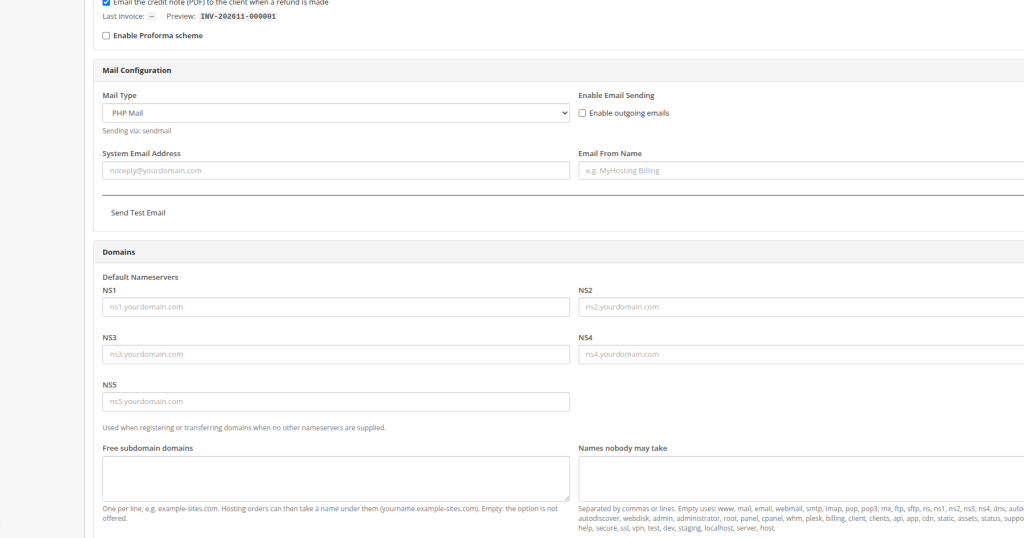
For reference, the public Truehost article on standard WHMCS gives the path Setup → System Settings → General Settings → Mail tab. Your reseller panel may use either label, so follow the menu you actually see and use the matching names below.

  1. Log in to your reseller panel’s admin area.
  2. Open the mail settings at the path above.
  3. Set Mail Type to SMTP.
  4. Tick Enable outgoing emails
  5. Fill in the fields in the table below.
  6. Save.
FieldWhat it meansWhat to enter
System Email AddressThe address the panel uses as its system sender and for relevant panel notificationsYour business email address
Email From NameThe sender name recipients seeYour business or billing name
Mail TypeThe method used to send outgoing messagesSMTP
Enable outgoing emailsControls whether the panel sends email at allTicked
SMTP HostThe address of the external mail serverYour provider’s SMTP hostname
SMTP PortThe connection portThe port your provider specifies
SMTP UsernameThe account used to log in to the mail serverUsually the full email address
SMTP PasswordThe mailbox passwordThe password set for that mailbox
SMTP EncryptionHow the connection is protectedTLS (STARTTLS) or SSL, as your provider specifies

Enable outgoing emails: do not skip this #

If Enable outgoing emails is switched off, the panel sends none of the automated emails your clients depend on. No invoices, no reminders, no ticket replies. This setting is easy to overlook, so check it every time you change your mail settings.

Why choose SMTP instead of PHP Mail? #

PHP Mail asks the web server that runs your panel to send the message itself. That only works well if the server has a properly configured mail system, and messages from such servers are often rejected or marked as spam.

SMTP connects the panel to a mail server you choose, logging in with your mailbox credentials. Your provider sends the message, so it comes from your own domain with your provider’s reputation behind it. That is why SMTP is the recommended choice for a billing panel.

 The brief suggests tying this recommendation to the reseller panel’s Docker environment. Truehost’s public guide does not mention Docker, so do not state that the environment lacks a local mail server unless Truehost confirms it.

Match encryption to the port #

The encryption setting and the port must agree with each other and with your provider’s requirements. As a general rule, port 587 pairs with TLS (STARTTLS) and port 465 pairs with SSL/TLS. A mismatch is one of the most common reasons a connection fails.

Save before you test #

Select the save button and wait for the panel to confirm the settings were stored. Do not move on until you see that confirmation, because the test in the next step uses the saved settings. Reopen the page and check that your values are still there.

Step 3: Send a test email to verify the configuration #

The test email confirms that the panel can log in to your mail server and send a message.

  1. Save your mail settings.
  2. Find Send Test Email on the same page.
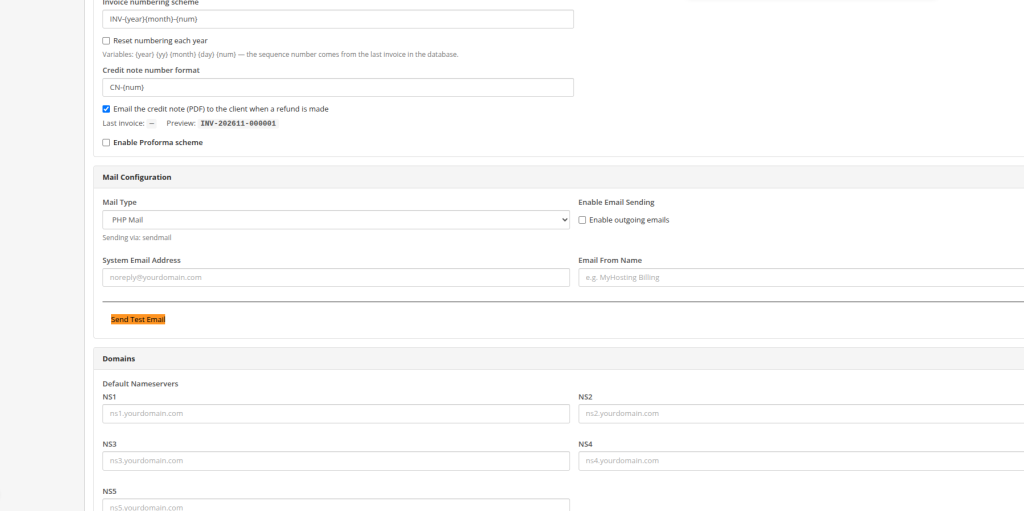
  1. Enter or confirm the destination address if the panel asks for one. Use an address you can open, such as a personal mailbox.
  2. Send the test message.
  3. Open the destination inbox.
  4. If the message is missing, check the spam or junk folder.

A received test message proves that your SMTP host, port, encryption, username and password work together. It does not guarantee that every future email reaches every recipient’s inbox. Other mail systems can still filter messages.

If the test fails, check:

  • The SMTP hostname, for typing mistakes
  • The port
  • The encryption setting, matched to the port
  • The username, usually the full email address
  • The password
  • That the mailbox is active
  • That your email provider allows SMTP connections from other servers

Fix any test failure before you rely on the panel for real client communications.

Step 4: Configure email authentication to improve deliverability #

Connecting SMTP gets your emails sent. Authentication helps receiving servers trust them. These are DNS records on your domain, and your email provider tells you what to publish.

  • SPF (Sender Policy Framework) lists the mail servers allowed to send email on behalf of your domain.
  • DKIM (DomainKeys Identified Mail) adds a digital signature to each message, so receiving servers can check that it really came from your domain and was not altered.
  • DMARC (Domain-based Message Authentication, Reporting and Conformance) builds on SPF and DKIM. It tells receiving servers what to do with messages that fail those checks. A monitoring policy such as p=none is a common starting point when it is configured correctly.

What you need to do:

  1. Contact your email hosting provider.
  2. Ask for the correct SPF, DKIM, and DMARC DNS records for your domain.
  3. Add the records in your domain’s DNS settings if they are not already there.
  4. Ask the provider to verify that they are set up correctly.

The exact records depend on your provider, so do not copy values from other websites. Publish only one SPF record per domain, because duplicate SPF records cause failures. Authentication improves trust and deliverability, but it cannot guarantee that a message never lands in spam.

Step 5: Customise your outgoing email templates #

SMTP controls how emails are sent. Email templates control what clients read.

Navigation path : Setup → Email Templates. This also matches the path in Truehost’s public standard-WHMCS article.

Templates you will want to customise include:

  • Invoice Created
  • Invoice Reminder
  • Invoice Payment Confirmation
  • Domain Renewal Reminder
  • Service Suspension
  • Support Ticket Reply

To edit a template:

  1. Open Email Templates.
  2. Select the language you want to edit.
  3. Find the template you need.
  4. Select Edit.
  5. Change the Subject.
  6. Edit the Body (HTML).
  7. Select Save Template.

Select the language first. Templates are stored per language, so if you edit the English version, clients whose account language is different will still receive the original text.

Describe these status labels only after checking what each does in your panel. 

Tips for good template content: #

  • Use a recognisable business sender name.
  • Write clear subject lines, for example “Invoice {invoice_num} from {CompanyName}”.
  • Make invoice and payment details easy to find.
  • Say what action the client needs to take, such as paying by the due date.
  • Keep branding consistent across templates.
  • Keep messages short.

Do not remove important transactional details such as the invoice number, amount, due date, or payment instructions.

Step 6: Understand and use email merge fields #

Merge fields are placeholders. When the panel generates an email, it replaces each placeholder with real client or transaction information.

 Standard WHMCS usually writes merge fields with a dollar sign, for example {$client_name}, and Truehost’s public WHMCS article uses that form. Check the exact syntax in your panel’s template editor and use whichever form it shows.

Merge fieldInformation inserted
{client_name}Client’s name
{client_email}Client’s email address
{CompanyName}Your company name
{invoice_num}Invoice number
{invoice_total}Invoice amount
{invoice_due_date}Invoice due date
{domain}Domain name
{expiry_date}Domain expiry date
{reg_date}Domain registration date
{service_domain}Associated service domain
{product_name}Product or service name
{service_username}Service username
{ticket_id}Support ticket identifier
{ticket_subject}Support ticket subject
{ticket_dept}Support department
{ticket_reply}Support ticket response

Merge fields depend on context. Invoice fields work in invoice templates, ticket fields in ticket templates, and so on. Use a field only in a template that supports it.

Example: the template and the email the client receives

Template:

Subject: Invoice {invoice_num} from {CompanyName}

Hello {client_name},

Your invoice {invoice_num} for {invoice_total} is due on {invoice_due_date}.

Please pay by that date to avoid any interruption to your services.

Thank you,

{CompanyName}

Generated email:

Subject: Invoice 10452 from Yourbrand Hosting

Hello Chelangat Kalya,

Your invoice 10452 for KES 1,500.00 is due on 20 November 2026.

Please pay by that date to avoid any interruption to your services.

Thank you,

Yourbrand Hosting

A misspelled or unsupported merge field can show up as raw text, such as {invoce_num}, in the email your client receives. After every template change, trigger a real message of that type and read it before you rely on it.

Step 7: Check sent emails using Email Logs #

Navigation path (from the brief): Utilities → System Logs → Email Logs.

 Truehost’s public WHMCS article refers to a different location (Configuration → System Logs) and does not describe an email log viewer, so verify what your panel shows.

Email Logs show what the panel has recorded about messages it sent. Where available, expect columns such as:

  • Date and time
  • Recipient
  • Subject

When a client says they did not get an invoice, reminder or ticket reply:

  1. Find the message in Email Logs.
  2. Check that the panel recorded it.
  3. Confirm the recipient address is correct.
  4. Review the subject and the sending time.
  5. If the address is right, check your SMTP configuration, then ask the client to check spam or contact their mail provider.

A log entry shows that the panel handed the message to your mail server. It does not prove that the message reached the recipient’s inbox. Treat the log as evidence the panel did its part, not as a delivery receipt.

Step 8: Troubleshoot common outgoing email problems #

Not every email problem comes from SMTP. Some start in the panel, some at your email provider, and some in the recipient’s mail system.

ProblemWhat to investigateRecommended action
Send Test Email failsSMTP connection detailsVerify hostname, port, encryption and credentials
SMTP authentication failsUsername and passwordConfirm the mailbox credentials and that the mailbox is allowed to use SMTP
Incorrect SMTP connectionHostname or portGet the correct connection details from your email provider
Encryption mismatchPort and encryption combinationMatch the settings to your provider’s requirements (for example 587 with TLS, 465 with SSL/TLS)
Mail Type shows “log” instead of SMTPMail delivery configurationSelect SMTP and save the settings
Clients receive nothingOutgoing email settingConfirm Enable outgoing emails is ticked
Emails arrive in spamEmail authentication and sender reputationReview SPF, DKIM, DMARC and your sending practices
Template changes do not appearTemplate languageConfirm you edited the language the client uses
Merge fields appear in bracesIncorrect or unsupported placeholdersCheck the exact spelling and that the template supports the field
Email appears in logs but client reports no deliveryRecipient address or downstream mail handlingCheck the address and spam folder, then your email provider’s delivery diagnostics

Outgoing Email Setup Checklist #

  • Business email address is ready.
  • SMTP credentials have been obtained.
  • SMTP settings have been entered and saved.
  • SMTP is selected as the Mail Type.
  • Enable outgoing emails is ticked.
  • Test email has been received.
  • SPF, DKIM, and DMARC have been checked.
  • Important email templates have been customised.
  • Merge fields have been checked.
  • Email Logs have been reviewed.

The three checks that matter most: SMTP set up → Test received → Email Logs checked.

Frequently asked questions #

  1. Why are my Truehost Reseller Panel emails not sending?

Check three things first: that Enable outgoing emails is ticked, that Mail Type is SMTP (not “log”), and that your SMTP host, port, encryption, username and password are correct. Then send a test email to see whether the connection works.

2. What SMTP port should I use? #

Use the port your email provider specifies. The common choices are 587 with TLS (STARTTLS) and 465 with SSL/TLS.

3. What is the difference between SMTP and PHP Mail? #

SMTP sends through a mail server you choose, logging in with your mailbox credentials. PHP Mail relies on the web server’s own mail setup, which is often unreliable and more likely to be marked as spam.

4. Why do my outgoing emails land in spam? #

Usually because the domain lacks proper SPF, DKIM or DMARC records, or because of the sender’s reputation. Ask your email provider for the correct records and check that they are published.

5. How do I change the sender email address? #

Change the System Email Address and Email From Name in your mail settings, and update the SMTP username and password if the new address is a different mailbox. Save, then send a test email.

6. How do I customise invoice email templates? #

Open Email Templates, choose the language, select the invoice template, then edit the Subject and Body (HTML) and save the template. Test the result with a real invoice.

7. What are email merge fields? #

Placeholders such as {client_name} or {invoice_num} that the panel replaces with real information when it sends each email.

8. Where can I check emails sent by my reseller panel? #

In Email Logs5. Remember that a log entry shows the panel sent the message, not that it was delivered.

Automatic Suspension and TerminationSetting Up Support Tickets in the Truehost Reseller Panel

Powered by BetterDocs

Leave a Reply Cancel reply0

Your email address will not be published. Required fields are marked *


Table of Contents
  • Why outgoing email configuration matters
  • Step 1: Prepare your business email and SMTP credentials
  • Step 2: Connect your mail server to the Truehost Reseller Panel
    • Enable outgoing emails: do not skip this
    • Why choose SMTP instead of PHP Mail?
    • Match encryption to the port
    • Save before you test
  • Step 3: Send a test email to verify the configuration
  • Step 4: Configure email authentication to improve deliverability
  • Step 5: Customise your outgoing email templates
    • Tips for good template content:
  • Step 6: Understand and use email merge fields
  • Step 7: Check sent emails using Email Logs
  • Step 8: Troubleshoot common outgoing email problems
  • Outgoing Email Setup Checklist
  • Frequently asked questions
    • 2. What SMTP port should I use?
    • 3. What is the difference between SMTP and PHP Mail?
    • 4. Why do my outgoing emails land in spam?
    • 5. How do I change the sender email address?
    • 6. How do I customise invoice email templates?
    • 7. What are email merge fields?
    • 8. Where can I check emails sent by my reseller panel?

Share This Article :

  • Facebook
  • X
  • LinkedIn
  • Pinterest

Was it helpful ?

  • Happy
  • Normal
  • Sad
© 2026