 Domain RegistrationFind and register the perfect domain for your website.
 .COM DomainChoose a widely recognized domain to build global credibility.
 Domain TransferSeamless domain transfers with zero downtime and complete control.
 All TLDsFind and register your perfect domain. Choose from local and global extensions.
 SSL CertificatesKeep your website safe with reliable SSL Certificates that protect customer data and build trust.
 whoisCheck domain ownership details, expiration dates, and registrar information.
 US DomainRegister a .US domain and build trust in the USA.
 Web HostingEverything your website needs to run smoothly
 WordPress HostingWordPress hosting that just works
 Windows HostingReliable hosting for Windows environments
 Reseller HostingTurn hosting into your business
 Email HostingEmail that looks professional and works anywhere
 cPanel HostingFull control of your hosting with cPanel
 Affiliate ProgramJoin as a partner and earn commissions on every referral you send our way.
 Vps HostingScalable virtual servers that expand as you need.
 Dedicated ServersGet complete access and full control over your dedicated physical server.
 Managed vpsNot tech-savvy? We will take care of everything with our fully managed VPS hosting for you.
 AI Website BuilderCreate stunning websites in seconds with AI.
 Online ShopSet up a professional online store. No coding required.
 Web design serviceGet a tailored website designed to match your brand and support your goals.
 BlogFind helpful guides on web hosting, online selling, digital marketing, and more.
 Contact USYou can reach us anytime, day or night, through chat or email.
 SupportBrowse helpful guides and answers for all of our services.

Starting a web hosting business doesn’t have to mean buying physical servers, renting space in a data centre or building hosting infrastructure from scratch.
With white label reseller hosting, you buy a block of hosting resources from an established provider and sell hosting services under your own business name.
The main attraction is the customer experience.
Your clients sign up with your brand, pay your invoices and log in to your branded panel, while the provider supplies and maintains the infrastructure behind the scenes.
You focus on the customer relationship, and the provider keeps the servers running.
This guide explains how white label reseller hosting works, the tools involved, and how branding, pricing and customer management fit together.
It also walks through a step-by-step launch plan and compares four providers, so you can choose a reseller plan that suits the kind of hosting business you want to build.
How Does White Label Reseller Hosting Work?
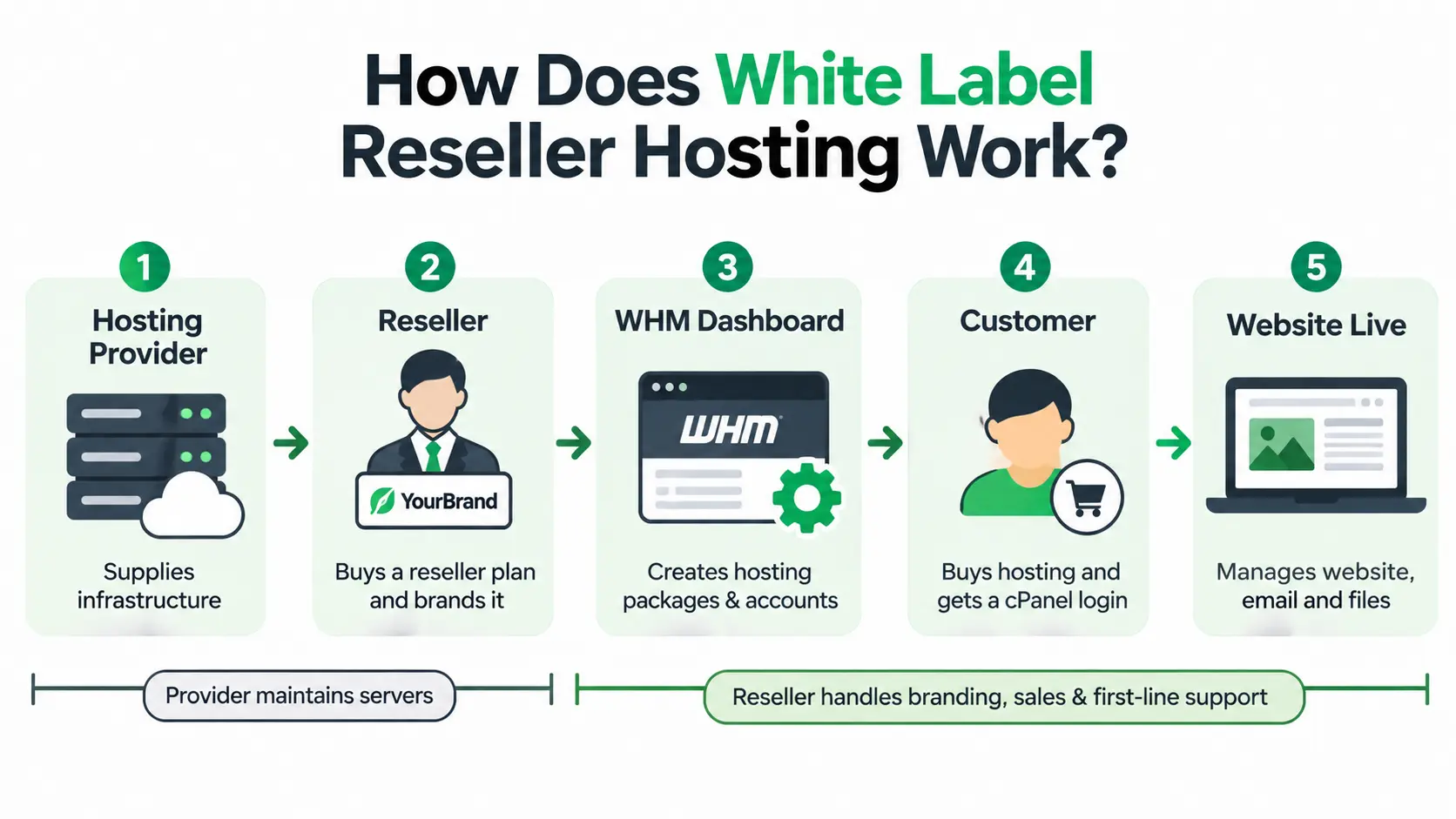
The process follows a fairly consistent order, whichever provider you choose.
- Buy a reseller hosting package. You purchase a plan from a hosting provider. It gives you a pool of resources, such as storage, bandwidth and a set number of cPanel accounts, to divide among your customers.
- Configure your branding. You add your business name, logo and brand details so the service looks like yours.
- Set up hosting packages. Inside the reseller panel, you decide how much storage, bandwidth and email capacity each package includes.
- Publish your packages. You list them, with prices, on your own website or reseller storefront.
- Receive orders and payments. Customers pick a package and pay you directly.
- Create and manage accounts. You set up each customer’s hosting account through the reseller tools, then handle upgrades, suspensions and renewals as they come up.
- Earn from the difference. Your revenue is what customers pay you, minus what the reseller plan and your running costs add up to.
From the customer’s point of view, the provider never appears anywhere in that chain.
That invisibility is exactly what the white label part means.
What Makes White Label Reseller Hosting Different From Regular Reseller Hosting?
Reseller hosting gives you the ability to sell hosting services.
White labelling adds control over how those services are presented.
Two resellers can buy very similar resources, yet one’s customers see the provider’s logo and nameservers while the other’s customers see only the reseller’s brand.
| Feature | Standard reseller hosting | White label reseller hosting |
|---|---|---|
| Sell hosting to customers | Yes | Yes |
| Set your own retail prices | Usually | Usually |
| Create separate client accounts | Yes | Yes |
| Use your own brand | Depends on provider | Yes |
| Custom nameservers | Depends on provider | Commonly supported |
| Branded client experience | May be limited | Core feature |
| Provider branding visibility | May remain visible | Can be removed where supported |
The pattern is easy to spot. The selling and account-management basics look alike across both types, while branding is where plans really separate.
Because depends on provider appears so often in the middle column, it’s worth reading each plan’s details rather than assuming a reseller package is fully white label.
How to Start Your Own White Label Reseller Hosting Business
Here’s a logical sequence that takes you from choosing a provider to winning your first customers.
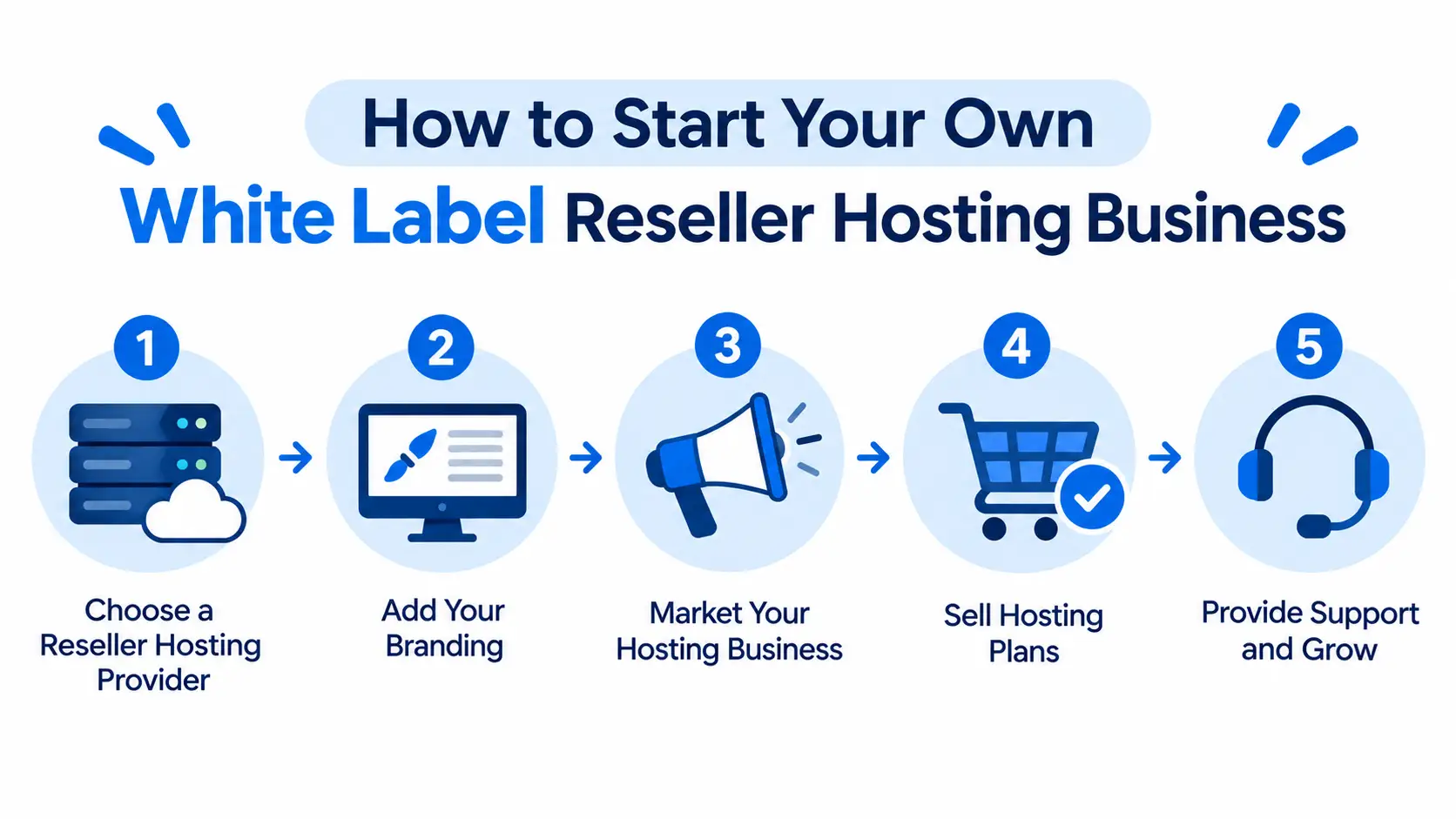
Step 1: Choose a Reseller Hosting Provider
Start by comparing providers on pricing, account limits, storage, bandwidth, white-label features, billing automation and technical support.
Check whether the provider lets customers use private nameservers and a branded client interface, since those two features do most of the white label work.
Read the provider’s support responsibilities and acceptable-use policies too, because they decide what you’re allowed to host and which questions the provider will answer for you.
Step 2: Choose a Business Name and Register a Domain
Pick a business name that suits a hosting service and is easy to say out loud.
Register a matching domain, then set up a professional business email address on it, because a hosting company using a free webmail address won’t win much trust.
You’ll use the domain for your storefront and, where the provider supports it, for private nameservers such as ns1.yourbrand.com.
Step 3: Create Your Hosting Packages
Use the reseller management panel to build your packages.
Decide how much storage, bandwidth and email capacity each one includes, and create several tiers so you can serve customers with different website needs.
Keep a running total as you go, because the allocations across all your customers should stay consistent with the resources your reseller plan actually provides.
Step 4: Set Up Your Branding
Upload your logo, enter your company name and set your brand colours.
Configure private nameservers, then set up the customer-facing panel, billing portal and email templates wherever the provider allows it.
Finish by signing up as a test customer and clicking through everything, looking for any trace of the provider’s branding that might still be visible.
Step 5: Configure Billing and Account Automation
Connect your billing platform to the reseller hosting environment, then set up payment methods and recurring billing.
Configure automatic account creation so a customer’s hosting is ready as soon as payment clears.
Test the whole cycle, including invoice generation, payment notifications, account suspension and renewals, before any real customer depends on it.
Step 6: Launch Your Hosting Website
Publish your packages and pricing, and explain clearly what each one includes.
Add your terms of service, privacy policy, refund policy and support information, since customers look for these before handing over money.
Run through the order process yourself at least once before inviting anyone to buy.
Step 7: Find Your First Hosting Customers
Web designers and developers are a natural first audience, because they constantly need hosting for client websites.
You can also offer hosting alongside website design and maintenance services, or approach small businesses that need a website and business email in one place.
SEO, referrals, partnerships and relevant online communities all help attract customers over time.
Offering free migration assistance can also tip the decision for anyone thinking of moving from another provider.
Four White Label Reseller Hosting Providers to Consider
These providers differ in their infrastructure, branding options, billing tools, resource allowances and business support, so the best choice depends on the kind of hosting business you want to run.
The table below gives a quick view, including what each one costs at entry level.
| Provider | Notable features | Best suited for | Entry-level reseller hosting cost |
|---|---|---|---|
| Truehost | WHM, cPanel, private nameservers and reseller automation | Freelancers, agencies and new hosting businesses | $270.00 |
| InMotion Hosting | WHM, WHMCS, domain reseller tools and white-label branding | Agencies and established resellers | From about $19.99 a month |
| ResellerClub | White-label hosting, wholesale pricing and multiple hosting products | Resellers offering several hosting services | From $23.99 a month |
| HostGator | WHM account management and reseller branding controls | Existing HostGator resellers, or resellers building on VPS or dedicated hosting | No standalone reseller plan for new customers |
Prices for the other providers are starting figures from their public pages at the time of writing. They change with billing term and promotions, so confirm current prices before you buy.
a) Truehost
Truehost offers white label reseller hosting for entrepreneurs, agencies, freelancers and web designers who want to sell hosting under their own brand.
Its reseller packages let you create hosting accounts for customers and present everything with your own name, logo and nameservers, without Truehost branding appearing to your clients.
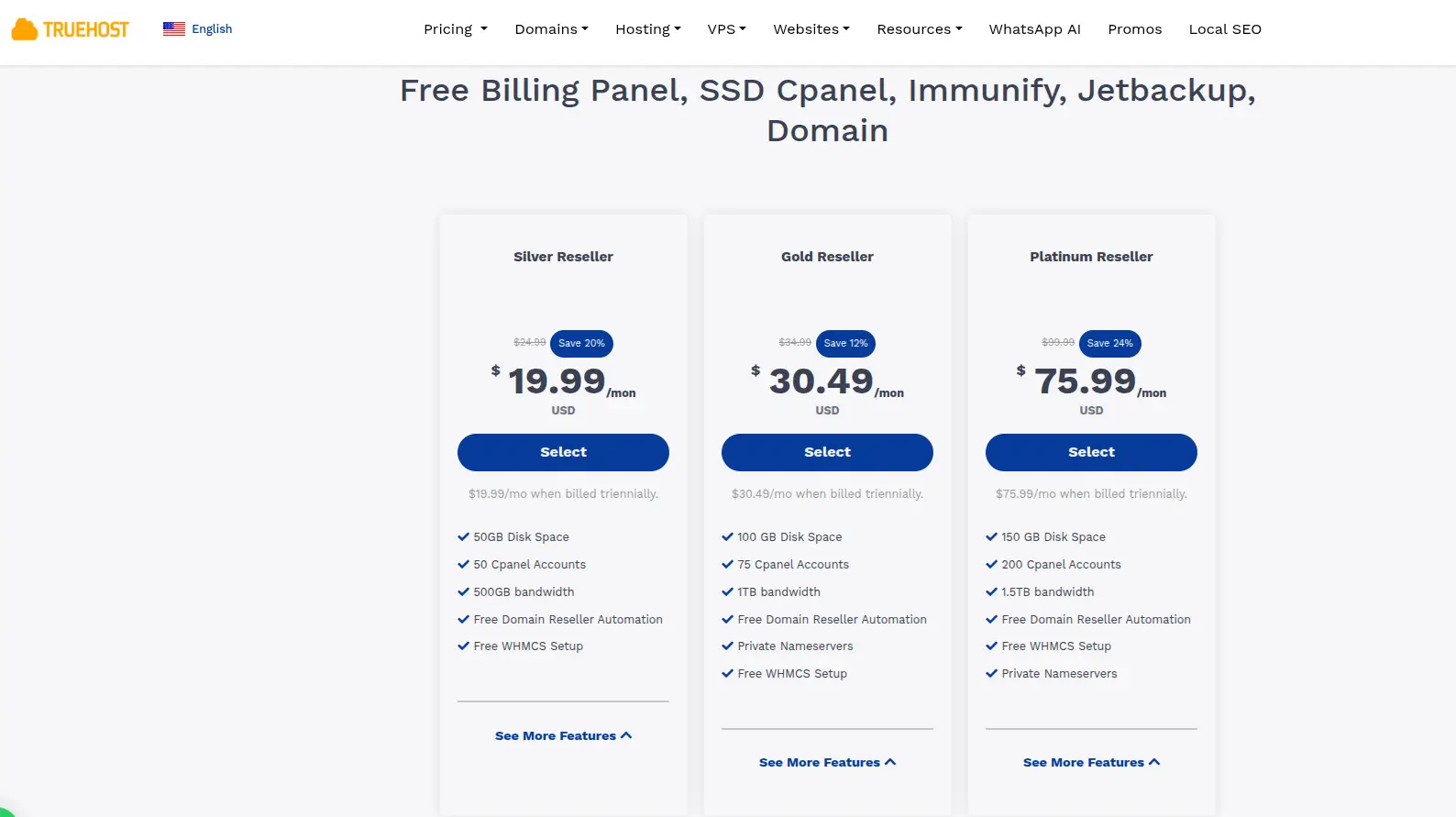
Every plan comes with WHM and cPanel access, private nameservers, reseller package creation, domain reseller automation and free WHMCS setup.
Depending on the package you choose and the current plan terms, you also get features such as SSL, LiteSpeed, SSD storage and the Softaculous one-click installer.
Truehost sells reseller hosting in tiers, so you can start with a smaller account allowance and move up to higher-capacity packages as your customer base grows.
| Plan | Storage | cPanel accounts | Displayed price* |
|---|---|---|---|
| Silver | 50 GB | 50 | $270.00 |
| Gold | 100 GB | 75 | $395.88 |
| Platinum | 150 GB | 200 | $995.88 |
Prices come from the Truehost store and depend on the billing cycle you select. Confirm current prices, billing terms and package inclusions before purchase.
Truehost’s domain reseller automation helps if you want to offer domain registration alongside hosting, which gives customers one place to buy everything and gives you an extra revenue stream.
The support model is worth knowing before you sign up.
Truehost handles infrastructure support, which means the servers and the underlying platform. You remain responsible for the customer relationship and for front-line support, so your customers will contact you first.
Explore Truehost reseller hosting to compare packages and start building your own hosting brand.
b) InMotion Hosting
InMotion Hosting is a long-established provider that offers reseller hosting with WHM and WHMCS included.
It suits people who want billing and account management bundled together from the start.
On the branding side, you can use your own business name, logo and domain, so customers deal with your brand.
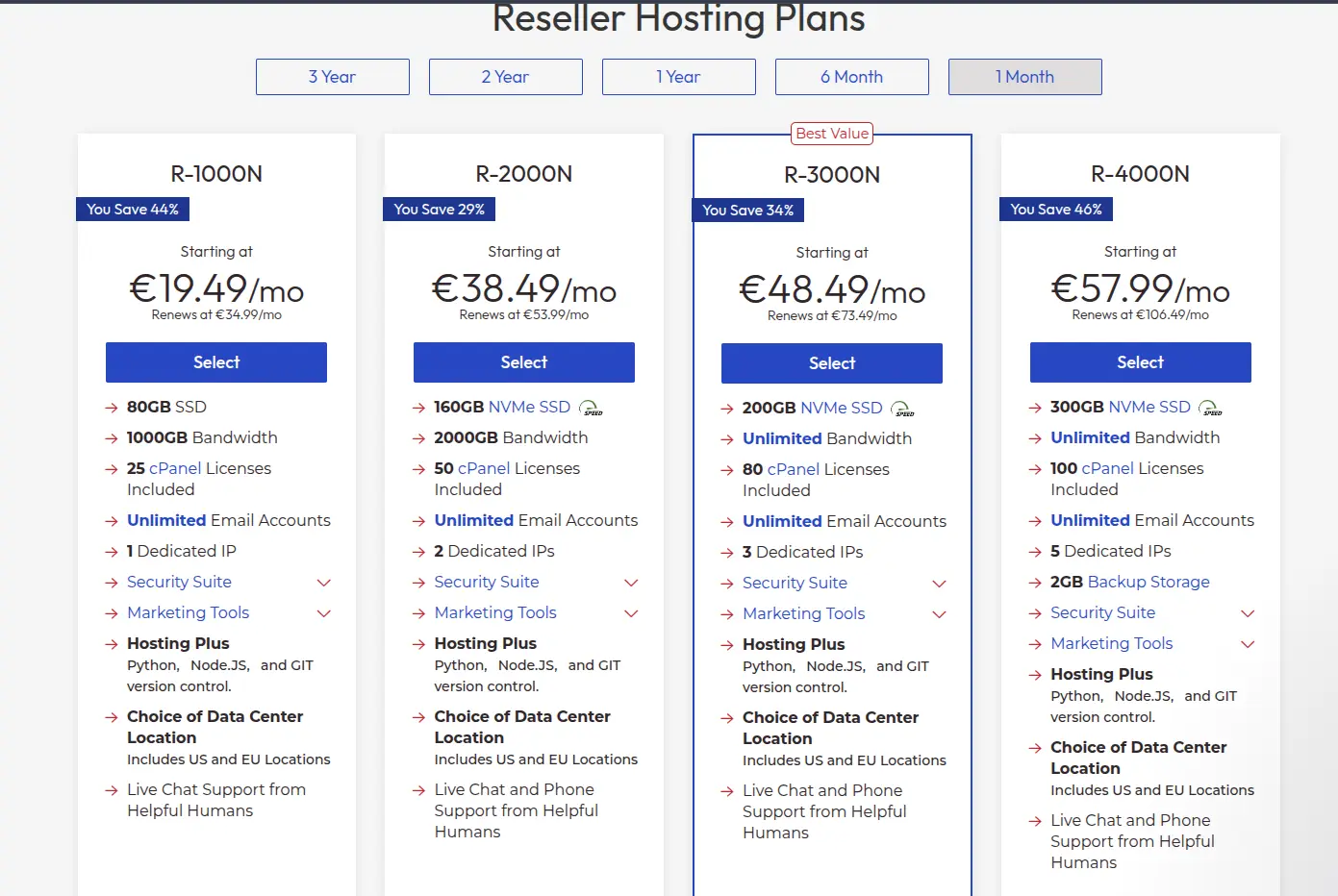
Entry-level plans include 25 cPanel accounts, and higher tiers raise that allowance along with storage, bandwidth and the number of dedicated IP addresses.
Domain reseller tools are available too, and InMotion advertises a 90-day money-back guarantee, though it’s worth checking which billing terms qualify.
The WHMCS billing automation does a lot of the heavy lifting.
It helps you manage orders, invoices and hosting accounts without stitching together separate tools.
InMotion lists reseller plans from about $19.99 a month, with several tiers above that, so check the current price list before you choose.
On support, InMotion offers phone, email, chat and ticket options.
As with any reseller arrangement, you are expected to handle your own customers’ everyday questions and escalate server-level problems to the provider.
Agencies and developers who want US-based infrastructure and a bundled billing system will find the packages a sensible fit.
c) ResellerClub
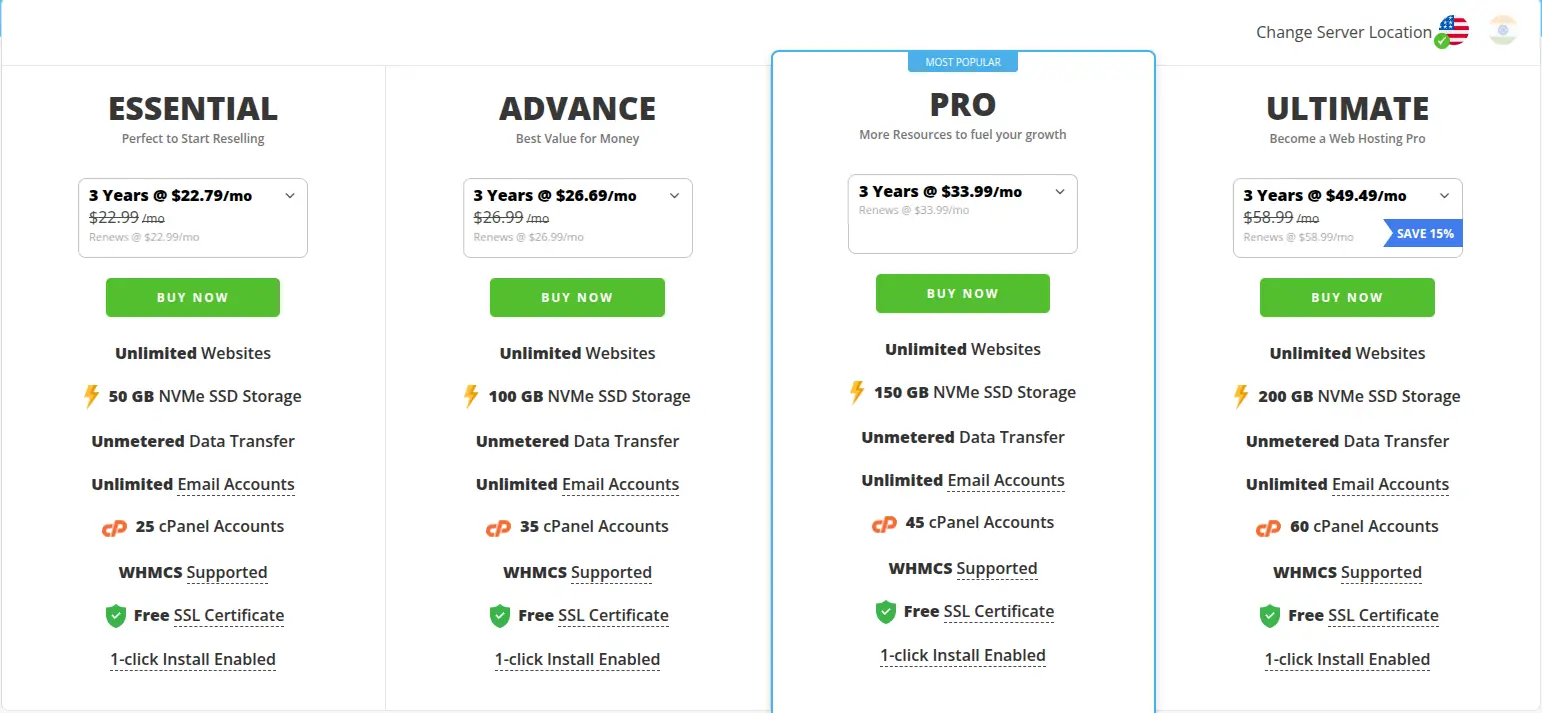
ResellerClub is a platform that sells wholesale hosting, which resellers then sell under their own brands.
Its range goes well beyond reseller hosting, covering shared hosting, business hosting, VPS, managed VPS and dedicated servers, so you can build a catalogue around one supplier.
The customer experience is white label by design.
According to ResellerClub, your brand appears on the storefront, the control panel your customers see and the invoices you send, and your customers never see ResellerClub itself.
You set your own retail prices, which means you earn a margin on both new sales and renewals. Its reseller hosting starts from $23.99 a month.
ResellerClub also supports reselling related products.
Domains are its original specialty, and email and SSL resale are available where offered, which lets you attach extras to each hosting sale.
Server location is a real consideration here.
ResellerClub’s options include India and the United States, and a server closer to your customers generally means faster page loads for them.
Pick the location that matches where most of your audience lives.
For help getting started, ResellerClub offers onboarding and support options, including a call-back request on its pricing pages.
d) HostGator
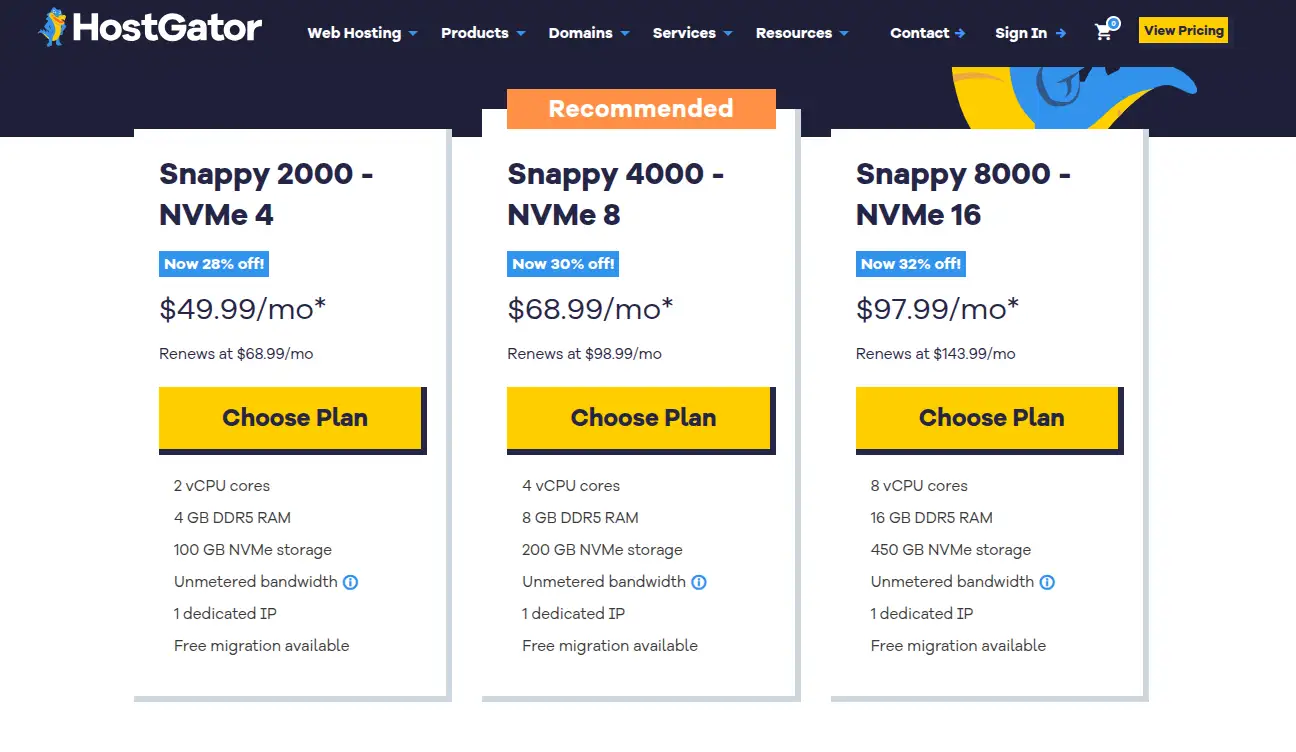
HostGator is the provider that needs the most caution on this list.
Its help centre states that its standalone reseller hosting plans are no longer offered for new sign-ups, although existing reseller customers are still supported.
Reselling remains permitted on its VPS and dedicated plans, and HostGator’s own comparison chart lists private nameservers as available on those two options.
Where WHM is available, it lets a reseller create, manage and suspend separate cPanel accounts.
That covers the day-to-day account and package work, but server-level settings generally stay with whoever controls the server.
On a reseller-level login, that means the provider.
On a VPS or dedicated server, you gain deeper control, along with the extra responsibility that comes with it.
Branding controls depend on the product.
Private nameservers let you hide the host’s name, while customisation of hosting and control panel screens varies by plan.
Customer requests go to you first, and you work with HostGator support for anything that needs the provider’s intervention.
Check which billing, automation and branding features come with the exact plan you’re considering, rather than assuming every part of the customer experience is white labelled.
HostGator’s old reseller plans bundled free WHMCS, but a VPS-based setup may leave you arranging billing yourself.
Is White Label Reseller Hosting Profitable?
It can be, but profitability depends on the gap between what it costs you to operate and what customers pay you.
Buying a reseller package doesn’t guarantee customers or recurring income. You still have to find buyers, support them and keep them for the long term.
Revenue can come from several places: monthly or annual hosting subscriptions, domain registration and renewal margins, business email packages, SSL certificates and other add-ons, and services such as website design, maintenance and migration.
Many resellers find that these extras bring in as much as the hosting itself.
How to Calculate Your Hosting Business Profit Margin
A simple example shows the maths. Suppose your reseller plan costs $30 a month and you sell hosting to 15 customers at $5 each.
| Item | Example |
|---|---|
| Monthly reseller hosting cost | $30 |
| Number of paying customers | 15 |
| Monthly price per customer | $5 |
| Total monthly revenue | $75 |
| Gross amount remaining | $45 |
The formula is: Gross profit = Hosting revenue – Reseller hosting cost
That $45 isn’t necessarily net profit. It leaves out payment processing fees, billing software, marketing, taxes, customer support and other operating expenses, all of which come out of it.
In this example you’d need six paying customers just to cover the $30 plan, so every customer beyond that adds to your margin.
How to Price Your Hosting Packages
Start by adding up the cost of your reseller plan and any extra software.
Then estimate how many paying accounts the package can realistically support, since overselling resources leads to slow sites and unhappy customers.
Build in a margin for customer support and unexpected costs.
Compare what competitors serving the same audience charge, so your prices stay competitive.
Finally, avoid pricing packages so low that renewals and support become unprofitable, because a cheap first-year deal can cost you money in the second year.
Start Your White Label Hosting Business With Truehost
Launching a hosting brand comes down to a handful of practical requirements: server resources, account management, branding, billing and customer support.
A white label reseller hosting plan handles the first of those for you, so your time goes into the parts that build a business.
Truehost provides the reseller hosting infrastructure and tools for businesses that want to sell hosting under their own brand.
When you compare packages, look at the storage, the cPanel account allowance, the domain reseller automation and your billing requirements, then choose the tier that fits the number of customers you expect to serve in your first year.
Ready to launch your own hosting brand?
Explore Truehost white label reseller hosting, compare the available plans and choose the resources you need to start selling hosting under your own business name.