 Domain RegistrationFind and register the perfect domain for your website.
 .COM DomainChoose a widely recognized domain to build global credibility.
 Domain TransferSeamless domain transfers with zero downtime and complete control.
 All TLDsFind and register your perfect domain. Choose from local and global extensions.
 SSL CertificatesKeep your website safe with reliable SSL Certificates that protect customer data and build trust.
 whoisCheck domain ownership details, expiration dates, and registrar information.
 US DomainRegister a .US domain and build trust in the USA.
 Web HostingEverything your website needs to run smoothly
 WordPress HostingWordPress hosting that just works
 Windows HostingReliable hosting for Windows environments
 Reseller HostingTurn hosting into your business
 Email HostingEmail that looks professional and works anywhere
 cPanel HostingFull control of your hosting with cPanel
 Affiliate ProgramJoin as a partner and earn commissions on every referral you send our way.
 Vps HostingScalable virtual servers that expand as you need.
 Dedicated ServersGet complete access and full control over your dedicated physical server.
 Managed vpsNot tech-savvy? We will take care of everything with our fully managed VPS hosting for you.
 AI Website BuilderCreate stunning websites in seconds with AI.
 Online ShopSet up a professional online store. No coding required.
 Web design serviceGet a tailored website designed to match your brand and support your goals.
 BlogFind helpful guides on web hosting, online selling, digital marketing, and more.
 Contact USYou can reach us anytime, day or night, through chat or email.
 SupportBrowse helpful guides and answers for all of our services.
A Linux VPS plan under five dollars a month usually raises a flag. Buyers assume that a price this low means throttled bandwidth or oversold servers. Some also expect hidden fees waiting at checkout.
Truehost prices its Linux VPS plans starting at $4.47 per month. That number alone pushes some shoppers away before they check the specs.
This review tests that assumption against real numbers. It covers the actual hardware behind the price, the plans, and the add-on costs. It also looks at what paying customers say once the server goes live.
By the end, you will know if the low price hides a weak product. Or you will see that it reflects lean pricing on solid infrastructure.
Truehost Linux VPS at a Glance
| Detail | Truehost Linux VPS |
|---|---|
| Starting price | $4.47/month (triennial billing) |
| Top managed tier | $23.08/month |
| Storage | SSD across all tiers |
| Managed option | Yes, both managed and unmanaged plans |
| Platform uptime | 99.97% |
| Network uptime | 99.999% (redundant network link) |
Truehost’s Linux VPS lineup is ideal for developers, small business owners, and agencies who want low entry pricing. It also suits buyers who want a US-facing server without a high upfront cost.
Beginners get a managed option so they never touch raw server configuration.
Pricing lands as the strongest part of the offer here. Data center transparency comes across as the weakest part, and we cover why below.
Ease of use holds up well on the managed tiers, since Truehost handles setup and patching.
Truehost Linux VPS Plans and Pricing in the USA
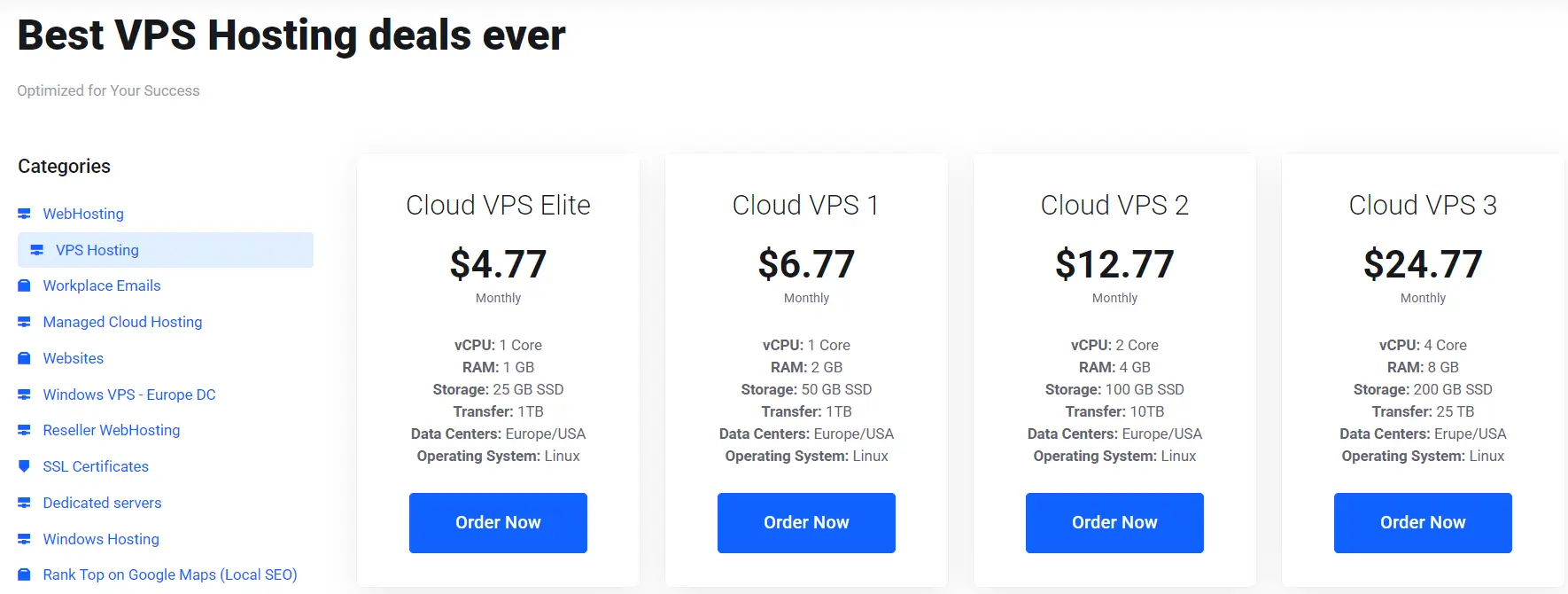
Here are the current Linux VPS tiers billed in US dollars, priced at the triennial rate:
| Plan | Price (3-year term) | Regular Monthly Price | vCPU | RAM | Storage | Transfer | Data Center |
|---|---|---|---|---|---|---|---|
| Cloud VPS Elite | $4.47/month | $4.77/month | 1 Core | 1 GB | 25 GB SSD | 1 TB | Europe/USA |
| Cloud VPS 1 | $6.24/month | $6.77/month | 1 Core | 2 GB | 50 GB SSD | 1 TB | Europe/USA |
| Cloud VPS 2 | $11.47/month | $12.77/month | 2 Core | 4 GB | 100 GB SSD | 10 TB | Europe/USA |
| Cloud VPS 3 | $23.08/month | $24.77/month | 4 Core | 8 GB | 200 GB SSD | 25 TB | Europe/USA |
Every listed price above assumes a three-year commitment paid upfront. Monthly billing runs higher, so check the exact rate before you choose a term.
Buyers who only need a server for a short-term project should compare monthly rates first. The triennial discount can look better on paper than it actually is.
Notice how storage and transfer scale with each price increase. Cloud VPS 3 offers four times the RAM and 25 times the transfer of Cloud VPS Elite.
That gap can determine whether your site can handle more visitors down the road.
Managed vs Unmanaged Linux VPS: Which Fits You
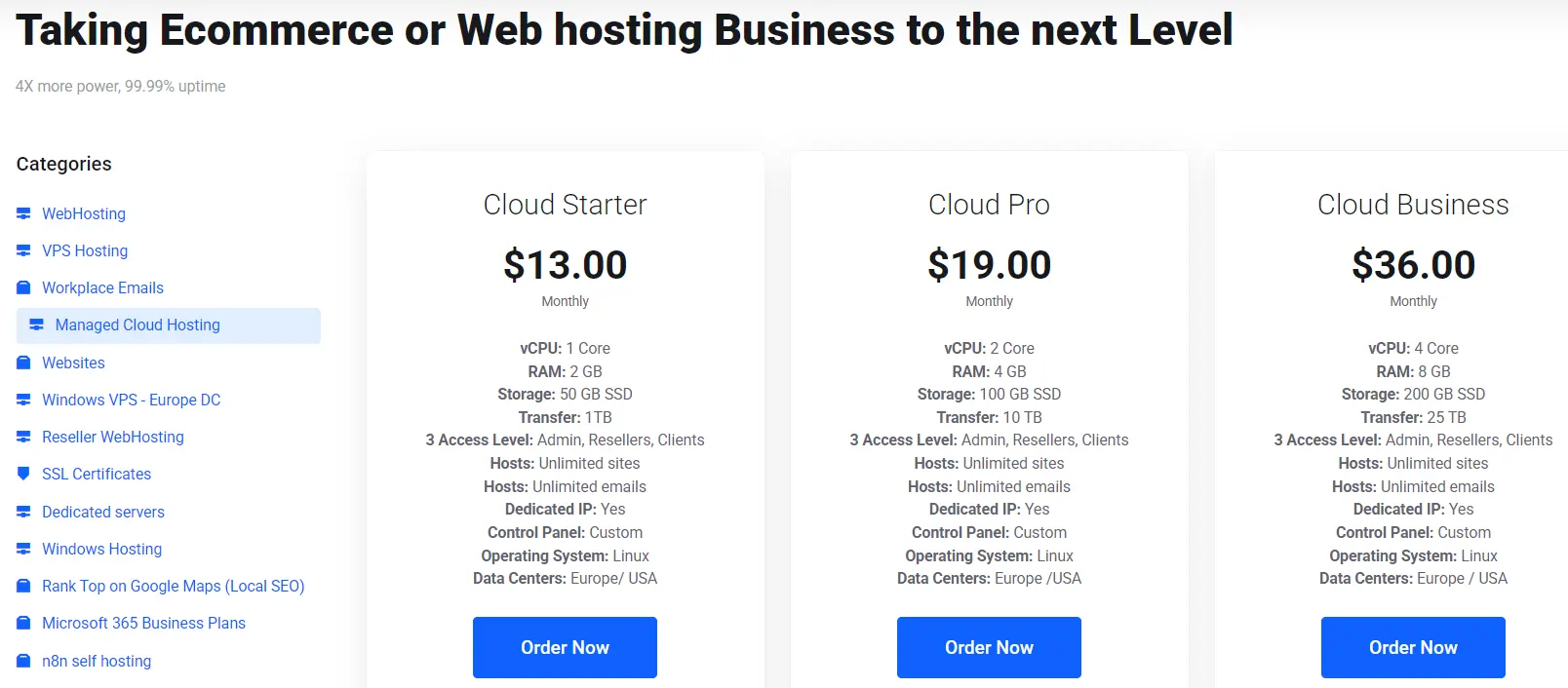
Truehost splits its Linux VPS lineup into two paths. Unmanaged plans hand you the server and leave configuration to you. Managed plans include setup, patching, and support on the same hardware.
| Managed Cloud Plan | Price (3-year term) | Regular Price | vCPU | RAM | Storage | Transfer |
|---|---|---|---|---|---|---|
| Cloud Starter | $11.00/month | $13.00/month | 1 Core | 2 GB | 50 GB SSD | 1 TB |
| Cloud Pro | $17.00/month | $19.00/month | 2 Core | 4 GB | 100 GB SSD | 10 TB |
| Cloud Business | $32.00/month | $36.00/month | 4 Core | 8 GB | 200 GB SSD | 25 TB |
Managed plans also add unlimited hosted sites, unlimited email accounts, and a dedicated IP.
A custom control panel comes bundled at no extra charge, which unmanaged buyers pay for separately.
The support scope shifts significantly between the two paths. Managed support covers performance issues, security concerns, and general optimization.
Unmanaged support mostly confirms that the server stays online and the network works.
Here is a simple rule for choosing between them. Pick managed if you have never run a Linux server before.
Pick unmanaged only if you already know your way around a command line. A budget to hire someone who also works.
Linux VPS Features and Technical Specs
Every Truehost Linux VPS plan runs on the same infrastructure, regardless of tier. Here is what backs that price:
- Server hardware. Intel Xeon and AMD Ryzen processors run the platform, paired with a shared pool of 512 GB RAM across the cluster.
- Storage speed. Every plan runs on SSD storage, which speeds up database queries and file access compared to older spinning disks.
- Network bandwidth. Each VPS connects through an un-throttled 100MB/s link, so data transfers in and out without artificial caps.
- Virtualization. Truehost builds its VPS lineup on KVM. Each server runs its own isolated kernel, so it behaves like a standalone machine.
- Root access. Every plan gives full root access, so you can install any software stack your project needs.
- IP addressing. Every VPS includes a free dedicated IPv4 address. An optional IPv6 address is available, too.
- Backup options. The platform supports on-demand, scheduled, and live snapshots, so you can choose the level of protection that fits your budget.
- Security layer. Anti-DDoS protection and a configurable firewall come standard on every tier.
Linux Distributions Supported on Truehost VPS
Truehost lets you pick from five major Linux distributions at signup:
- Ubuntu
- Debian
- AlmaLinux
- Rocky Linux
- Oracle Linux
This range covers most production stacks without forcing you into one operating system. Node.js and PHP applications run well on Ubuntu or Debian.
Enterprise workloads that need long-term support often lean toward AlmaLinux, Rocky Linux, or Oracle Linux.
Switching a distribution after you provision the server usually means a fresh rebuild. Pick the right one at signup, so you skip a reinstall later.
The Hidden Costs: Control Panels, Backups, and Security Add-Ons
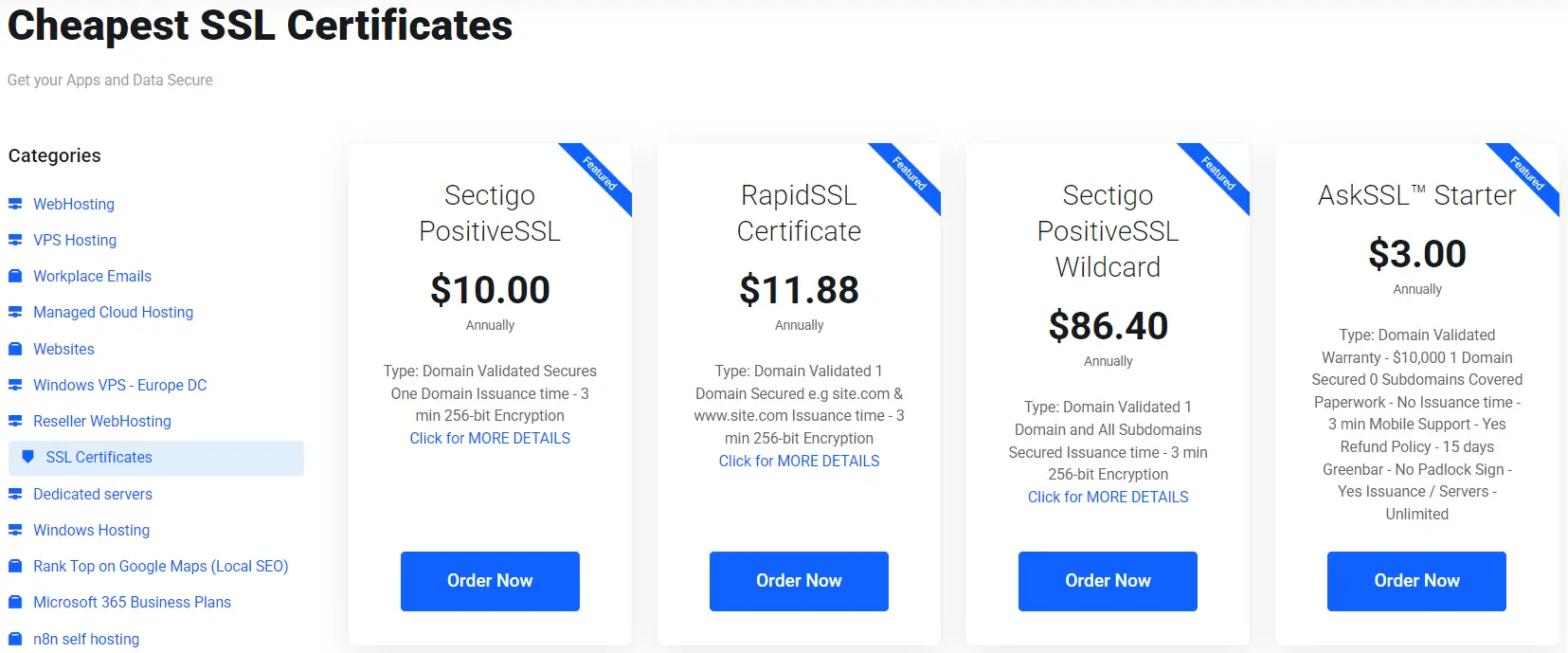
The advertised price only covers the bare server. Several add-ons drive the actual monthly cost higher, and unmanaged buyers feel this most.
| Add-on Category | Examples | What It Covers |
|---|---|---|
| Control panels | WHM/cPanel, Plesk, Softaculous | Graphical server management, one-click app installs |
| Backups | JetBackup 5, Cloudoon Vault | Automated backup and restore for files, emails, and databases |
| Security | KernelCare Imunify360, CXS | Vulnerability scanning, malware detection, and exploit alerts |
| Network | Additional IPv4 address | Extra IP for load distribution or a second SSL certificate |
| One-time | Setup fee | Waived on longer terms, charged on some short-term orders |
A cPanel license alone typically costs $25 to $30 per month on unmanaged VPS plans. That figure reflects typical Truehost regional pricing.
That cost alone can double the price of an entry-level plan like Cloud VPS Elite. Managed plans usually fold a control panel into the price, so this cost mostly hits unmanaged buyers.
Backups also sit outside the base price on lower tiers. Skip this add-on, and a server failure means real data loss with no way back.
Data Center Locations: The Europe/USA Question
Most of Truehost’s budget Linux VPS tiers list their data center as “Europe/USA”; you can pick a pick-your-region option at checkout. That detail catches some buyers off guard.
In practice, this setup works fine for a global audience or a US-adjacent one. Latency stays low enough for most web apps, APIs, and small stores.
A project needing a guaranteed US-only server for compliance reasons should confirm the exact location first.
The Kenya-specific tiers and the worldwide Cloud VPS L plan avoid this ambiguity. Each names its region directly, so you know exactly where your data sits.
Real Customer Feedback: What the Reviews Say
Trustpilot lists 229 reviews for truehost.com at the time of writing. Most reviewers report a somewhat positive experience overall.
Customers consistently praise the support staff for quick, efficient responses to setup and domain issues.
Several reviewers also call out how smooth the domain registration and account management process feels. That praise appears again and again throughout the review set.
The complaints follow a clear pattern, too. Negative reviews mention slow response times to urgent technical problems.
Taken together, the feedback paints a fair picture rather than a purely promotional one. Routine support requests get handled quickly. Complex or urgent tickets sometimes take longer than a buyer would like.
Truehost Linux VPS Pros and Cons
Pros
- Low entry pricing, even on short billing terms
- SSD storage across every tier
- Full root access on every plan
- Free dedicated IP and free SSL included
- A managed option for buyers without server experience
- Checkout support for Cash App, Klarna, and Affirm, on top of standard cards
Cons
- Europe/USA data centers pool together without a region choice
- cPanel and Plesk licensing add real cost to unmanaged plans
- Backup add-ons cost extra on lower tiers
- Support speed varies depending on how urgent or complex the ticket is
How Truehost Compares to DigitalOcean and Hostinger
| Provider | Starting Price | Baseline Specs | US Data Center | Managed Option | Support |
|---|---|---|---|---|---|
| Truehost | $4.47/month | 1 vCPU, 1 GB RAM | Yes, pooled with Europe | Yes | 24/7 chat, WhatsApp, ticket |
| DigitalOcean | From $6/mo | 1 vCPU, 1 GB RAM, 25 GB SSD | Yes, dedicated regions | Mostly unmanaged | Community and ticket |
| Hostinger | $6.49/mo | 1 vCPU, 4 GB RAM | Yes | Managed options available | 24/7 chat |
Truehost lands as the budget-first pick among this group. It offers a lower headline price than DigitalOcean and Hostinger, as well as a managed option that Vultr mostly skips.
DigitalOcean and Vultr suit developers who want a dedicated US region and full command-line control from day one.
Hostinger and Truehost both suit buyers who want an easier path. Neither buyer minds handing infrastructure decisions to the host.
FAQs
Is Truehost legit?
Truehost operates as a real hosting company with a public Trustpilot page and hundreds of verified reviews. The company runs regional sites across several countries, and its US pricing, checkout, and support channels function as advertised.
Is Truehost VPS good for WordPress hosting?
Yes, a Linux VPS handles WordPress well. Truehost’s plans include enough RAM and storage for most WordPress sites, starting with the Cloud VPS 1 plan. Larger WordPress stores with heavy traffic should size up to Cloud VPS 2 or Cloud VPS 3.
Can I switch from unmanaged to managed VPS later?
Yes, Truehost allows a switch between the two through the client dashboard. Expect a short reconfiguration window during the change, and plan it outside your peak traffic hours to avoid disruption.
How does Truehost VPS compare to DigitalOcean or Vultr?
Truehost undercuts both providers on entry price and adds a managed option that Vultr mostly lacks.
DigitalOcean and Vultr offer dedicated US-only regions, while Truehost pools its budget tiers under both Europe and the USA locations.
Pick Truehost for price and simplicity, and pick DigitalOcean or Vultr for a guaranteed dedicated US region.
Final Verdict: Should You Buy Truehost’s Linux VPS?
The low price does not mean stripped-down hardware. Every tier runs on the same SSD storage, KVM virtualization, and unthrottled network, no matter which plan you pick.
The myth that cheap Linux VPS hosting always means a weak product does not hold up against these specs.
If you are ready to compare plans, place the unmanaged Cloud VPS Elite next to the managed Cloud Starter plan. Both share nearly identical hardware.
The real choice comes down to managing the server yourself or handing that job to Truehost’s team.