 Domain RegistrationFind and register the perfect domain for your website.
 .COM DomainChoose a widely recognized domain to build global credibility.
 Domain TransferSeamless domain transfers with zero downtime and complete control.
 All TLDsFind and register your perfect domain. Choose from local and global extensions.
 SSL CertificatesKeep your website safe with reliable SSL Certificates that protect customer data and build trust.
 whoisCheck domain ownership details, expiration dates, and registrar information.
 US DomainRegister a .US domain and build trust in the USA.
 Web HostingEverything your website needs to run smoothly
 WordPress HostingWordPress hosting that just works
 Windows HostingReliable hosting for Windows environments
 Reseller HostingTurn hosting into your business
 Email HostingEmail that looks professional and works anywhere
 cPanel HostingFull control of your hosting with cPanel
 Affiliate ProgramJoin as a partner and earn commissions on every referral you send our way.
 Vps HostingScalable virtual servers that expand as you need.
 Dedicated ServersGet complete access and full control over your dedicated physical server.
 Managed vpsNot tech-savvy? We will take care of everything with our fully managed VPS hosting for you.
 AI Website BuilderCreate stunning websites in seconds with AI.
 Online ShopSet up a professional online store. No coding required.
 Web design serviceGet a tailored website designed to match your brand and support your goals.
 BlogFind helpful guides on web hosting, online selling, digital marketing, and more.
 Contact USYou can reach us anytime, day or night, through chat or email.
 SupportBrowse helpful guides and answers for all of our services.
A dedicated server is a physical machine reserved for one client only. No other website or business shares its resources. You get the full CPU, RAM, storage, and bandwidth for your own use.
This setup differs from shared hosting, where dozens of accounts share the same server.
It also differs from a VPS, where virtual partitions split one physical machine among several users.
With a dedicated server, the hardware belongs to you alone for as long as you rent it.
You also get root access, so you pick the operating system, install your own software, and configure the server around your exact workload.
That level of control matters a lot once traffic grows past what shared hosting can handle.
How a Dedicated Server Works
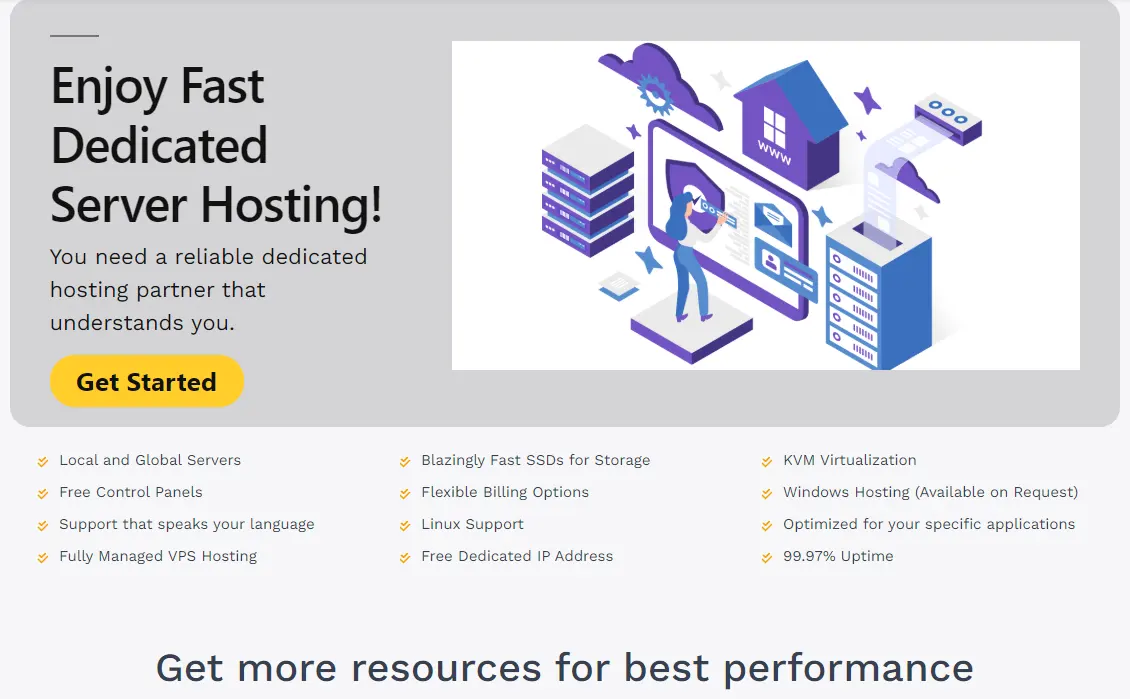
A dedicated server ties its full set of resources to one account. Nobody else runs scripts on that machine, so nothing slows your site down but your own traffic.
Where the server sits also plays a role in performance. A data center close to your main audience cuts latency and speeds up page loads for US-based visitors.
Truehost places dedicated servers in EU and US data centers, so American businesses get low-latency connections without routing traffic overseas.
Root access opens the door to custom firewalls, specific software versions, and compliance setups that shared plans can’t offer.
You decide how the server runs, right down to the kernel settings if you need that level of depth.
Before you buy, you’ll also pick between managed and unmanaged service. That choice shapes daily operations more than almost any other decision, and we’ll break it down fully below.
Primary Advantages of a Dedicated Server
1) Consistent Performance
Shared hosting slows down when one site on the server pulls too many resources.
A dedicated server never runs into that problem, since nobody else touches your CPU or RAM.
Load times stay steady even during traffic spikes. If a sale or a viral post sends a rush of visitors your way, the server handles it without competing against other tenants.
2) Stronger Security
An isolated server cuts off a whole category of risk. Other accounts can’t infect your environment with malware or expose you to a poorly secured neighbor.
You also get to build your own firewall rules and monitoring setup. Businesses that need to meet PCI DSS or similar standards find this control makes compliance far more manageable.
3) Full Customization
Shared hosting locks you into whatever software stack the provider chose. A dedicated server hands you the keys instead.
Pick your OS, install the exact database version your application needs, and tune server settings around your specific workload. Nothing about the setup gets forced on you.
4) Better Uptime and Reliability
Dedicated bandwidth means your traffic never competes with someone else’s spike.
That alone removes one of the most common causes of slowdowns on shared plans.
Fewer points of failure also mean fewer outages. A dedicated server gives your site or application steadier uptime than shared hosting can promise.
5) Scalability for Growing Traffic
As your traffic grows, you can add RAM, swap in faster storage, or upgrade the CPU.
The hardware adjusts with your business instead of forcing an early migration.
Growing companies often start on shared hosting, move to a VPS, then land on a dedicated server once traffic and data needs outgrow both.
Dedicated Server vs VPS vs Shared Hosting
Each hosting type fits a different stage of growth. Here’s how the three compare side by side.
| Feature | Shared Hosting | VPS | Dedicated Server |
|---|---|---|---|
| Resource sharing | Full server shared among many accounts | Virtual partition shared on one physical server | No sharing, the entire server is yours |
| Typical cost | Lowest | Mid-range | Highest |
| Control level | Minimal | Root access within your virtual partition | Full root access to physical hardware |
| Best for | Small blogs and low-traffic sites | Growing sites that need more consistent resources | High-traffic sites, apps, and compliance-heavy workloads |
If your site gets a few hundred visitors a day and doesn’t run anything resource-heavy, shared hosting still gets the job done.
A VPS fits businesses that have outgrown shared hosting but don’t need a full physical machine yet.
A dedicated server makes sense once your traffic, data, or compliance needs push past what a VPS can handle safely.
Managed vs Unmanaged Dedicated Servers
Managed hosting means the provider handles patching, monitoring, backups, and general server upkeep on your behalf.
You focus on your site or application instead of server maintenance.
Unmanaged hosting hands you the raw server and nothing else. You set up the OS, install software, apply security patches, and troubleshoot issues yourself.
Choose unmanaged if you already have an in-house sysadmin comfortable working with root access and server hardening.
Choose managed if you want the performance benefits of a dedicated server without hiring dedicated IT staff.
Truehost’s dedicated server plans start at $98.10 per month for the H1 plan, which includes 4 vCPU cores, 32 GB RAM, and 2×240 GB SSD storage.
The H2 plan runs $138.60 per month with similar specs, and the H3 plan starts at $194.40 per month with 6 cores, 64 GB RAM, and 2×1 TB SSD storage.
All three plans include 24/7 live chat support and free control panel access.
Who Actually Needs a Dedicated Server
A few business types get the most out of a dedicated server. Here’s where the investment tends to pay off fastest.
- High-traffic e-commerce stores that can’t risk downtime during a big sale
- SaaS platforms or apps that run heavy, sustained workloads around the clock
- Businesses handling sensitive data under HIPAA, PCI DSS, or similar compliance rules
- Agencies or developers running several client sites that need isolated environments
If your business fits one of these patterns, the cost of a dedicated server usually pays for itself through fewer outages and less risk.
Disadvantages to Weigh Before Buying
A dedicated server isn’t the right fit for every budget or every stage of growth. A few tradeoffs deserve a closer look before you commit.
The monthly cost runs higher than shared or VPS hosting, sometimes by a wide margin. For a small site with light traffic, that extra spend won’t pay off.
Unmanaged plans also add setup and maintenance work. Without an in-house sysadmin, patching and securing the server yourself can eat up a lot of time.
Hardware is fixed to the physical machine you’re renting. Scaling past its limits sometimes means migrating to a new server instead of a quick upgrade.
Dedicated Server Pricing in 2026
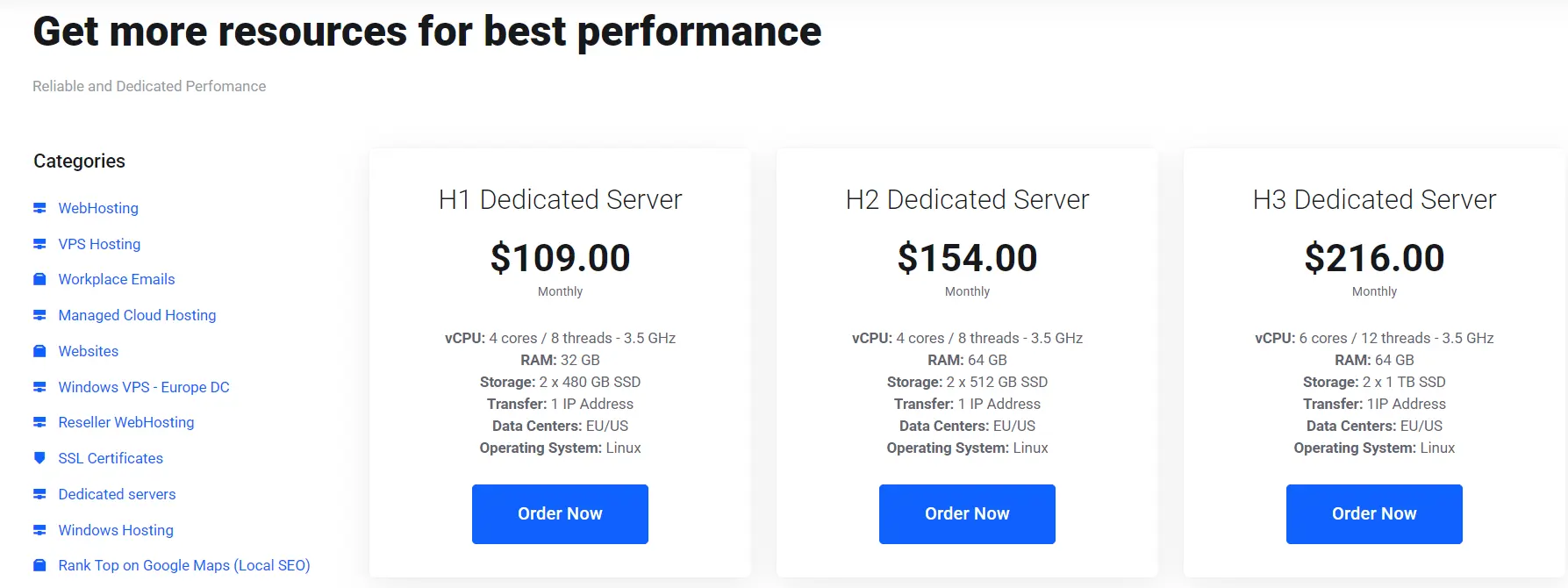
Truehost offers three dedicated server plans built for different traffic levels and budgets.
H1 Dedicated Server costs $98.10 per month when billed triennially, down from $109.00. It includes 4 vCPU cores, 32 GB RAM, 2×240 GB SSD storage, one dedicated IP, and a Linux OS with EU/US data center placement.
H2 Dedicated Server costs $138.60 per month on the triennial plan, down from $154.00. Specs match the H1 tier closely, making it a solid middle option for growing sites.
H3 Dedicated Server costs $194.40 per month when billed triennially, down from $216.00. It steps up to 6 vCPU cores, 64 GB RAM, and 2×1 TB SSD storage for heavier workloads.
Setup fees vary by plan, and billing triennially unlocks the lowest monthly rate across all three tiers. For an exact quote based on your traffic and storage needs, check current pricing directly with Truehost.
FAQs
What is a dedicated server used for?
Businesses use dedicated servers for high-traffic websites, large databases, SaaS applications, and any workload that needs steady performance without sharing resources with other accounts.
Is a dedicated server worth it for a small business?
For a small site with light traffic, shared hosting or a VPS usually covers your needs at a lower cost. A dedicated server pays off once traffic, data, or compliance demands grow.
How secure is a dedicated server compared to shared hosting?
A dedicated server offers stronger security since no other accounts share your environment. You control your own firewall rules, monitoring, and compliance setup from the ground up.
Can a dedicated server improve website speed?
Yes. Since your site doesn’t compete with other accounts for CPU, RAM, or bandwidth, load times stay fast and steady even during traffic spikes.
Get Started With Dedicated Server Hosting
A dedicated server trades a higher monthly cost for full control, steady performance, and stronger security.
That tradeoff makes sense once your traffic, data, or compliance needs outgrow what shared hosting or a VPS can handle.
If your business fits that stage of growth, take a look at Truehost’s dedicated server plans and compare specs against your current traffic to find the right starting configuration.