 Domain RegistrationFind and register the perfect domain for your website.
 .COM DomainChoose a widely recognized domain to build global credibility.
 Domain TransferSeamless domain transfers with zero downtime and complete control.
 All TLDsFind and register your perfect domain. Choose from local and global extensions.
 SSL CertificatesKeep your website safe with reliable SSL Certificates that protect customer data and build trust.
 whoisCheck domain ownership details, expiration dates, and registrar information.
 US DomainRegister a .US domain and build trust in the USA.
 Web HostingEverything your website needs to run smoothly
 WordPress HostingWordPress hosting that just works
 Windows HostingReliable hosting for Windows environments
 Reseller HostingTurn hosting into your business
 Email HostingEmail that looks professional and works anywhere
 cPanel HostingFull control of your hosting with cPanel
 Affiliate ProgramJoin as a partner and earn commissions on every referral you send our way.
 Vps HostingScalable virtual servers that expand as you need.
 Dedicated ServersGet complete access and full control over your dedicated physical server.
 Managed vpsNot tech-savvy? We will take care of everything with our fully managed VPS hosting for you.
 AI Website BuilderCreate stunning websites in seconds with AI.
 Online ShopSet up a professional online store. No coding required.
 Web design serviceGet a tailored website designed to match your brand and support your goals.
 BlogFind helpful guides on web hosting, online selling, digital marketing, and more.
 Contact USYou can reach us anytime, day or night, through chat or email.
 SupportBrowse helpful guides and answers for all of our services.
You found the perfect domain name.
Now the registrar is asking you to choose an extension.
.com? .us? .co? .site? .store? .io?
There are hundreds of options and most people just pick .com without thinking about it.
Sometimes that is the right call. Sometimes it is not.
This guide explains how to choose the perfect domain extension so you get the one that fits your business, your audience, and your long-term goals.
Ready to register? Search available domain extensions on Truehost and lock in your name today.
What Is a Domain Extension?
A domain extension is the part of a web address that comes after the dot.
In “truehost.com,” the extension is .com. In “example.us,” it is .us.
Definition of a Domain Extension
A domain extension is also called a top-level domain, or TLD. It sits at the highest level of the Domain Name System hierarchy and is managed by ICANN, the organization that oversees how domain names work globally.
How Domain Extensions Work
When someone types your web address into a browser, the DNS system reads the extension first to locate the right registry, then finds the specific domain within it. Different extensions are managed by different registries with their own rules and pricing.
Why Choosing the Right Extension Is Important
Your domain extension signals a lot about your business before a visitor reads a single word on your site. A .org signals a nonprofit. A .gov signals a government agency. A .io signals a tech company.
Pick the wrong one and you create a mismatch between expectation and reality before anyone even clicks.
Difference Between a Domain Name and a Domain Extension
Your domain name is the unique part you choose, like “truehost.” The domain name extension is what follows the dot. Together they form your complete domain: truehost.com.
Why Your Domain Extension Matters
The extension is not just punctuation. It does real work for your brand.
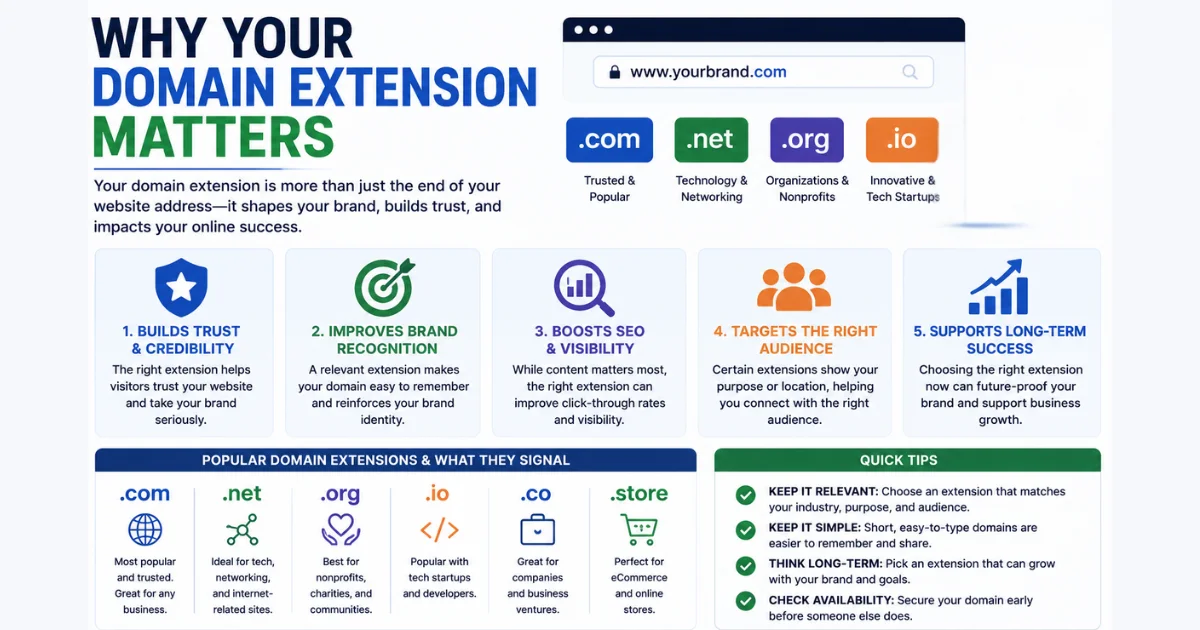
- Brand credibility. A .com is still the default expectation for most businesses. Anything else has to work slightly harder to earn the same level of automatic trust from first-time visitors.
- Customer trust. Local customers in the US are more comfortable clicking on a
.usor.comdomain than an unfamiliar extension they have never seen before. - SEO. Google has stated that generic TLDs like .com and .us are treated equally in search rankings. Country-code domains like .us can give you a local SEO boost when targeting a specific geographic audience. Moz’s guide to TLDs and SEO covers this in more detail.
- Audience targeting. A .us domain sends a clear geographic signal. A .store domain makes your e-commerce focus immediately obvious. Extensions let you communicate audience and purpose before anyone reads your content.
- Marketing and memorability. People remember .com. They are less likely to remember
.onlineor.sitewithout a prompt. If you are running ads or word-of-mouth campaigns, a familiar extension reduces the risk of someone typing the wrong thing.
How to Choose the Perfect Domain Extension
Here is a practical way to approach the decision.
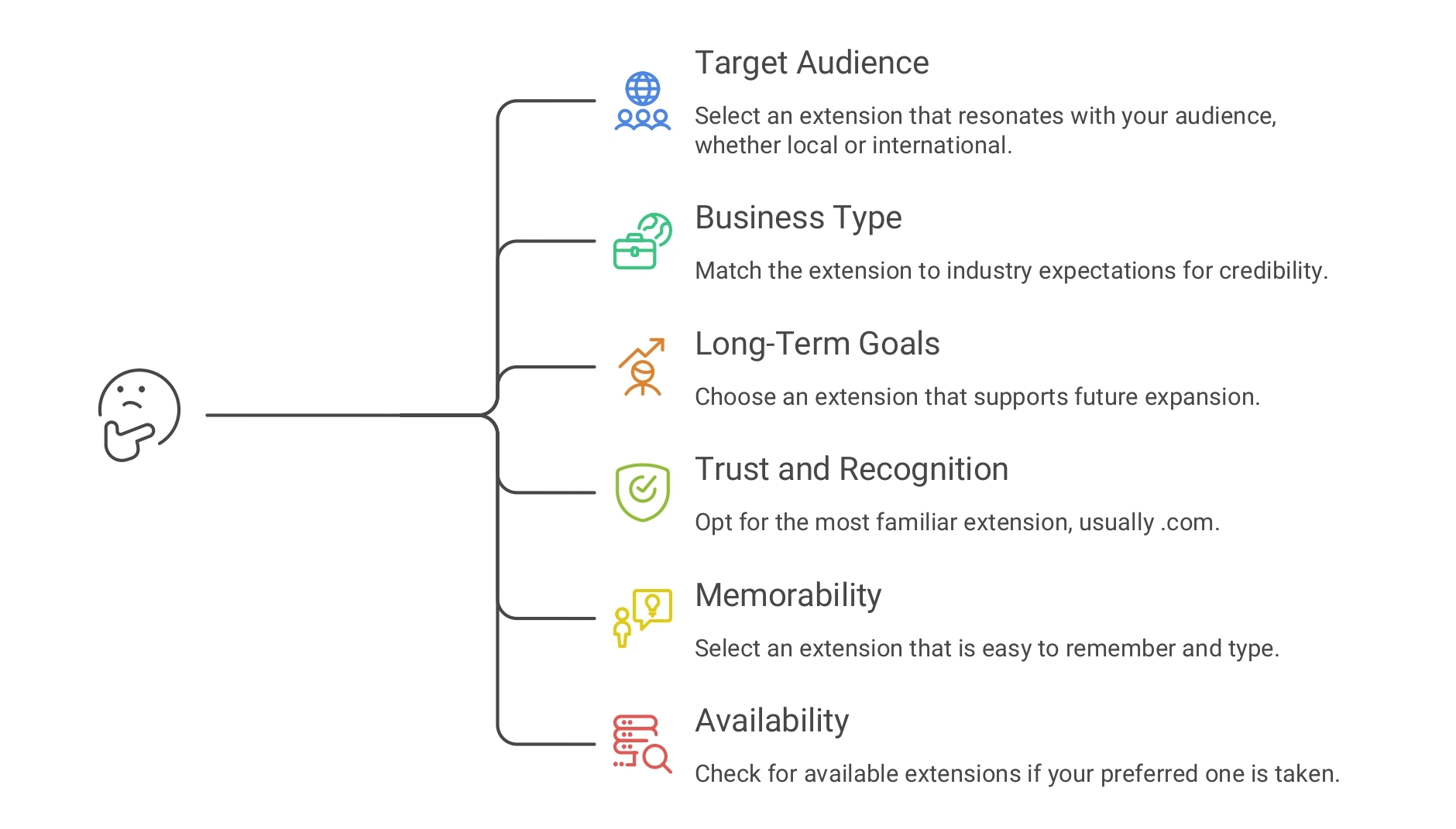
- Identify your target audience. Are you selling locally in the US? Internationally? To a tech-savvy niche? Your audience determines which extension resonates and which one creates friction.
- Consider your business type. A law firm, a bakery, and a SaaS startup have different credibility signals. Match the extension to the professional expectations of your industry.
- Think about your long-term goals. If you plan to expand internationally, a
.comgives you more flexibility than a country-specific extension. If you are building a US-focused brand, a.uscan actually reinforce that positioning. - Prioritize trust and recognition. When in doubt, go with the extension that needs the least explanation.
.comwins that battle almost every time. - Choose an extension that is easy to remember. If someone hears your URL mentioned on a podcast or in conversation, can they type it correctly from memory? The more familiar the extension, the better.
- Check domain availability. Sometimes the decision gets made for you. If yourbrand.com is taken but yourbrand.us is available and your audience is US-based, that might be the right call. Truehost’s domain search lets you check multiple extensions at once.
Popular Domain Extensions Explained
Here is what each of the major extensions is best for and where they fall short.
| Extension | Best For | Watch Out For |
|---|---|---|
| .com | Most businesses, global reach, general use | Highly competitive, most .com names already registered |
| .us | US-based businesses, local and national audience | Less recognizable internationally |
| .net | Tech and networking companies, .com backup | No longer has strong category identity |
| .org | Nonprofits, communities, open-source projects | Misleading if used by a for-profit business |
| .co | Startups, modern brands, short and clean look | Can be confused with .com in verbal communication |
| .site | Personal projects, portfolios, small business | Less familiar to mainstream audiences |
| .online | E-commerce, online services, digital businesses | Generic, harder to stand out |
| .store | E-commerce and retail businesses | Narrow in scope, limits future pivots |
| .io | Tech startups, SaaS, developer tools | Higher cost, mostly recognized in tech circles |
| .ai | AI companies and tools | Premium pricing, niche audience |
The honest summary: .com is the safest choice for most businesses. Every other extension has a specific use case that can make sense in the right context.
Country-Specific vs Generic Domain Extensions
This is where a lot of people get confused.
Country-code top-level domains, or ccTLDs, are extensions assigned to specific countries. The .us domain belongs to the United States. The .uk belongs to the United Kingdom. The .ca belongs to Canada.
Generic top-level domains, or gTLDs, are not tied to any country. .com, .net, and .org are gTLDs.
When to Choose a .us Domain
A .us domain makes sense when your business is US-based and your entire audience is in the United States. It signals local commitment and can support local SEO by reinforcing your geographic relevance to search engines.
When a .com Is a Better Choice
If you plan to serve customers beyond the US, or if your brand has any international ambition, .com keeps your options open. It carries no geographic restriction and is universally recognized.
Comparison: ccTLD vs gTLD
| Factor | Country-Specific (.us) | Generic (.com) |
|---|---|---|
| Geographic signal | Strong local targeting | No geographic restriction |
| Local SEO | Can improve local rankings | Requires geo-targeting setup |
| International reach | Limited | Global |
| Customer trust (local) | High for US audience | Universally trusted |
| Availability | More names available | Most short names already taken |
| Best for | Local and national US brands | Businesses with global reach or plans |
Industry-Specific Domain Extensions
Newer extensions let businesses signal their niche from the domain itself.
.shop / .storework well for e-commerce businesses that want to make their retail focus immediately clear. “yourproduct.store” communicates purpose before a customer even lands on the page..techsuits technology companies, IT services, and software products. It is a credible alternative for tech brands that cannot get the .com or .io they want..blogis straightforward for content publishers and bloggers who want their format stated upfront. It works better for personal brands and niche content creators than for businesses..appis increasingly used by mobile app developers and web applications. It has grown in recognition alongside the rise of app culture. You can explore the full list of available TLDs through IANA’s root zone database..agencyis a natural fit for marketing agencies, creative studios, and consulting firms. It reads as professional and descriptive without needing any explanation.
The trade-off with all of these: they narrow your brand into a category. If your business pivots or expands, a .store or .blog can start to feel limiting. Think about where you are going, not just where you are now.
Common Mistakes to Avoid
These are the ones that trip people up.
- Choosing an extension based only on price. A cheap extension that confuses your customers is not a bargain. It is a liability.
- Selecting an extension that does not match your audience. A .io domain makes perfect sense for a developer tool. It looks strange on a local florist’s website.
- Ignoring branding. Your extension is part of your brand. It appears in every email, every ad, every business card. Treat it like a branding decision, not an afterthought.
- Registering only one extension. If your .com is taken by a competitor or parked domain, customers who mistype your extension may land on their site instead of yours. Secure the key variations.
- Overlooking future growth. A .store extension is fine today, but what happens when you add a service offering or move into B2B? Register an extension you will not need to replace in two years.
Registering Your Domain Extension
Found the right combination of name and extension? Here is how to make it yours.
- Check domain availability. Search your preferred domain across multiple extensions at once. Truehost’s domain availability search shows you all options in seconds.
- Register your preferred extension. Complete the registration through a reliable registrar. Enter your contact details, choose your registration period, and confirm payment. Done.
- Register multiple extensions to protect your brand. If your primary domain is yourbrand.com, also grab yourbrand.us and any common misspellings. It costs a few dollars a year per domain and prevents competitors or squatters from taking what is adjacent to your brand.
- Enable domain privacy and auto-renewal. WHOIS privacy hides your personal details from public records. Auto-renewal ensures the domain does not lapse because you forgot a renewal date. Both are essential. Truehost includes domain privacy on eligible registrations and makes auto-renewal simple to set up in your dashboard.
FAQs
How do I choose the best domain extension?
Match the extension to your audience, your industry, and your long-term goals. If you are building a US-based business with no international ambitions, .us is a solid choice. For most other businesses, .com is still the safest default.
Is .com still the best domain extension?
For most businesses, yes. It is the most recognized, most trusted, and most memorable extension available. People default to typing .com from memory. Every other extension has to work harder to earn the same level of automatic credibility.
Does a domain extension affect SEO?
Directly, not significantly. Google treats most generic TLDs equally in global rankings. Country-code domains like .us can provide a local SEO signal that helps with geographically targeted searches. The bigger SEO factor is always your content and backlink profile, not the extension.
Should I choose a .us or a .com domain?
If your entire audience is in the United States and you want to signal local commitment, .us is a strong choice. If you have international ambitions or want maximum recognition from any audience, .com gives you more flexibility.
Can I register multiple domain extensions for the same business?
Yes, and you should. Registering your brand name across .com, .us, .net, and common misspellings protects your brand from squatters and ensures customers always find you regardless of which extension they type.
Which domain extension is best for a small business?
.com is the default recommendation for most small businesses. If .com is unavailable, .us works well for US-based businesses, and .co is a clean alternative for startups and modern brands.
The Right Extension Makes Your Domain Work Harder
Knowing how to choose the perfect domain extension is not complicated, but it does require thinking beyond just price and availability.
Match the extension to your audience. Think about where your business is going, not just where it is today. Secure the .com if you can, register the variations if you cannot, and never let a domain expire.
Get it right from the start. Search and register your domain extension with Truehost and launch with a name that works as hard as you do.