 Domain RegistrationFind and register the perfect domain for your website.
 .COM DomainChoose a widely recognized domain to build global credibility.
 Domain TransferSeamless domain transfers with zero downtime and complete control.
 All TLDsFind and register your perfect domain. Choose from local and global extensions.
 SSL CertificatesKeep your website safe with reliable SSL Certificates that protect customer data and build trust.
 whoisCheck domain ownership details, expiration dates, and registrar information.
 US DomainRegister a .US domain and build trust in the USA.
 Web HostingEverything your website needs to run smoothly
 WordPress HostingWordPress hosting that just works
 Windows HostingReliable hosting for Windows environments
 Reseller HostingTurn hosting into your business
 Email HostingEmail that looks professional and works anywhere
 cPanel HostingFull control of your hosting with cPanel
 Affiliate ProgramJoin as a partner and earn commissions on every referral you send our way.
 Vps HostingScalable virtual servers that expand as you need.
 Dedicated ServersGet complete access and full control over your dedicated physical server.
 Managed vpsNot tech-savvy? We will take care of everything with our fully managed VPS hosting for you.
 AI Website BuilderCreate stunning websites in seconds with AI.
 Online ShopSet up a professional online store. No coding required.
 Web design serviceGet a tailored website designed to match your brand and support your goals.
 BlogFind helpful guides on web hosting, online selling, digital marketing, and more.
 Contact USYou can reach us anytime, day or night, through chat or email.
 SupportBrowse helpful guides and answers for all of our services.
The United States is the No. 1 country in AI overall in 2026. It has the strongest combination of frontier AI companies, private investment, advanced models, cloud infrastructure and data-centre capacity.
That answer is less comfortable than it was a year ago. China now leads in AI publication volume, research citations, total patent output and industrial robot installations.
The performance gap between the best US and Chinese models has also become very small.
The honest verdict is therefore: the US leads the complete AI ecosystem, while China leads several of the measures that may decide the next phase of the race.
The AI Leadership Scorecard
There is no official world championship for AI.
Rankings combine different indicators, and changing the weight of investment, research, skills or government policy can change the result.
This scorecard separates the main measures instead of pretending they all answer the same question.
Measure | Current leader | What the evidence shows |
|---|---|---|
Overall AI ecosystem | United States | Stanford’s broad country index and Oxford Insights’ readiness index place the US first |
Frontier model production | United States | The US produces more top-tier models, although the quality gap with China is now narrow |
Private AI investment | United States | US private investment reached $285.9 billion in 2025, compared with $12.4 billion in China |
AI data-centre count | United States | The US hosts 5,427 data centres, more than ten times any other country |
AI publications and citations | China | China leads the volume and citation measures tracked by Stanford |
Generative AI patents | China | WIPO ranks China first for GenAI patent origins in 2025 |
AI patents per person | South Korea | South Korea leads Stanford’s AI patent-per-capita measure |
General AI preparedness | Singapore | Singapore has the highest score in the IMF’s AI Preparedness Index |
Fast consumer adoption | United Arab Emirates | Stanford estimated 64% generative AI adoption, with Singapore also high at 61% |
Leading-chip fabrication | Taiwan | TSMC fabricates almost every leading AI chip, according to Stanford |
Stanford’s country-level Global AI Vibrancy Tool currently provides annual comparisons through 2024.
Its broader 2026 AI Index adds 2025 investment, infrastructure and model evidence.
The scorecard above uses the newest available source for each measure, checked in July 2026.
Why the United States Is Still No. 1 Overall
The US lead does not come from one breakthrough or one company.
It comes from a system in which research, capital, computing power and a large commercial market reinforce one another.
The leading frontier AI companies are concentrated in the US
Anthropic, Google, Meta, OpenAI and xAI are headquartered in the United States.
Nvidia, the dominant designer of chips used to train and run many AI systems, is also American.
Location alone does not make a model better though. These companies employ international teams and rely on global suppliers.
Their concentration still matters because it brings decision-making, investment, engineering talent, cloud platforms and customers into the same commercial network.
Stanford’s 2026 AI Index reports that the US continues to produce more top-tier AI models than China.
Industry also produced more than 90% of the world’s notable frontier models in 2025, showing how strongly model leadership now depends on companies with access to very large amounts of capital and compute.
The US has an enormous private-investment advantage
Private AI investment in the United States reached $285.9 billion in 2025, according to Stanford.
China received $12.4 billion and the United Kingdom $5.9 billion.
That puts the reported US total at more than 23 times China’s. The US also recorded 1,953 newly funded AI companies, more than ten times the number in the next country in this ranking.
Now, this is not a complete measure of national spending. Private-investment comparisons undercount Chinese state-backed funding.
Even with that qualification, the US has a much deeper private market for financing expensive model training, AI infrastructure and new companies.
It has the largest visible AI infrastructure base
Advanced AI requires more than good software. Developers need data centres, specialised chips, electricity, networking and cloud services.
The 2026 AI Index counts 5,427 data centres in the United States, more than ten times the count in any other country.
While this does not mean every facility trains frontier models, the scale itself gives US companies easier access to the infrastructure needed to build and deliver AI products.
The supply chain remains international. Stanford notes that
TSMC in Taiwan fabricates almost every leading AI chip. And it’s not slowing down:
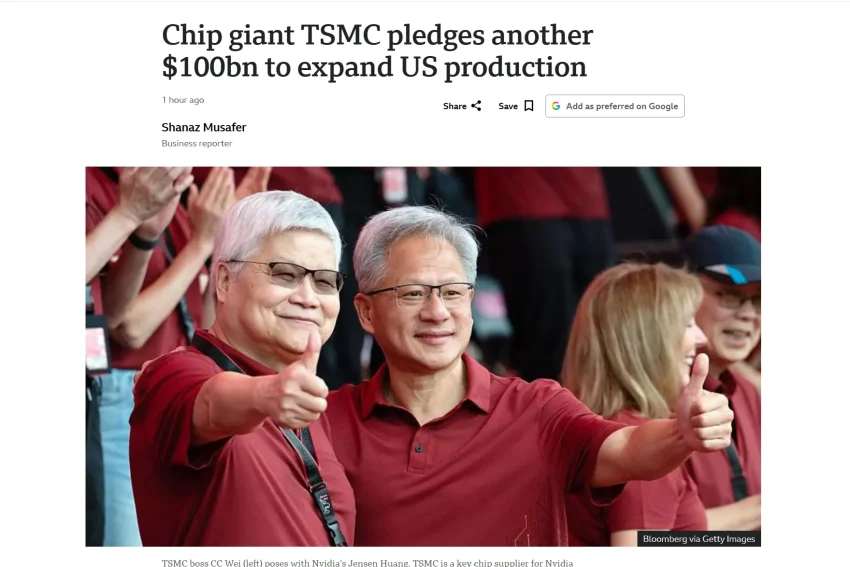
As such, a country can lead in model development while still depending on manufacturing capacity elsewhere.
Two broad indexes still place the US first
Stanford’s Global AI Vibrancy Tool compares countries across research and development, the economy, policy, education, infrastructure and public opinion.
Under its default weighting, the United States is the overall leader.
The Oxford Insights Government AI Readiness Index 2025 also ranks the US first among 195 governments.
That index asks a more specific question: how capable is a government of enabling, governing and using AI for public benefit?
When indexes with different methods reach the same overall winner, the case for the United States becomes stronger.
How Close Is China to Taking the Lead?
China is the only country that competes with the United States across almost the entire AI system:
Research,
Models,
Patents,
Chips,
Cloud services,
Robotics,
Consumer products and
Industrial deployment.
The change in model performance is especially important.
Stanford reports that US and Chinese models traded the lead several times from early 2025.
DeepSeek-R1 briefly matched the leading US model in February 2025. By March 2026, the top US model led Stanford’s selected Chinese model by only 2.7%.
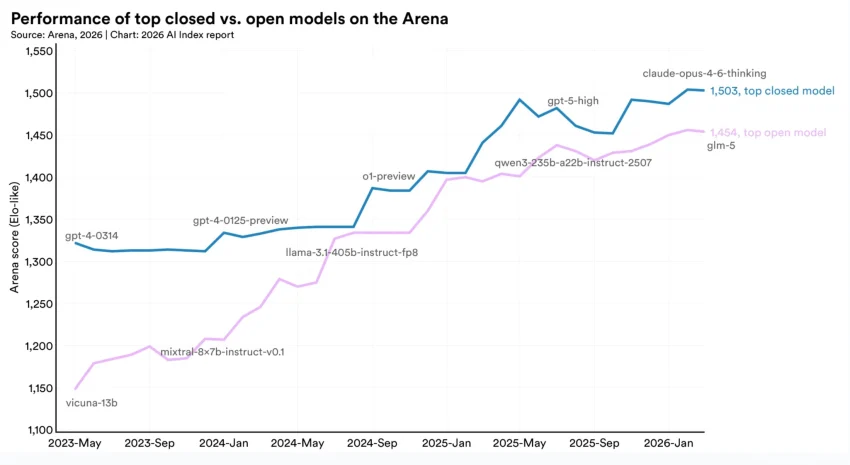
That is why two apparently contradictory claims can both be true:
The United States is No. 1 overall.
China has effectively closed the model-performance gap.
China already leads several scale measures.
Stanford gives it the lead in AI publications, citations, total patents and industrial robot installations.
The World Intellectual Property Organization’s 2025 patent update also ranks China first for the origin of generative AI inventions, ahead of the United States, Japan, South Korea and India.
Patents do not automatically become valuable products, and publication volume does not guarantee the most influential discovery.
These indicators still reveal the depth of China’s research and industrial pipeline. They make a permanent, uncontested US lead unlikely.
Which Other Countries Lead in AI?
The US-China contest dominates the headlines, but smaller countries can outperform both when the measure rewards readiness, specialisation or results relative to population.
Singapore leads in preparedness
The IMF AI Preparedness Index assesses 174 countries using digital infrastructure, human capital and labour-market policy, innovation, economic integration, regulation and ethics.
Singapore has the highest overall score.
This means the country is exceptionally well prepared to absorb AI into its economy and institutions.
The UAE stands out for adoption
AI adoption is how quickly people are incorporating available tools into their daily lives.
Stanford’s 2026 report estimates generative AI adoption at 64% in the United Arab Emirates, compared with 61% in Singapore.
The same report places the US 24th at 28.3% on this measure.
It’s clear, adoption is not invention. A country can use AI widely without training many frontier models of its own.
South Korea leads in patent intensity
South Korea leads the world in AI patents per person.
Its strengths in semiconductors, electronics, robotics and advanced manufacturing make it a significant AI country even though its absolute investment is below US and Chinese levels.
Taiwan is indispensable to AI hardware
Most rankings focus on software, papers and companies.
That race would look very different without Taiwan’s chip-manufacturing capacity.
The UK remains a strong research and policy centre
The United Kingdom combines leading universities, a mature startup and investment market, the presence of Google DeepMind, and an early role in international AI safety work.
Its constraint is scale: it does not match US investment or infrastructure, and it does not match China’s industrial base.
What the AI Race Means for a Business
You do not need to operate in the No. 1 AI country to benefit from the technology.
Most businesses are buyers and users of AI rather than frontier-model developers.
a) Choose tools by the job
Test AI against a defined task:
Drafting support replies,
Summarising documents,
Analysing a spreadsheet,
Producing product descriptions or
Building a first website draft.
You want to measure accuracy, time saved, cost and the amount of human review required.
The best model for coding may not be the best model for customer service, or content marketing.
b) Keep control of your data and customer access
Check what information a tool stores, whether it uses submitted data for training, where it is processed and how you can export your work.
You want to avoid putting confidential client, financial or health information into a consumer AI tool without an approved data policy.
Your website and domain should also remain under your control. Social and AI platforms can change their rules; an owned site gives customers a stable place to find, verify and contact the business.
c) Turn experiments into something customers can use
AI has value when it shortens a real path for the customer.
A useful result might be a
Clearer product page,
Faster quotation flow,
Searchable knowledge base or
Working online store.
If the immediate goal is getting a business online, the Truehost AI Website Builder can produce the first site structure from a business description and connect it to a custom domain.
You can then review the copy, replace generic images and publish only after the facts and contact details are correct.
For a global-facing brand, a .COM domain from Truehost gives that AI-assisted work a recognisable address you control.
AI Rankings FAQs
Which country is No. 1 in AI in 2026?
The United States is No. 1 overall. It combines the strongest frontier-model industry with the largest private AI investment total and the biggest visible data-centre base. China leads several individual measures and is now a close competitor on model performance.
Is the US or China ahead in artificial intelligence?
The US is ahead across the overall AI ecosystem, private investment, frontier-model production and data-centre capacity. China leads publication volume, citations, total patent output, generative AI patent origins and industrial robot installations. The answer depends on the measure.
Which country has the most advanced AI models?
US developers still produce more top-tier models, but there is no permanent winner on every benchmark. Stanford reports that leading US and Chinese models traded first place and were separated by only a small performance gap in March 2026.
Which country has the most AI patents?
China leads in total AI patents and is the top origin of generative AI patent families in WIPO’s 2025 data. South Korea leads in AI patents per person. Patent quantity should not be treated as a complete measure of quality or commercial impact.
Which country is best prepared to use AI?
Singapore ranks first in the IMF AI Preparedness Index, which covers digital infrastructure, skills, innovation, economic integration, regulation and ethics. Oxford Insights ranks the United States first for government AI readiness because it uses a different method.
Can a country lead in AI without building frontier models?
Yes. A country may lead through chip manufacturing, workforce readiness, adoption, robotics, public services or specialised research. Taiwan, Singapore, the UAE and South Korea illustrate different forms of AI leadership.
The Verdict
The United States is the best-supported answer to which country is No. 1 in AI.
It still has the broadest and best-funded AI ecosystem in 2026.
China is no longer a distant second. It has the scale to challenge the US in models, research, patents and deployment, and it already leads several of those measures.
Singapore, the UAE, South Korea, Taiwan and the UK show why the rest of the story cannot be reduced to one ranking.
For a business, the useful question is not which flag wins. It is whether a tool makes a specific job faster, better or less expensive without giving up control of important data.
Start with one measurable use case, review the output, and publish the result on a digital property you own.