 Domain RegistrationFind and register the perfect domain for your website.
 .COM DomainChoose a widely recognized domain to build global credibility.
 Domain TransferSeamless domain transfers with zero downtime and complete control.
 All TLDsFind and register your perfect domain. Choose from local and global extensions.
 SSL CertificatesKeep your website safe with reliable SSL Certificates that protect customer data and build trust.
 whoisCheck domain ownership details, expiration dates, and registrar information.
 US DomainRegister a .US domain and build trust in the USA.
 Web HostingEverything your website needs to run smoothly
 WordPress HostingWordPress hosting that just works
 Windows HostingReliable hosting for Windows environments
 Reseller HostingTurn hosting into your business
 Email HostingEmail that looks professional and works anywhere
 cPanel HostingFull control of your hosting with cPanel
 Affiliate ProgramJoin as a partner and earn commissions on every referral you send our way.
 Vps HostingScalable virtual servers that expand as you need.
 Dedicated ServersGet complete access and full control over your dedicated physical server.
 Managed vpsNot tech-savvy? We will take care of everything with our fully managed VPS hosting for you.
 AI Website BuilderCreate stunning websites in seconds with AI.
 Online ShopSet up a professional online store. No coding required.
 Web design serviceGet a tailored website designed to match your brand and support your goals.
 BlogFind helpful guides on web hosting, online selling, digital marketing, and more.
 Contact USYou can reach us anytime, day or night, through chat or email.
 SupportBrowse helpful guides and answers for all of our services.
ChatGPT can produce a 3,500-word blog post from one sentence. That does not mean the post will be accurate, original or useful.
The one-prompt approach usually creates the same problems:
Generic introduction,
Predictable headings,
Repeated advice,
Unsupported facts and a conclusion that says little.
The draft looks finished before the real editorial work has started.
A better method treats ChatGPT as a research and writing assistant. In this approach, you provide the audience, decision, evidence and editorial standards.
ChatGPT helps question the brief, organize the material, develop examples, draft sections and find weaknesses.
A human remains responsible for every published claim and recommendation.
A strong blog post needs eight separate jobs
Do not ask ChatGPT to research, reason, draft, optimize and fact-check in one response.
These jobs need different instructions and different checks.
Stage | ChatGPT can help with | You must own |
|---|---|---|
Brief | Ask questions and organize requirements | Reader, purpose and business goal |
Research plan | Identify claims and possible source types | Source selection and verification |
Source notes | Summarize material you provide | Whether the summary matches the source |
Outline | Arrange the argument and expose gaps | Editorial angle and final structure |
Draft | Turn approved notes into prose | Judgment, examples and factual limits |
Edit | Find repetition, weak transitions and unclear passages | Final voice and meaning |
SEO package | Suggest titles, descriptions and internal links | Search intent and honest promise |
Publication | Produce a clean handoff checklist | Approval, attribution and accountability |
This separation gives you checkpoints. If the research is weak, you can repair it before 2,000 words of polished prose hide the problem.
1) Start with a result, not a topic
“Write about ecommerce platforms” names a subject. It does not tell ChatGPT what the article must help someone do.
A useful starting instruction contains four things:
the reader’s situation;
the decision or action the post should support;
the boundaries of the topic; and
the result the reader should reach.
Compare these two prompts.
Weak prompt:
Write a detailed blog post about choosing an ecommerce platform.Stronger prompt:
Help me create a fact-based blog post for solo founders launching their first physical-product store.

The post should help the reader compare Shopify, WooCommerce and Wix, then create a three-platform shortlist based on total three-year cost,setup effort, payment options, ownership, customization and growth limits.

Assume the reader understands online shopping but has never built a store.
Explain hosting, transaction fees, payment gateways and plugins in plain English. Don't over explain, or define the obvious. Do not draft the article yet.
The second prompt defines success. It also stops ChatGPT from filling the article with every fact it associates with ecommerce.
2) Make ChatGPT question the brief
Writers often prompt ChatGPT with incomplete assumptions, then blame the output for being vague. Reverse the sequence: ask it to interview you first.
This prompt works across most blog topics:
Act as an editorial planner.

I want to write a blog post about [TOPIC]. The intended outcome is
[READER OUTCOME]. Do not create an outline or draft yet.

Ask me the five to seven questions that would materially change the
article's angle, evidence, examples, depth or recommendation. Do not ask
for information that can be inferred safely from the topic.
I tested this, and the AI produced questions about the primary audience, platforms to compare, article goal, required depth and sourcing requirements.
Those questions changed the brief before any prose was written.
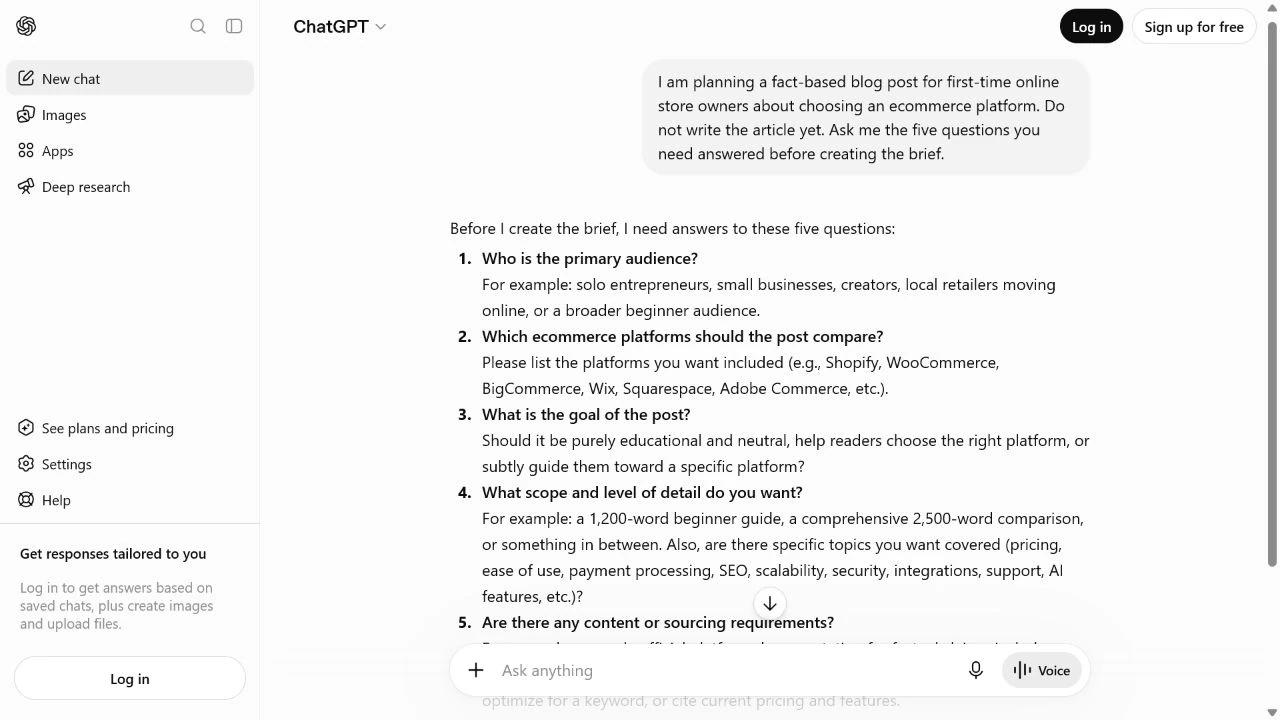
Answer with specifics rather than adjectives. “Detailed” is vague. “Explain transaction fees, hosting and plugins for a beginner, then provide a weighted scoring exercise” gives ChatGPT work it can execute.
Example reply:
Here are my answers:

1. Reader: a solo founder launching a first physical-product store.
2. Options: Shopify, WooCommerce and Wix only.
3. Decision factors: total three-year cost, setup effort, payment options,
   ownership, customization and growth limits.
4. Depth: beginner-friendly, but explain hosting, transaction fees and
   plugins without hiding the trade-offs.
5. Outcome: a weighted scoring rubric plus recommendations for three
   different founder profiles.
6. Evidence: current official documentation for all prices, features,
   limits and policies. Flag every claim that needs a live source.

Now restate the brief. Identify any assumption you still need me to approve.
Do not draft the article.
The instruction to restate the brief catches misunderstandings early. Correcting one sentence now is cheaper than rewriting an entire draft later.
3) Convert the answers into an editorial contract
An editorial brief prevents the conversation from drifting as it becomes longer.
Ask ChatGPT to produce a compact contract that you can paste back into later messages.
Turn my answers into an editorial brief with these fields:

- working title;
- target reader and starting knowledge;
- reader problem;
- one promise;
- decision or action at the end;
- search intent;
- scope;
- excluded topics;
- required evidence;
- examples to develop;
- voice and reading level;
- claims to avoid;
- primary call to action.

Use one or two sentences per field. If a required decision is missing, write "OPEN DECISION" instead of inventing an answer.
For the ecommerce example, the core of the resulting brief should resemble this:
reader: Solo founder planning a first physical-product store
problem: The platforms look similar until cost, maintenance and control are compared
promise: Build a three-option shortlist using six decision criteria
scope:
  - Shopify
  - WooCommerce
  - Wix
evidence:
  - Current official pricing and fee pages
  - Official payment-provider documentation
  - Official export, hosting and customization documentation
exclusions:
  - Enterprise commerce suites
  - Marketplace selling strategies
  - Detailed payment-processing rate comparisons
final_action: Complete a weighted platform scorecard
YAML is optional. Its value is the visible structure: a missing field looks missing instead of disappearing inside a polished paragraph.
Save the approved brief.
ChatGPT can remember earlier turns inside the current conversation, but a compact restatement keeps the important constraints close to the work.
For a recurring publication, Projects or custom instructions may help preserve shared context when those features are available on your plan.
4) Research claims before requesting prose
ChatGPT can help plan research.
OpenAI’s ChatGPT capabilities overview describes Search for recent information and Deep Research for multi-source research tasks.
Access depends on the account, subscription and settings. If those tools are unavailable, collect the official sources yourself and paste or upload the relevant material.
Start by making a claims register:
Using the approved brief, list every factual claim the article may need.

Return a table with these columns:
1. Claim to verify
2. Why the claim affects the reader's decision
3. Best primary source type
4. Freshness risk: low, medium or high
5. Exact qualifier to preserve

Separate provider-controlled claims, independent comparisons and stable
background explanations. Do not supply facts from memory.
The qualifier column is important. “Shopify charges transaction fees” can become misleading if the fee depends on the payment method, plan or country.
The source note should preserve the condition, not only the number.
Build a source matrix that is hard to misuse
For every important claim, record the source, date checked, exact evidence and limitation.
Claim | Source | Checked | Evidence captured | Limitation |
|---|---|---|---|---|
Platform subscription price | Official pricing page | 20 July 2026 | Plan, currency, billing period | Promotion may change |
External payment fee | Official fee documentation | 20 July 2026 | Plan-specific percentage and exception | Market-dependent |
Store export options | Official help documentation | 20 July 2026 | Exported data types | Does not prove easy migration |
Then give ChatGPT only the approved material:
The source notes below are the complete evidence set for this section.

Rules:
- Use only these notes for factual claims.
- Preserve dates, regions, billing periods, conditions and exclusions.
- Do not convert an absence of evidence into a negative claim.
- Put [SOURCE NEEDED] after any sentence that cannot be supported.
- Distinguish a source fact from an editorial inference.

[PASTE SOURCE MATRIX AND NOTES]

Summarize the supported findings. Do not draft the article yet.
Never paste passwords, private customer records, unpublished financial data, confidential contracts or personal identifiers into a chat.
OpenAI’s Data Controls FAQ explains training controls and Temporary Chats. Your organization may require stricter handling rules than the consumer product provides.
5) Ask for an argument, not a list of headings
A weak outline is a table of contents. A strong outline shows how each section moves the reader toward the promised result.
Use the approved brief and source findings:
Create a decision-led outline for this article.

For every proposed section, provide:
- the reader question it answers;
- the section's one-sentence conclusion;
- evidence or example required;
- the next question created by that conclusion.

Use H2s for changes in the reader's task and H3s only for real
subdivisions. Remove any section that merely defines a familiar term, repeats the introduction or summarizes an earlier verdict.

The outline must end with the reader completing [FINAL ACTION].
Do not draft body copy.
This prompt makes empty headings easier to spot. If ChatGPT cannot state the conclusion or evidence for a section, the section may be padding.
For the ecommerce example, a useful progression could be:
Calculate the three-year cost, not the introductory price.
Decide who will handle hosting, updates and backups.
Eliminate platforms that cannot support required payment methods.
Compare control and portability before adding design features.
Score the surviving options against realistic growth plans.
That order follows the buyer’s decision. A generic What Is Ecommerce? section would delay it.
Stress-test the outline
Do not accept the first structure automatically. Ask ChatGPT to attack it.
Review this outline as a skeptical editor.

Identify:
- sections that repeat the same conclusion;
- headings that could fit any article;
- claims without approved evidence;
- missing objections or exceptions;
- examples that are too convenient to be credible;
- places where the reader is asked to act before receiving enough context;
- any section included only for SEO.

Recommend deletions before additions.
“Recommend deletions before additions” counters the tendency to solve every weakness by making the article longer.
6) Draft one section at a time
Once the evidence and outline are approved, draft in controlled sections. This keeps ChatGPT close to the relevant notes and makes review manageable.
Draft only the section titled:
"Calculate the three-year cost, not the introductory price"

Section job: Help a first-time store owner identify every recurring and
one-time cost before comparing platforms.

Approved conclusion: A low entry price is not useful unless the comparison
also includes hosting, required apps, payment-related platform fees,
maintenance and likely upgrades over three years.

Use only these source notes:
[PASTE RELEVANT NOTES]

Requirements:
- 350 to 500 words;
- explain the calculation in plain English;
- include one realistic worked example with clearly labelled assumptions;
- separate provider facts from the example calculation;
- link every current claim to its approved source;
- do not write the next section or a section-ending summary.
Review the section before requesting another. Check facts first, then reasoning, then style. If you start with sentence polish, you may spend time improving a claim that should be deleted.
Give useful revision instructions
“Make it better” tells ChatGPT almost nothing. Name the failure and the intended repair.
Weak revision request:
Make this section more engaging and human.
Specific revision request:
Rewrite this section without changing its facts or recommendation.

The current draft has three problems:
1. The opening repeats the heading.
2. Two paragraphs describe cost as "important" without naming the
   consequence of an incomplete comparison.
3. The worked example mixes official prices with assumed plugin costs.

Open with the buyer discovering a required cost in year two. Label every
assumption in the calculation. Keep the source-backed prices separate.
Use ordinary, direct English and no rhetorical questions.
The second prompt gives ChatGPT observable editing targets. It also protects facts that are already correct.
7) Use examples that expose the decision
An example should make a trade-off visible. It should not merely replace Company A with a fictional bakery.
For the platform article, create three founder scenarios:
a maker who wants to launch 20 products quickly and avoid maintenance;
a content-led brand that already runs WordPress and needs deep control; and
a small catalogue business that values visual editing over advanced customization.
Ask ChatGPT to keep assumptions explicit:
Create three short buyer scenarios that test the approved comparison.

For each scenario, state:
- products and expected order volume;
- technical skill and available setup time;
- required payment methods;
- customization needs;
- maintenance tolerance;
- likely change over the next three years.

Then explain which criterion receives the highest weight and why.
Do not choose a platform until the scoring rules have been applied.
Do not invent customer quotes, revenue figures or performance results.
You can also ask for an exact sample readers may reuse. A blockquote works well for a prompt, email or policy statement because the wording itself is the useful object.
For example, a reader could paste this into ChatGPT when a recommendation feels too absolute:
“Separate facts from judgment in this recommendation. For every sentence, label it internally as source fact, calculation, assumption or editorial inference. Rewrite any sentence whose category is unclear.”
Remove the internal labels from the finished copy only after checking the distinction.
8) Edit the draft in passes
One giant “edit this article” prompt invites ChatGPT to change facts while polishing sentences. Use separate passes with narrow permissions.
Pass one: factual integrity
Audit the draft against the approved source matrix.

Return only a table with:
- draft claim;
- supporting source ID;
- status: supported, partly supported, unsupported or outdated;
- missing qualifier;
- recommended action.

Do not rewrite the article. Do not treat the draft itself as evidence.
Pass two: logic and usefulness
Review the draft for reasoning problems.

Find:
- recommendations that do not follow from the evidence;
- comparisons using different units, dates or scopes;
- advice that assumes knowledge the reader does not have;
- examples that fail to change the decision;
- repeated conclusions;
- missing exceptions that would change the reader's action.

Suggest the smallest repair for each problem. Do not line-edit yet.
Pass three: voice and readability
Edit for a direct, practical voice.

Preserve all verified facts, links, qualifications and recommendations.
Remove generic openers, inflated claims, repeated summaries, vague
importance statements and corporate language. Vary sentence and paragraph
length according to the idea. Keep paragraphs together when a claim needs
its qualification.

Return the revised copy followed by a short change log.
Pass four: anti-slop scan
Scan the article for recognizable AI-writing patterns.

Flag, but do not automatically replace:
- generic introductions;
- repeated heading structures;
- "Why X matters" headings;
- excessive em dashes;
- moreover, furthermore, leverage, delve, robust and seamless;
- fake quotations or invented experience;
- every section ending with a summary;
- unsupported superlatives;
- FAQ answers that duplicate the body.

For each hit, quote the sentence and explain the exact problem.
ChatGPT is useful here because it can search a long draft for patterns. The final choice still belongs to the editor; a technical use of “robust” may be correct even when the word is overused elsewhere.
9) Verify every fact, quotation and link yourself
ChatGPT can produce a plausible citation that does not support the sentence. It may also merge details from different plans, regions or dates.
Open every source and check:
the source says what the draft claims;
the information applies to the correct country, plan and date;
a promotion has not been presented as the normal price;
a fee includes its condition or exception;
a quotation matches the original wording;
the link resolves to the relevant page; and
an editorial inference is not presented as the provider’s statement.
Use this final claim-check prompt only after you have performed the source review:
Here is the final draft and the approved source matrix.

List every sentence containing a number, date, price, named feature,
quotation, ranking, legal statement, policy, technical limit or statement
about another company.

For each sentence, show the supporting source ID and the exact source note.
Mark any sentence with no direct support as REMOVE OR VERIFY.
Do not use general knowledge to fill a gap.
Google’s guidance on generative AI content focuses on accuracy, quality and relevance. It also warns that generating many pages without adding value can violate its policy on scaled content abuse. Using ChatGPT is not a substitute for original evidence, first-hand judgment or editorial review.
10) Package the article for search without weakening it
SEO packaging should describe the finished article. It should not reshape a useful draft around a repeated keyword.
Give ChatGPT the article and request several materially different options:
Create an SEO package for the approved article.

Primary search query: how to choose an ecommerce platform
Reader outcome: create a three-platform shortlist

Return:
- 8 title options, each under 60 characters where practical;
- 3 meta descriptions between 140 and 160 characters;
- one short URL slug;
- 5 internal-link opportunities described by reader need;
- descriptive alt text for the comparison graphic;
- a one-sentence excerpt.

Do not promise a universal winner, guaranteed results or current prices.
Do not add a year unless the article contains evidence that requires one.
Choose the title that matches the page, not the most dramatic option. Then read the title, description, H1, opening and major headings together. If they repeat the same phrase mechanically, rewrite them as a set.
For internal links, ask for the reason before the anchor:
Identify places where the reader develops a new question that an existing
article or product page could answer. Describe the reader's question and
suggest natural anchor text. Do not invent URLs.
You can then match those needs to verified pages. A reader who has finished the writing workflow may need instructions for starting a blog, broader ChatGPT prompts for business or a check against common WordPress blog mistakes.
A reusable master prompt for the full workflow
The individual prompts above give you tighter control. The following template is useful when you want ChatGPT to manage the stages while still stopping for approval.
You are my blog-writing assistant. You may help plan, research from approved
sources, outline, draft and edit. You may not invent evidence or make the
final publication decision.

TOPIC
[Topic]

READER
[Situation, existing knowledge and main concern]

READER OUTCOME
[Decision or action the post should enable]

BUSINESS GOAL
[Why the publisher is creating the post]

SCOPE
[Required subjects, providers, markets or examples]

EXCLUSIONS
[What the article should not cover]

EVIDENCE RULES
- Use only sources I approve.
- Preserve dates, markets, billing terms and exceptions.
- Mark unsupported claims as [SOURCE NEEDED].
- Never invent a statistic, quotation, case study, link or personal result.
- Separate source facts, calculations, assumptions and editorial inferences.

VOICE
[Tone, reading level, point of view and phrases to avoid]

FORMAT
[Desired length, heading depth, tables, examples and code blocks]

WORKFLOW
Stage 1: Ask up to seven questions that would materially change the brief.
Stop for my answers.

Stage 2: Produce the editorial brief, research checklist and claims register.
Stop for approval.

Stage 3: Summarize only the approved sources I provide. Produce a source
matrix and identify gaps. Stop for approval.

Stage 4: Produce a decision-led outline with the conclusion and evidence
required for every section. Stop for approval.

Stage 5: Draft one approved section at a time. Stop after each section.

Stage 6: Run separate factual, logic, voice and anti-slop edits. Never change
a verified fact during a style edit.

Stage 7: Produce SEO metadata and a final publication checklist.

Begin with Stage 1 only.
The pauses are the control system. Remove them and the master prompt becomes another one-shot request.
Use ChatGPT features only when they improve the job
ChatGPT’s interface and available tools can vary by account and plan. Choose a feature because it removes a real constraint.
Search: Useful for locating current pages and source-backed answers. Open and verify the cited pages before publishing.
Deep Research: Useful for multi-source briefs when available. Check source quality, scope and dates rather than treating the report as final evidence.
File uploads: Useful for style guides, interview transcripts, product documentation and source packs. Remove confidential or unnecessary personal information first.
Canvas: Useful for working through a longer draft and requesting targeted edits without repeatedly pasting the full article.
Projects: Useful for a recurring publication with shared instructions, files and chats.
Custom instructions: Useful for stable preferences such as spelling, point of view or prohibited phrases. Keep article-specific decisions inside the brief.
OpenAI’s prompting guidance for ChatGPT recommends clear, specific instructions and iterative refinement. The workflow above turns that principle into editorial checkpoints.
Publish the draft only after the human review
A finished ChatGPT response is not a finished blog post.
Before publication, confirm that a person has:
read every linked source;
approved the argument and recommendations;
added genuine experience or accountable judgment where the topic needs it;
removed private, licensed or confidential material that should not appear;
tested code, calculations and procedures;
checked the rendered desktop and mobile page; and
accepted responsibility for the final wording.
The useful role for ChatGPT is not replacing the writer. It is making each editorial decision visible early enough to inspect, challenge and improve.