 Domain RegistrationFind and register the perfect domain for your website.
 .COM DomainChoose a widely recognized domain to build global credibility.
 Domain TransferSeamless domain transfers with zero downtime and complete control.
 All TLDsFind and register your perfect domain. Choose from local and global extensions.
 SSL CertificatesKeep your website safe with reliable SSL Certificates that protect customer data and build trust.
 whoisCheck domain ownership details, expiration dates, and registrar information.
 US DomainRegister a .US domain and build trust in the USA.
 Web HostingEverything your website needs to run smoothly
 WordPress HostingWordPress hosting that just works
 Windows HostingReliable hosting for Windows environments
 Reseller HostingTurn hosting into your business
 Email HostingEmail that looks professional and works anywhere
 cPanel HostingFull control of your hosting with cPanel
 Affiliate ProgramJoin as a partner and earn commissions on every referral you send our way.
 Vps HostingScalable virtual servers that expand as you need.
 Dedicated ServersGet complete access and full control over your dedicated physical server.
 Managed vpsNot tech-savvy? We will take care of everything with our fully managed VPS hosting for you.
 AI Website BuilderCreate stunning websites in seconds with AI.
 Online ShopSet up a professional online store. No coding required.
 Web design serviceGet a tailored website designed to match your brand and support your goals.
 BlogFind helpful guides on web hosting, online selling, digital marketing, and more.
 Contact USYou can reach us anytime, day or night, through chat or email.
 SupportBrowse helpful guides and answers for all of our services.
You want a business email address that looks professional. Your budget is tight, and you hate surprises. That is why you are reading a Truehost email hosting review.
I went through every Truehost Workplace plan. I checked prices, limits, and what each tier leaves out. You get the short answer first, then the proof.
Now let me show you what that money buys.
What Each Truehost Workplace Plan Gives You
Truehost sells five bundled tiers. Each tier fixes the number of mailboxes. You pay one yearly price for the whole bundle.
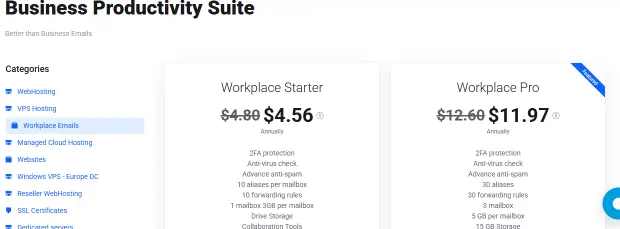
| Plan | Price per year | Mailboxes | Storage per mailbox | Total storage | Aliases |
| Starter | $4.80 | 1 | 3 GB | 3 GB | 10 |
| Pro | $12.60 | 3 | 5 GB | 15 GB | 30 |
| Business | $22.20 | 5 | 10 GB | 50 GB | 50 |
| Premium | $44.00 | 10 | 10 GB | 100 GB | 100 |
| Enterprise | $88.00 | 20 | 10 GB | 200 GB | 200 |
Every tier includes the same core protection. You get 2FA, anti-virus checks, and anti-spam filtering. You also get drive storage, Docs, Sheets, and Presentations. Setup costs nothing.
Those inclusions look strong at this price. Next, let me show why the bundle model saves you money.
Why Flat Bundle Pricing Wins on Cost
Most email hosts charge per user. Every new hire adds another monthly bill. Truehost charges one price per bundle instead.
Here is what five mailboxes cost per year:
- Truehost Workplace Business: $22.20, flat.
- Zoho Mail Lite: About $60, at roughly $1 per user monthly.
- Namecheap Private Email: About $60 to $120.
- Hostinger Business Email: About $23 on promo, then about $95 at renewal.
Hostinger looks close at first. Its promo needs a 48-month commitment, though. Then the price jumps. Truehost asks for one year.
The gap grows as your team grows. Ten users on Zoho Mail Lite cost about $120 a year. Truehost Premium covers ten mailboxes for $44. Twenty users cost about $240 on Zoho, while Truehost Enterprise covers twenty for $88.
Zoho Mail Free costs nothing for up to five users. It limits access options, though. Prices change often, so confirm each figure on the provider’s site before you buy.
What I Like About Truehost Email Hosting

Several strengths stand out once you compare plans side by side.
- Low entry price. One professional inbox costs $4.80 a year.
- Predictable cost. Flat bundles stop per-seat bills from piling up.
- Office tools included. Docs, Sheets, and Presentations come with every plan.
- Security on every tier. Even Starter gets 2FA, anti-virus, and anti-spam.
- One account. You manage your domain and email in one place.
- Day and night support. You reach the team by chat or email.
- Local payment option. Truehost lists M-Pesa among its payment methods.
These strengths share one theme. Truehost removes steps between you and a working inbox. Still, no host fits everyone, so let me cover the downsides.
Where Truehost Falls Short
I will be direct about the limits. Each one could change your decision.
- 10 GB mailbox cap. Even the Enterprise tier stops at 10 GB per person.
- Yearly billing only. You cannot pay month to month.
- Fixed mailbox counts. Each plan locks you to 1, 3, 5, 10, or 20 mailboxes.
- Twenty mailbox ceiling. Larger teams need a second plan.
- No built-in video meetings. Open-Xchange offers OX Meeting. Truehost does not.
- Small Starter inbox. Three GB fills fast if you send large attachments.
Heavy attachment senders should read that list twice. Most small teams stay under 10 GB for a long time, though. Save big files to drive storage, and your inbox lasts longer.
One rival comes up in almost every search. Let me compare it directly.
Truehost vs Open-Xchange: Which Fits Better?
Open-Xchange does not sell mailboxes to businesses directly. You buy it through a hosting provider. That provider sets the price, the storage, and the support. For the full breakdown, read the Truehost vs Open-Xchange comparison.
• Price: Open-Xchange often starts near $5 per mailbox. Truehost starts near $0.40 a month.
• Storage: Open-Xchange plans often give 5 GB to 25 GB. Truehost caps at 10 GB.
• Collaboration: Open-Xchange adds OX Meeting for video calls.
• Support: Truehost handles billing and technical help itself.
Choose Open-Xchange when video inside email is non-negotiable. Choose Truehost when cost and simplicity come first. Most small teams already use a free video tool, so the gap shrinks for them.
Will Your Emails Reach the Inbox?
This fear sits behind most email hosting decisions. A cheap host means little if your mail lands in spam. Three DNS records decide most of the outcome.
• SPF: Confirms your server may send mail for your domain.
• DKIM: Adds a signature that proves the message is yours.
• DMARC: Tells receiving servers what to do with failed messages.
Truehost provides the exact DNS values during onboarding. You copy them into your domain settings. Then send test emails to Gmail, Outlook, and Yahoo. A free tool like Mail Tester checks your spam score.
Good delivery depends on setup, so let me walk through that next.
How Long Does Setup Take?
The mailbox steps take under an hour for most people. DNS changes can take a few hours to spread. Plan your switch for a quiet period.
- Choose a plan and add it to your cart.
- Enter your domain, or register a new one.
- Point your MX records to the Truehost mail servers.
- Create your mailboxes and aliases.
- Add your SPF, DKIM, and DMARC records.
- Send test emails before you go live.
Moving from another host? Copy your old messages over IMAP. Export your calendar and contacts too, because mail copying alone leaves them behind. Keep your old account for two weeks as a safety net.
How to Stretch a Small Plan Further
A small plan can carry a surprising workload. A few habits keep you on a low tier for longer. Each habit also delays your next upgrade.
• Use aliases. Addresses like info@, sales@, and billing@ can land in one inbox.
• Keep files out of your inbox. Save large attachments to drive storage, then delete the message.
• Archive each year. Move old threads into an archive folder.
• Add mailboxes with care. Give a mailbox only to people who must send as themselves.
These habits cost nothing and take minutes. Upgrade when the inbox fills despite good housekeeping, not before.
Is Cheap Email Hosting Safe?
A low price does not have to mean weak security. Check the protection, not the price tag. Truehost includes 2FA, anti-virus checks, and anti-spam on all five plans, even Starter.
Ask every provider the same question. Does the cheapest tier get the same protection as the top tier? Some hosts reserve security features for pricier plans.
Who Should Buy Truehost Email Hosting
Match the plan to your team size today.
• Freelancer or solo consultant: Starter covers one professional inbox.
• Two or three people: Pro gives each person a mailbox.
• Small business or agency: Business covers five people, plus aliases like sales@ and support@.
• Growing team of six to ten: Premium keeps everyone on one plan.
• Team of up to twenty: Enterprise adds storage and aliases for departments.
Expect to hire this year? Buy one tier above your headcount. That choice avoids a mid-year scramble.
Who Should Skip It
Be honest about your needs. These situations point you elsewhere.
• Your team needs more than 10 GB per mailbox.
• You need video meetings inside your email suite.
• You want month-to-month billing.
• You have more than twenty people on one plan.
Zoho Mail Premium offers 50 GB per mailbox at about $4 per user monthly. That option fits heavy storage needs better.
Quick Answers Before You Decide
Does Truehost email include office tools? Yes. Every plan includes Docs, Sheets, and Presentations, plus drive storage.
Can I host my website elsewhere? Yes. You point your MX records to Truehost, and your website stays wherever it lives.
Which plan should a five-person team pick? Workplace Business fits five people at $22.20 a year. Each mailbox gets 10 GB.
The Verdict: Is Truehost Email Hosting Worth It?
Yes, for most small businesses. Truehost gives you a professional inbox at a very low price. You also get security, office tools, and one account for everything. The limits only hurt teams with heavy storage or video needs.
Before you pay, check the renewal price at checkout. Then match a tier to your headcount. For more on pricing, see this breakdown of cheap email hosting plans.
Ready to stop emailing clients from a free address? Review the Workplace plans and choose the tier that fits your team.