 Domain RegistrationFind and register the perfect domain for your website.
 .COM DomainChoose a widely recognized domain to build global credibility.
 Domain TransferSeamless domain transfers with zero downtime and complete control.
 All TLDsFind and register your perfect domain. Choose from local and global extensions.
 SSL CertificatesKeep your website safe with reliable SSL Certificates that protect customer data and build trust.
 whoisCheck domain ownership details, expiration dates, and registrar information.
 US DomainRegister a .US domain and build trust in the USA.
 Web HostingEverything your website needs to run smoothly
 WordPress HostingWordPress hosting that just works
 Windows HostingReliable hosting for Windows environments
 Reseller HostingTurn hosting into your business
 Email HostingEmail that looks professional and works anywhere
 cPanel HostingFull control of your hosting with cPanel
 Affiliate ProgramJoin as a partner and earn commissions on every referral you send our way.
 Vps HostingScalable virtual servers that expand as you need.
 Dedicated ServersGet complete access and full control over your dedicated physical server.
 Managed vpsNot tech-savvy? We will take care of everything with our fully managed VPS hosting for you.
 AI Website BuilderCreate stunning websites in seconds with AI.
 Online ShopSet up a professional online store. No coding required.
 Web design serviceGet a tailored website designed to match your brand and support your goals.
 BlogFind helpful guides on web hosting, online selling, digital marketing, and more.
 Contact USYou can reach us anytime, day or night, through chat or email.
 SupportBrowse helpful guides and answers for all of our services.
You send an invoice from your personal Gmail and wonder if it looks amateur. A client asks for a call, and you scramble between three free tools to share a document and a calendar link.
Both moments point to the same gap: your business runs on consumer tools built for individuals, not companies.
Short answer: You need a Google Workspace account for business because free Gmail was never built to run a business.
It hands you a custom email domain, proper security controls, and shared storage that a personal account cannot match.
This guide walks through exactly what changes once you upgrade, and how to know you have already outgrown free email.
It also covers what switching takes, in time and in cost. You will finish knowing whether your business needs this switch today.
What a Google Workspace Account Adds Over Free Gmail
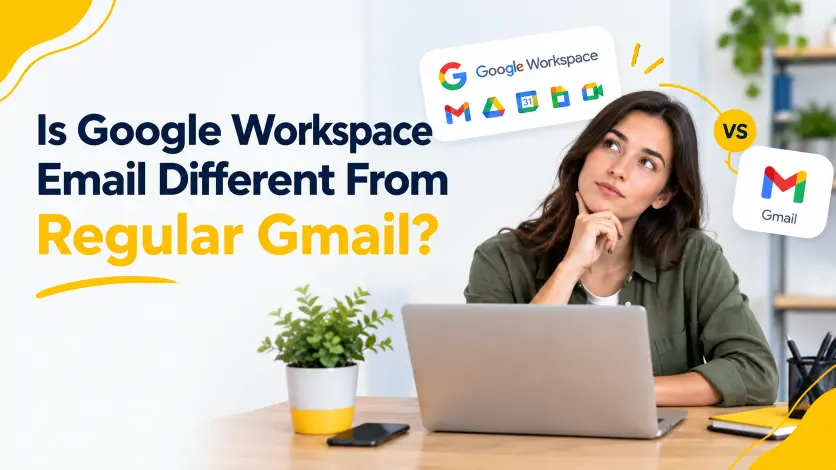
Free Gmail and Google Workspace run on the same Gmail interface, so the difference is easy to miss at first glance.
The gap shows up in three places: your email address, who controls the account, and how much storage you get.
- A custom domain address instead of a generic @gmail.com one
- An admin console that lets one person manage every account, password, and permission
- Pooled storage that starts at 30GB per user and scales into terabytes on higher plans
- Security tools built for teams, including two-step verification and phishing protection that you cannot configure on a personal account
Each of those differences solves a specific business problem. The next four sections cover them one at a time.
It Makes Your Business Look Credible From the First Email
A client forms an opinion about your business before you say a word to them.
Your email address often carries that first impression, and a generic @gmail.com address reads as unfinished.
A custom domain address, such as [email protected], tells the reader your business owns a domain and stands behind it.
That single detail builds trust before the reader opens the email. Consistency compounds that impression across your whole team.
Every staff member sending mail from the same domain presents one unified brand.
A mix of Gmail, Yahoo, and Outlook addresses instead makes a small company look scattered.
It Puts You, Not an Ex-Employee, in Control of Company Data
Personal Gmail accounts belong to the person who created them, not to your business. When that employee leaves, their emails, contacts, and files often leave with them.
A Google Workspace account flips that ownership entirely.
Every mailbox, document, and calendar belongs to your organization, and an administrator can reassign or remove access the moment someone departs.
The admin console also lets you enforce basic security standards across every account at once.
You can require two-step verification, set password rules, and revoke access from a single dashboard instead of chasing down individual settings.
It Blocks the Threats a Personal Gmail Account Was Never Built to Stop
Free Gmail includes solid spam filtering, but Google built it for one person checking one inbox.
A business faces a different threat pattern, since staff across departments become targets for phishing attempts aimed at your company specifically.
Google Workspace layers enterprise-grade protection on top of standard Gmail filtering.
That includes advanced phishing and malware detection tuned for business email traffic, plus administrator alerts when something looks wrong.
Uptime carries just as much weight as security once your team depends on email daily.
Google backs Workspace with a 99.9% uptime guarantee, so a dropped connection does not mean a dropped sale.
It Keeps You Reachable and Working Even When Something Breaks
A free email account gives you no service guarantee, so an outage is your problem to wait out.
A business cannot afford that kind of silence during a busy sales period or a client deadline.
Google Workspace also gives you a genuine support line instead of a help forum.
Paid plans include phone, chat, and email support around the clock, so a broken setting does not sit unresolved for days.
That same support extends to migration. Moving years of old mail from a personal account is one of the biggest reasons businesses delay switching.
A built-in migration tool removes most of that friction.
It Gives Your Team Room to Collaborate Properly
Emailing a document back and forth invites version confusion the moment two people edit it. Google Docs, Sheets, and Slides solve that problem directly.
A team can edit the same file at the same time, and every change saves automatically.
That collaboration lives inside the same account as your email and calendar, so nobody juggles a separate login for a separate tool.
Meetings, files, and messages all sit in one connected system.
Storage also stops being a daily worry once you switch. Free Gmail caps you at 15GB shared across Gmail, Drive, and Photos combined.
Even the entry Workspace plan starts at 30GB pooled per user, and climbs sharply from there.
Google Workspace vs Just Adding a Custom Domain to Free Gmail
Some business owners look for a shortcut first. They buy a domain and set up free email forwarding, so mail sent to [email protected] lands in a personal Gmail inbox.
That trick fixes the address on the surface, but it changes nothing underneath. You still cannot send mail natively from that address in most setups.
You still have no admin console. And you still lose everything if the underlying account gets suspended or the employee who owns it leaves.
Forwarding works as a patch, never as a fix. It solves how your address looks. It does not solve who owns it.
It does not solve how secure it is, or what happens once your business scales past one inbox.
Signs Your Business Has Already Outgrown Free Email
Some businesses wait for a clear signal before switching, and several signals tend to show up together. Check the list below against your own inbox.
- Multiple staff share one Gmail login for a support or sales inbox
- Google keeps warning that your storage is nearly full
- You have no way to remove a former employee’s access to shared files
- A client or investor has asked why your email is not on your own domain
- Your team emails spreadsheets back and forth instead of editing one shared copy
Two or more of those signs point to a business that has outgrown free email. Nobody may have said so out loud yet, but the pattern is already there.
Do You Need Google Workspace If You Are a Solo Founder
Team size is not the only reason to switch.
A solo founder emailing clients, investors, or suppliers still benefits from the credibility a custom domain brings to every message sent.
Storage counts just as much for one person as for ten. A freelancer storing years of client contracts and design files fills 15GB fast.
Large attachments pile up faster than most people expect.
A solo operator also plans for growth, even without a team yet. Starting on Google Workspace from day one pays off later.
Adding a second mailbox takes minutes, instead of migrating an entire business off free Gmail mid-project.
What It Costs to Fix This
Google Workspace starts at $8.50 per user per month for Business Starter through Truehost, billed monthly with no annual lock-in required.
Higher tiers add storage, meeting capacity, and advanced security for teams that need more.
Every plan includes free setup, so you are not left configuring DNS records or migration tools alone.
Weigh that monthly cost against the risk this guide has covered. It is smaller than the cost of one lost client, one missed order, or one departed employee’s unrecovered files.
How Long Does Switching to Google Workspace Take
Most small businesses complete the switch in under a day, not the weeks some owners fear. The steps follow a simple order.
- Choose a plan based on your team size and storage needs
- Verify or point your domain to Google using a DNS record
- Create mailboxes for each staff member
- Migrate old mail, contacts, and calendar entries using the built-in tool
- Send a test message to confirm everything routes correctly
The domain verification step is usually the slowest part, and even that typically finishes within a few hours.
Nothing about the process requires technical expertise on your side when a provider handles setup for you.
A provider such as Truehost completes the domain and DNS steps for you as part of setup. Your own task list shrinks to approving the change and handing over old login details.
Move Your Business Off Personal Gmail Today
Every day your team runs on personal Gmail is another day your business data sits outside your control.
It is also another day, and a client sees a generic address and quietly notices.
Compare the plans on the Truehost Google Workspace page and pick the tier that matches your team size today.
Setup is free, so your business can be running on a professional inbox within the day.