 Domain RegistrationFind and register the perfect domain for your website.
 .COM DomainChoose a widely recognized domain to build global credibility.
 Domain TransferSeamless domain transfers with zero downtime and complete control.
 All TLDsFind and register your perfect domain. Choose from local and global extensions.
 SSL CertificatesKeep your website safe with reliable SSL Certificates that protect customer data and build trust.
 whoisCheck domain ownership details, expiration dates, and registrar information.
 US DomainRegister a .US domain and build trust in the USA.
 Web HostingEverything your website needs to run smoothly
 WordPress HostingWordPress hosting that just works
 Windows HostingReliable hosting for Windows environments
 Reseller HostingTurn hosting into your business
 Email HostingEmail that looks professional and works anywhere
 cPanel HostingFull control of your hosting with cPanel
 Affiliate ProgramJoin as a partner and earn commissions on every referral you send our way.
 Vps HostingScalable virtual servers that expand as you need.
 Dedicated ServersGet complete access and full control over your dedicated physical server.
 Managed vpsNot tech-savvy? We will take care of everything with our fully managed VPS hosting for you.
 AI Website BuilderCreate stunning websites in seconds with AI.
 Online ShopSet up a professional online store. No coding required.
 Web design serviceGet a tailored website designed to match your brand and support your goals.
 BlogFind helpful guides on web hosting, online selling, digital marketing, and more.
 Contact USYou can reach us anytime, day or night, through chat or email.
 SupportBrowse helpful guides and answers for all of our services.
Wikipedia.org, WordPress.org, NTP.org, nginx.org, and Mozilla.org are the five highest-ranked public .org websites in this list.
I built the ranking from Tranco list N2Q8W, dated August 28, 2026, and checked the selected sites on August 29.
A raw popularity list contains domains that serve ads, resolve network requests, distribute files, or support other websites without presenting a useful homepage to a person.
I removed those machine-facing entries before selecting the first 70 distinct websites.
A popular domain is not automatically a public website
Tranco combines ranking signals from browser use, DNS activity, and links.
That breadth makes it useful for comparing domains, but it also surfaces infrastructure alongside familiar websites.
For this article, a domain had to meet four conditions:
end in
.org;appear in the dated Tranco list;
provide a current, human-facing website; and
remain a distinct
.orgdestination after redirects.
The filter removed ad systems, CDN and registry endpoints, pure DNS utilities, duplicate redirects, and adult sites.
For example, ampproject.org now redirects to amp.dev, so it does not belong in a current list of websites using .org.
Tranco rank is not a visitor count, trust score, or measure of social impact.
It gives us a reproducible order based on several popularity signals over 30 days.
Directory of 70 popular .ORG sites
Rank | Website | What you will find |
|---|---|---|
1 | Community encyclopedia | |
2 | Open-source publishing platform | |
3 | Network time resources | |
4 | Web server project | |
5 | Firefox and open-web programs | |
6 | Open-source project foundation | |
7 | Digital collections and web history | |
8 | Web standards | |
9 | Open-content licenses | |
10 | Messaging apps | |
11 | Free-knowledge project portal | |
12 | Linux distribution | |
13 | Free software and licenses | |
14 | United Nations programs | |
15 | Cookie and service reference | |
16 | Internet engineering standards | |
17 | Research preprints | |
18 | News, radio, and podcasts | |
19 | Engineering membership and standards | |
20 | Education, science, and culture | |
21 | Academic publishing and assessment | |
22 | International standards | |
23 | Collaborative map data | |
24 | Python downloads and documentation | |
25 | Privacy and security education | |
26 | Management ideas and research | |
27 | Health information and care | |
28 | Research journals | |
29 | Development data and projects | |
30 | Advertising-industry standards | |
31 | Petitions and campaigns | |
32 | Global policy discussion | |
33 | Fanworks archive | |
34 | Search engine | |
35 | Public television and learning | |
36 | Local classified listings | |
37 | Ad-blocking software | |
38 | Economic data and policy | |
39 | Internet threat intelligence | |
40 | Psychology research and profession | |
41 | Competitive gaming coverage | |
42 | Free TLS certificates | |
43 | Online courses and credentials | |
44 | Religious publications | |
45 | Free online chess | |
46 | Open-science journals | |
47 | Linux kernel releases | |
48 | Database software | |
49 | Scholarly library | |
50 | Hosted game servers | |
51 | Collaborative dictionary | |
52 | Currency and market data | |
53 | Business and complaint profiles | |
54 | Internet identifier coordination | |
55 | Fedora Linux community | |
56 | Digital-rights advocacy | |
57 | Community fiction publishing | |
58 | Computing profession and research | |
59 | Food and agriculture programs | |
60 | Chemistry research and profession | |
61 | Open learning community | |
62 | Public-opinion research | |
63 | Community movie and TV database | |
64 | Health information and care | |
65 | Researcher identifiers | |
66 | Public-interest technology research | |
67 | Science journals and news | |
68 | Multidisciplinary research journal | |
69 | Open-source operating system | |
70 | JavaScript runtime project |
Ranks 1-10: platforms that shaped the web
1) Wikipedia.org
Wikipedia turns volunteer contributions into a multilingual reference work. The domain now functions as shorthand for freely accessible knowledge.
2) WordPress.org
WordPress is the community home of the downloadable CMS, plugin directory, theme directory, documentation, and contributor programs.
3) NTP.org
NTP publishes Network Time Protocol software and technical material for keeping computers and network devices on a common clock.
4) nginx.org
[nginx](https://nginx.org/) provides releases, documentation, and security notices for the open-source web server used throughout modern web infrastructure.
5) Mozilla.org
Mozilla brings Firefox downloads together with policy, advocacy, and programs intended to keep the internet open and accessible.
6) Apache.org
The Apache Foundation gives hundreds of open-source projects a shared governance, licensing, and community home.
7) Archive.org
The Internet Archive preserves digital media and past versions of websites through collections that include the Wayback Machine.
8) W3.org
W3C coordinates the specifications and guidance that help browsers, websites, and assistive technologies work together.
9) CreativeCommons.org
Creative Commons supplies standardized licenses that let creators define how other people may share and reuse their work.
10) Telegram.org
Telegram distributes its messaging applications from a .org address, showing that the extension remains open to commercial services.
Ranks 11-20: communities, protocols, and global work
11) Wikimedia.org
Wikimedia routes visitors to Wikipedia, Wikidata, Wiktionary, Commons, and the foundation’s other free-knowledge projects.
12) Debian.org
Debian supports its Linux distribution with downloads, package records, manuals, security information, and contributor resources.
13) GNU.org
GNU connects free software, the GNU operating system, public campaigns, and licenses such as the GPL.
14) UN.org
The United Nations uses a two-letter name to publish global work on peace, development, humanitarian response, and human rights.
15) CookieDatabase.org
Cookie Database catalogs cookies, scripts, and online services so website owners and visitors can understand tracking behavior.
16) IETF.org
The IETF organizes the working groups and open standards process behind many core internet protocols.
17) arXiv.org
arXiv lets researchers circulate papers in physics, mathematics, computing, and related fields before or alongside formal journal publication.
18) NPR.org
NPR combines national and local reporting with radio programs, music coverage, and podcasts.
19) IEEE.org
IEEE serves engineers through membership, conferences, publications, education, and technical standards.
20) UNESCO.org
UNESCO publishes programs and resources covering education, science, culture, communication, and heritage.
Ranks 21-30: knowledge, health, and policy resources
21) Cambridge.org
Cambridge presents books, journals, educational materials, exams, and assessment services from Cambridge University Press & Assessment.
22) ISO.org
ISO explains international standards and the expert committees that develop them across industries and technologies.
23) OpenStreetMap.org
OpenStreetMap lets contributors build and maintain geographic data that other people can view, download, and reuse.
24) Python.org
Python provides language releases, documentation, tutorials, events, and entry points into the Python developer community.
25) AllAboutCookies.org
All About Cookies publishes consumer-facing explanations and reviews related to privacy, identity protection, and online security.
26) HBR.org
HBR carries management research, case-based thinking, commentary, and practical advice from Harvard Business Review.
27) MayoClinic.org
Mayo Clinic pairs medical reference content with information about appointments, departments, and clinical care.
28) FrontiersIn.org
Frontiers runs open-access journals and gives researchers routes to submit, review, and discover scholarly work.
29) WorldBank.org
The World Bank makes development projects, country reports, indicators, and research accessible through one global domain.
30) TheNAI.org
The NAI publishes advertising-industry principles, policy positions, member information, and consumer choice tools.
Ranks 31-40: campaigns, media, and trust systems
31) Change.org
Change.org hosts petitions and organizing tools for individuals and campaigns, despite operating as a commercial company.
32) WEForum.org
The World Economic Forum publishes research, event discussions, and initiatives focused on economic and policy questions.
33) ArchiveOfOurOwn.org
AO3 gives fans a nonprofit, volunteer-supported archive for fiction and other transformative works.
34) Ecosia.org
Ecosia runs a search engine with an environmental business proposition, blending commercial operations with public-purpose branding.
35) PBS.org
PBS organizes video, programs, schedules, and educational resources from the public television network.
36) Craigslist.org
Craigslist has used .org for decades while operating local classified marketplaces for housing, jobs, goods, and services.
37) AdblockPlus.org
Adblock Plus provides browser extensions, help content, and project information for its ad-filtering software.
38) OECD.org
The OECD shares cross-country statistics, policy recommendations, reports, and economic analysis.
39) Spamhaus.org
Spamhaus publishes research and threat-intelligence services used to identify spam and malicious internet activity.
40) APA.org
The APA represents psychology through research, public education, professional resources, publishing, and standards.
Ranks 41-50: specialist audiences and open tools
41) HLTV.org
HLTV serves the competitive Counter-Strike audience with matches, player statistics, rankings, results, and reporting.
42) LetsEncrypt.org
Let’s Encrypt issues free automated TLS certificates, lowering the cost and friction of adopting HTTPS.
43) Coursera.org
Coursera sells courses, certificates, and degree programs from universities and companies through a commercial learning platform.
44) JW.org
JW.org publishes the official teachings, news, media, and organizational information of Jehovah’s Witnesses in many languages.
45) Lichess.org
Lichess offers free chess games, tournaments, puzzles, studies, and analysis through an open-source platform.
46) PLOS.org
PLOS operates open-access journals and promotes research practices that make scientific work easier to share and examine.
47) Kernel.org
Kernel.org gives developers an authoritative location for Linux kernel releases, repositories, and project information.
48) PostgreSQL.org
PostgreSQL supports the database project with downloads, manuals, release notes, events, and community information.
49) JSTOR.org
JSTOR provides searchable access to journals, books, images, and primary sources for research and education.
50) Aternos.org
Aternos lets players create and manage hosted game servers, with Minecraft as its best-known use case.
Ranks 51-60: governance, rights, and professional bodies
51) Wiktionary.org
Wiktionary applies Wikimedia’s collaborative model to definitions, translations, pronunciations, and word origins.
52) TGJU.org
TGJU tracks Iranian and international currencies, gold, metals, market indexes, and other financial data.
53) BBB.org
The BBB publishes business profiles, ratings, consumer reviews, and complaint information across its regional network.
54) IANA.org
IANA coordinates DNS root-zone information, IP address pools, and protocol parameter registries.
55) FedoraProject.org
Fedora presents downloads, editions, documentation, and participation routes for the Fedora Linux community.
56) EFF.org
The EFF combines litigation, policy work, technical tools, and public campaigns around digital civil liberties.
57) Syosetu.org
Syosetu runs a Japanese web-fiction community where members publish, discover, and discuss serialized stories.
58) ACM.org
The ACM supports computing research and practice through conferences, publications, professional groups, and education.
59) FAO.org
The FAO publishes global programs, data, and guidance related to food systems, agriculture, and hunger.
60) ACS.org
The ACS serves chemistry through journals, education, careers, meetings, standards, and professional membership.
Ranks 61-70: learning, science, and research infrastructure
61) Moodle.org
Moodle is the community hub for the open-source learning platform, including support forums, downloads, plugins, and contributor activity.
62) PewResearch.org
Pew Research publishes nonpartisan polling, demographic analysis, international surveys, datasets, and research methods.
63) TheMovieDB.org
TMDB maintains a community-built database of movies, television programs, people, images, and release information.
64) ClevelandClinic.org
Cleveland Clinic offers health reference content alongside information about care, specialists, locations, and appointments.
65) ORCID.org
ORCID gives researchers persistent identifiers that connect their names with publications, affiliations, funding, and other work.
66) MITRE.org
MITRE conducts public-interest research and operates federally funded research and development centers in the United States.
67) Science.org
Science is the digital home for AAAS journals, scientific news, commentary, and research careers.
68) PNAS.org
PNAS publishes peer-reviewed research across biological, physical, and social sciences through the National Academy of Sciences.
69) FreeBSD.org
FreeBSD supplies releases, documentation, security advisories, and community resources for the open-source operating system.
70) NodeJS.org
Node.js distributes the open-source JavaScript runtime and provides documentation, release information, learning material, and contribution routes.
What .ORG signals, and what it cannot prove
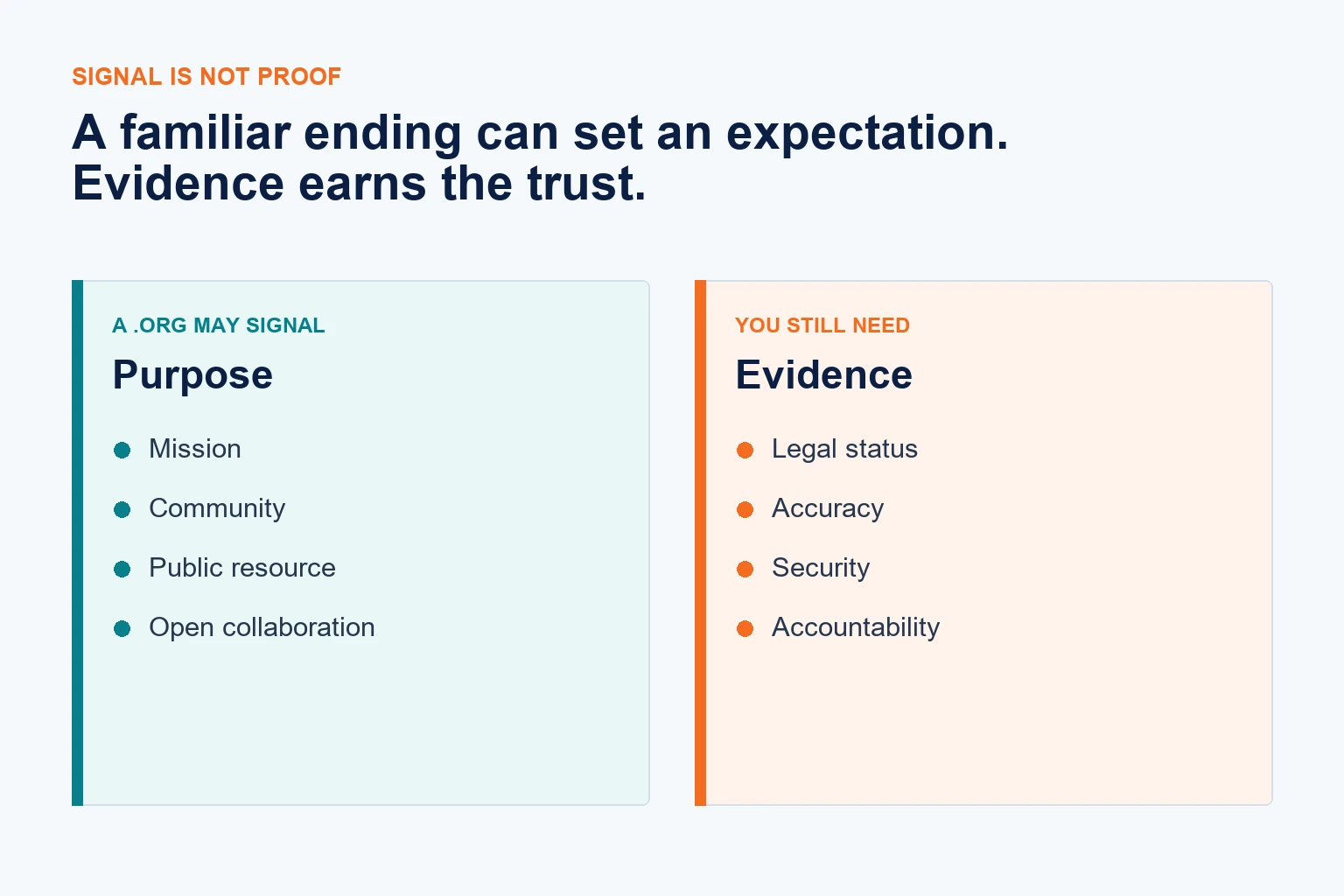
The examples explain why people associate .org with service, learning, standards, and communities. They also show why the extension cannot function as a trust certificate.
Public Interest Registry confirms that .org is open to anyone. Registration does not require nonprofit status, an educational charter, or evidence of public benefit.
A .org address may signal:
a mission larger than a product sale;
an organization or member community;
an open-source or shared-knowledge project; or
a public resource, standard, or institution.
It cannot prove:
nonprofit or tax-exempt status;
factual accuracy or editorial independence;
secure technology or responsible data handling; or
honest leadership and financial practices.
Four patterns across the 70 sites
Open technology belongs near the top
WordPress, NTP, nginx, Mozilla, Apache, Debian, GNU, Python, PostgreSQL, FreeBSD, and Node.js show how strongly open technical communities use .org. Their sites need contributors, documentation, and public governance as much as downloads.
Commercial activity does not disqualify a domain
Telegram, HBR, Change.org, Ecosia, Craigslist, Coursera, Aternos, and other commercial services appear in the ranking. They can use .org because the registry does not restrict eligibility.
Short names compound recognition
Domains such as un.org, w3.org, iso.org, eff.org, and acs.org pair familiar initials with a familiar extension. The result is easy to say, print, and remember.
Reputation comes from the operator
Mayo Clinic, the World Bank, Pew Research Center, and the scientific publishers earn attention through their institutions, methods, and content. The extension supports their positioning; it does not create their authority.
Does .ORG fit your name?
Start with the expectation your visitor should have before opening the site.
Choose .org when your clearest identity is a cause, association, research effort, open project, professional body, religious organization, public resource, or member community. A commercial company can still use it, but the homepage should resolve any mismatch immediately.
Before registration, check three things:
Meaning: Does
.orgmake your purpose clearer rather than more confusing?Memory: Can someone repeat and spell the complete domain after hearing it once?
Proof: Does the website show the people, policies, contact information, and evidence needed to earn trust?
Our ORG guide covers the extension’s rules and registration details. Use our extension guide when you are still comparing .org with other endings.
When you have a shortlist, use our domain search to check each name.
You can register the available .org with us, connect it to hosting, and use our site builder to publish the first version.