 Domain RegistrationFind and register the perfect domain for your website.
 .COM DomainChoose a widely recognized domain to build global credibility.
 Domain TransferSeamless domain transfers with zero downtime and complete control.
 All TLDsFind and register your perfect domain. Choose from local and global extensions.
 SSL CertificatesKeep your website safe with reliable SSL Certificates that protect customer data and build trust.
 whoisCheck domain ownership details, expiration dates, and registrar information.
 US DomainRegister a .US domain and build trust in the USA.
 Web HostingEverything your website needs to run smoothly
 WordPress HostingWordPress hosting that just works
 Windows HostingReliable hosting for Windows environments
 Reseller HostingTurn hosting into your business
 Email HostingEmail that looks professional and works anywhere
 cPanel HostingFull control of your hosting with cPanel
 Affiliate ProgramJoin as a partner and earn commissions on every referral you send our way.
 Vps HostingScalable virtual servers that expand as you need.
 Dedicated ServersGet complete access and full control over your dedicated physical server.
 Managed vpsNot tech-savvy? We will take care of everything with our fully managed VPS hosting for you.
 AI Website BuilderCreate stunning websites in seconds with AI.
 Online ShopSet up a professional online store. No coding required.
 Web design serviceGet a tailored website designed to match your brand and support your goals.
 BlogFind helpful guides on web hosting, online selling, digital marketing, and more.
 Contact USYou can reach us anytime, day or night, through chat or email.
 SupportBrowse helpful guides and answers for all of our services.
Choosing between Truehost vs HostGator web hosting looks simple at first.
Then you start reading the fine print, and it gets complicated fast.
Both are established web hosting providers serving website owners around the world.
Both offer shared hosting along with WordPress-focused plans built for beginners and small businesses.
But look past the homepage pricing and their plans, pricing structures, resource allocations, and support experiences start to differ in ways that genuinely count once you’re running a real site.
Here’s the thing worth keeping in mind before you commit to either one.
The cheapest advertised price isn’t necessarily the cheapest option.
Renewals, add-ons, and what happens after your first billing term ends all factor in too.
In this comparison, we’ll look at pricing, hosting features, performance, WordPress support, security, customer support, ease of use, scalability, and overall value for money.
That way you can see exactly where each provider holds up and where it doesn’t.
The short answer, before we get into the details: neither provider is automatically better for every website.
The right choice depends on your budget, what your website actually needs, and how much support and flexibility you’re looking for as it grows.
Truehost vs HostGator Web Hosting Comparison
| Feature | Truehost | HostGator |
|---|---|---|
| Starting shared hosting price | From around $1-2/month on long-term billing | From $2.75/month (Hatchling, intro rate) |
| Renewal price | Modest increase, no bait-and-switch pricing model | Jumps significantly, e.g. Hatchling renews around $10.99/month |
| Storage | 10-50 GB SSD depending on plan | 10-100 GB SSD depending on plan |
| Bandwidth | Unlimited* | Unmetered* |
| Free domain | Yes | Yes (on 12+ month terms) |
| Free SSL | Yes | Yes |
| Yes | Yes | |
| Backups | Yes, daily backups included | Not included standard (CodeGuard backup add-on available) |
| cPanel | Yes | Yes |
| WordPress support | Yes | Yes |
| Website migration | Yes, free migration included | Free only on VPS/dedicated; shared hosting migration is a paid add-on |
| Money-back guarantee | Varies by plan | 30-day guarantee (excludes monthly billing) |
| Support | 24/7 | 24/7 |
| Best for | Budget-conscious beginners who want backups and migration included | Users who want a widely recognised US brand and don’t mind paying more at renewal |
Truehost markets its bandwidth as unlimited. There’s no hard data transfer cap under normal use. HostGator uses the term unmetered instead. It doesn’t measure or bill based on data transfer, but it still enforces a CPU usage cap, commonly cited around 25% per account, and can flag accounts using disproportionate server resources. The two terms sound interchangeable but aren’t quite identical in practice.
1) Truehost vs HostGator Pricing
Pricing is probably the biggest reason anyone searches this comparison in the first place.
It’s worth spending real time here rather than skimming the headline numbers.
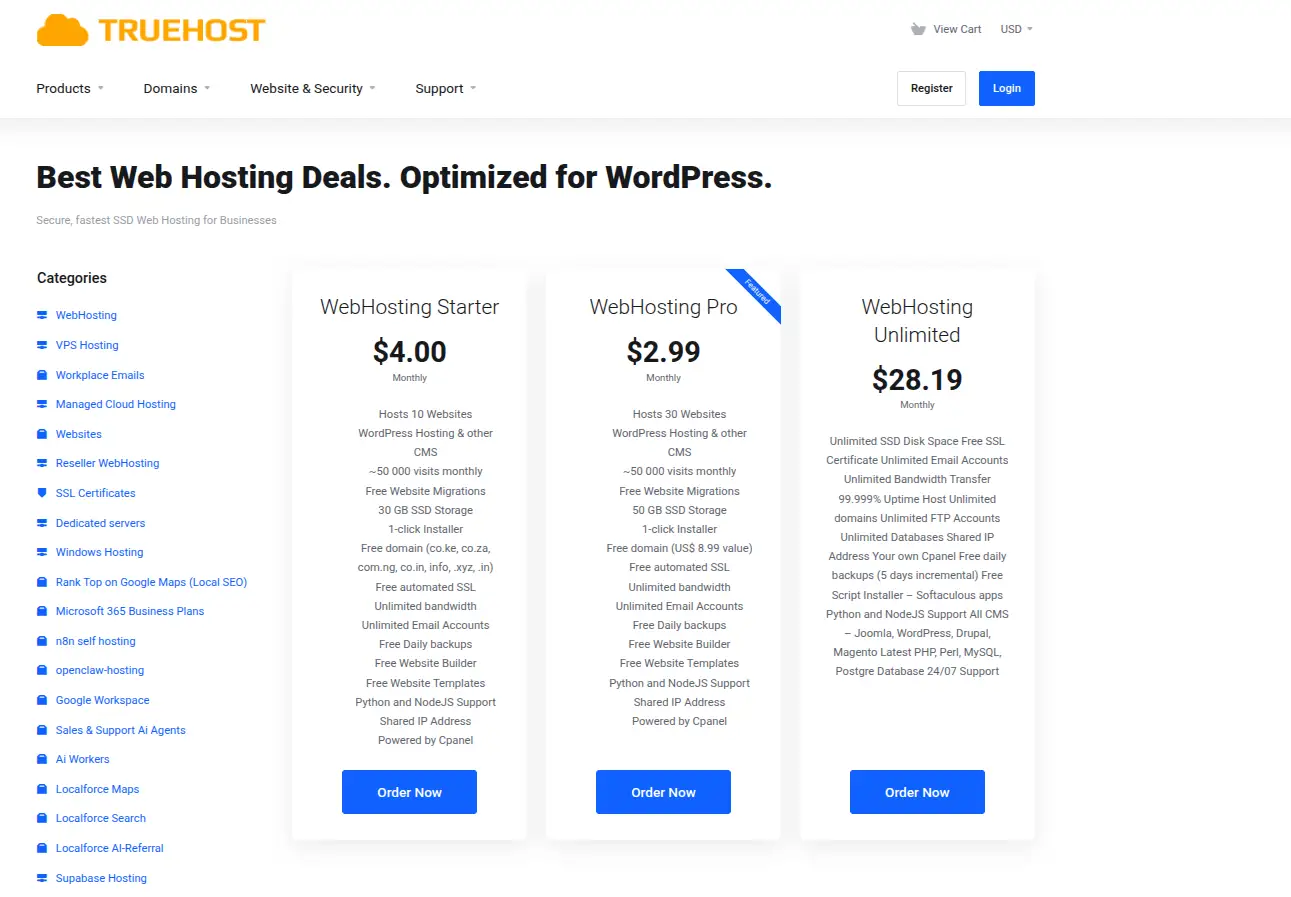
Truehost’s entry-level shared hosting starts remarkably low, commonly advertised from around $1 to $2 a month when billed on a longer term.
That entry tier typically includes free SSL, daily backups, and unlimited bandwidth from day one, rather than holding those back for higher tiers.
The mid-tier plan steps up storage and the number of hosted websites, generally landing in the $3 to $6 a month range depending on the billing period chosen.
The higher-tier business plan adds features like unlimited websites, dedicated IP options, and broader scripting support, usually in the $8 to $12 a month range.
Billing terms affect the rate substantially.
As with most hosts, longer commitments unlock the lowest monthly-equivalent price.
Truehost’s promotional pricing is presented fairly transparently as a long-term rate, rather than disguising it as a standalone monthly charge.
Still, it’s worth double-checking the exact billing term at checkout, since that low headline figure is almost always tied to paying upfront for a year or more.
Renewal pricing on Truehost tends to increase only modestly compared to the introductory rate, without the dramatic multi-year jump some competitors are known for.
HostGator’s three core shared hosting tiers are Hatchling, Baby, and Business. Hatchling currently advertises from around $2.75 a month.
Baby starts from around $3.95 a month. Business starts from around $5.95 a month.
These introductory numbers vary depending on the current promotion and the length of the term you select. The published regular renewal rates tell a very different story.
Hatchling typically renews around $10.99 a month. Baby renews around $16.49 a month. Business renews around $21.99 a month.
These are all figures based on the longest available billing term, with shorter terms renewing even higher.
Put plainly, that means a Hatchling plan signed up at $2.75 a month can renew at roughly four times that rate once the introductory period ends.
That’s a substantial jump worth budgeting for in advance, rather than discovering at renewal.
2) Storage
Both providers use SSD storage across their shared hosting lineups. That’s good news, since spinning disks are increasingly rare in this space.
Truehost’s storage scales from around 10 GB on entry plans up to 50 GB or more on higher tiers.
HostGator ranges from 10 GB on Hatchling up to 100 GB on its higher shared tiers.
Storage limits do vary meaningfully by plan on both sides.
So it’s worth actually estimating your site’s storage needs, images, plugins, email attachments, database size, rather than assuming any plan will comfortably fit everything.
Neither provider advertises truly unlimited storage on its entry-level plans.
And where storage is marketed as generous or unlimited on higher tiers, it typically still comes with an acceptable-use policy attached.
That means extreme usage affecting other customers on the same server can still trigger a review.
3) Bandwidth
This is one of the more misunderstood parts of any hosting comparison, so it’s worth being precise.
Truehost’s unlimited bandwidth wording means there’s no advertised data transfer ceiling for normal website traffic.
HostGator’s unmetered bandwidth wording means essentially the same thing in terms of billing, you won’t be charged extra for data transfer.
But HostGator does enforce a CPU usage cap around 25% per account on shared servers, and accounts that consistently exceed it can be asked to upgrade or face a suspension review.
In practice, both terms boil down to the same idea: no billing by the gigabyte, but a step-in if your account starts affecting other customers on the same server.
That’s an important distinction from CPU and RAM, which are separate, genuinely finite resources on any shared hosting plan regardless of how bandwidth is worded.
A site can have effectively unlimited bandwidth and still slow down or get flagged, simply because it’s straining CPU and memory rather than data transfer.
4) Number of Websites
Truehost’s entry-level Starter plan allows hosting multiple websites, commonly up to 10, straight out of the gate. That’s generous for an entry tier.
HostGator’s Hatchling plan, by contrast, limits you to a single website. You’d need to move up to the Baby plan to host multiple sites on one account.
If you’re planning to run more than one website from day one, this difference alone could tip the decision toward Truehost’s entry tier over HostGator’s cheapest option.
5) Email Hosting
Both providers include email hosting as part of their shared hosting plans.
They generally offer a workable number of email accounts even on entry tiers, along with webmail access through the included cPanel interface.
Mailbox size limits and total account counts scale up on higher-tier plans for both providers. Where things diverge is business email functionality specifically.
HostGator sells a separate Professional Email product with its own trial and recurring cost.
Truehost tends to fold more of that functionality into its existing hosting plans, without pushing a separate paid product for basic business email needs.
6) Control Panel
Both Truehost and HostGator use cPanel, which is genuinely one of the more useful points of comparison for beginners specifically.
cPanel’s layout is widely documented and broadly familiar if you’ve used any other cPanel-based host before.
It makes tasks like managing files, databases, email accounts, and SSL certificates approachable without needing command-line experience.
Neither provider holds a meaningful advantage here, since the underlying panel software is essentially identical.
The difference comes down more to how each host configures and supports it.
7) WordPress Installation

Both providers support one-click WordPress installation through Softaculous or an equivalent app installer bundled into cPanel.
Getting WordPress running takes only a few minutes on either platform.
Both also offer WordPress-specific hosting tiers beyond standard shared hosting, aimed at users who want a more tailored setup with WordPress-specific caching and optimisation.
Neither provider requires manual WordPress installation on their standard shared plans, which keeps this fairly even between the two.
8) Performance
Performance on shared hosting always comes down to server load and how many other accounts share the same resources.
Both hosts generally deliver acceptable performance for small to medium-sized websites under typical traffic levels.
Truehost’s infrastructure is built around SSD and NVMe storage on newer plans, which helps with database-heavy sites like WordPress installs.
HostGator similarly runs SSD storage across its shared tiers and layers in Cloudflare CDN access on some plans, which can help improve load times for visitors further from the server’s physical location.
Neither provider is going to outperform dedicated or VPS hosting under heavy, sustained traffic. But for typical small business or blog-level traffic, both hold up reasonably well.
9) SSL and Security
Free SSL certificates, generally via Let’s Encrypt, come standard on shared hosting plans from both providers.
That’s more or less the baseline expectation at this point. Beyond SSL, security features can differ in what’s bundled versus sold separately.
HostGator, for instance, offers SiteLock security as an optional paid add-on rather than including it by default, and domain privacy protection is also sold separately on domain renewals.
Truehost tends to bundle more baseline security and backup functionality directly into its standard plans, rather than presenting them as optional extras layered on top of the advertised price.
10) Backups
This is one of the more consequential differences between the two.
Truehost includes daily automated backups as a standard feature across its shared hosting plans.
That is genuinely important if something ever goes wrong with your site and you need to roll back quickly.
HostGator, by comparison, doesn’t include backups as standard on its shared plans.
Instead it offers CodeGuard backup service as a separate paid add-on, commonly priced around $32.95 a year.
If backups are critical to you, and they generally should, that’s a real cost difference to factor into any side-by-side price comparison between the two.
11) Customer Support
Both providers offer 24/7 support, which is table stakes for hosting at this point. But the channels and depth vary a little.
Truehost provides live chat, ticket support, and phone support around the clock, along with a self-service knowledge base for common issues.
HostGator similarly offers live chat and phone support 24/7, along with an extensive knowledge base built up over its many years in the hosting industry.
Where it’s worth paying attention is response quality and consistency, which tends to vary by provider and even by time of day.
Checking recent user reviews close to your signup date is generally more useful than relying on either company’s own marketing claims about support speed.
What to Consider Before Choosing Between Truehost and HostGator
Rather than declaring one provider the outright winner, it’s more useful to think about which one actually fits your specific situation.
Choose Truehost if its current plan gives you the resources you need at a better total cost once renewal pricing is factored in.
Truehost is also worth prioritising if you value having backups and website migration included rather than sold as separate add-ons.
The same goes if you want straightforward cPanel-based hosting without hunting through upsells.
Or if you expect to need flexible hosting options as your site grows without facing a steep renewal shock a year or two down the line.
Choose HostGator if its specific plan structure better matches what your website needs right now, particularly if a single-site Hatchling plan genuinely covers your use case.
HostGator is also a reasonable pick if you prefer its broader ecosystem and the familiarity of a long-established US hosting brand.
It’s worth considering too if the introductory pricing works out well for your budget over the term you’re committing to.
Or if you specifically value features bundled into HostGator’s current plans, like its CDN integration on higher tiers.
The overall verdict really comes down to price, resources, included features, support quality, and long-term value, rather than which brand is more widely recognised.
Truehost tends to edge ahead on included backups, free migration, and a gentler renewal curve. HostGator holds its own with brand familiarity and a broad support infrastructure.
But its renewal pricing and backup add-on costs are worth running the numbers on before you commit long-term.
If included backups, free migration, and predictable renewal pricing sound like what you’re after, Truehost’s shared hosting plans are worth a closer look.
Get started with Truehost web hosting and see whether its current plans line up with what your website actually needs.