 Domain RegistrationFind and register the perfect domain for your website.
 .COM DomainChoose a widely recognized domain to build global credibility.
 Domain TransferSeamless domain transfers with zero downtime and complete control.
 All TLDsFind and register your perfect domain. Choose from local and global extensions.
 SSL CertificatesKeep your website safe with reliable SSL Certificates that protect customer data and build trust.
 whoisCheck domain ownership details, expiration dates, and registrar information.
 US DomainRegister a .US domain and build trust in the USA.
 Web HostingEverything your website needs to run smoothly
 WordPress HostingWordPress hosting that just works
 Windows HostingReliable hosting for Windows environments
 Reseller HostingTurn hosting into your business
 Email HostingEmail that looks professional and works anywhere
 cPanel HostingFull control of your hosting with cPanel
 Affiliate ProgramJoin as a partner and earn commissions on every referral you send our way.
 Vps HostingScalable virtual servers that expand as you need.
 Dedicated ServersGet complete access and full control over your dedicated physical server.
 Managed vpsNot tech-savvy? We will take care of everything with our fully managed VPS hosting for you.
 AI Website BuilderCreate stunning websites in seconds with AI.
 Online ShopSet up a professional online store. No coding required.
 Web design serviceGet a tailored website designed to match your brand and support your goals.
 BlogFind helpful guides on web hosting, online selling, digital marketing, and more.
 Contact USYou can reach us anytime, day or night, through chat or email.
 SupportBrowse helpful guides and answers for all of our services.
You could be doing everything right and still losing customers.
Your products are solid. Your pricing makes sense. Your ads are bringing people in. But somewhere between clicking your link and reaching checkout, something goes wrong. The page takes too long to load. The site freezes. Or worse, it doesn’t open at all. And just like that, the customer is gone.
Most people don’t complain when this happens. They don’t send emails or leave feedback. They simply move on to the next store that works.
That’s the hidden cost of poor hosting.
A delay of just one second can quietly eat into your conversions and chip away at your revenue over time. Now imagine that happening across dozens or hundreds of visitors every day. It adds up faster than most store owners realize.
The tricky part is that many businesses never trace the problem back to their hosting provider. It often starts with a cheap plan that seems like a smart decision at the time. Then come the slow pages, random downtime, and frustrating checkout experiences that push customers away.
This is where the difference becomes clear. A reliable provider like Truehost is built for businesses that can’t afford those gaps. With consistent uptime, fast-loading servers, built-in security, and support that’s actually available when you need it, your store gets the kind of foundation that keeps customers moving instead of dropping off.
Choosing the right hosting isn’t just a technical decision. It directly affects how your store performs, how customers experience your brand, and how much revenue you keep.
This article walks you through what actually matters when selecting a hosting provider for your e-commerce site, so you can build on a setup that supports your growth instead of holding it back.
What Your Hosting Provider Is Really Costing You?
Web hosting is the service that stores your website files and delivers them to every visitor who types your URL. For a personal blog, a slow or unreliable host is an inconvenience. For an e-commerce store, it is a revenue leak.
Here is how your hosting choice directly affects your business:
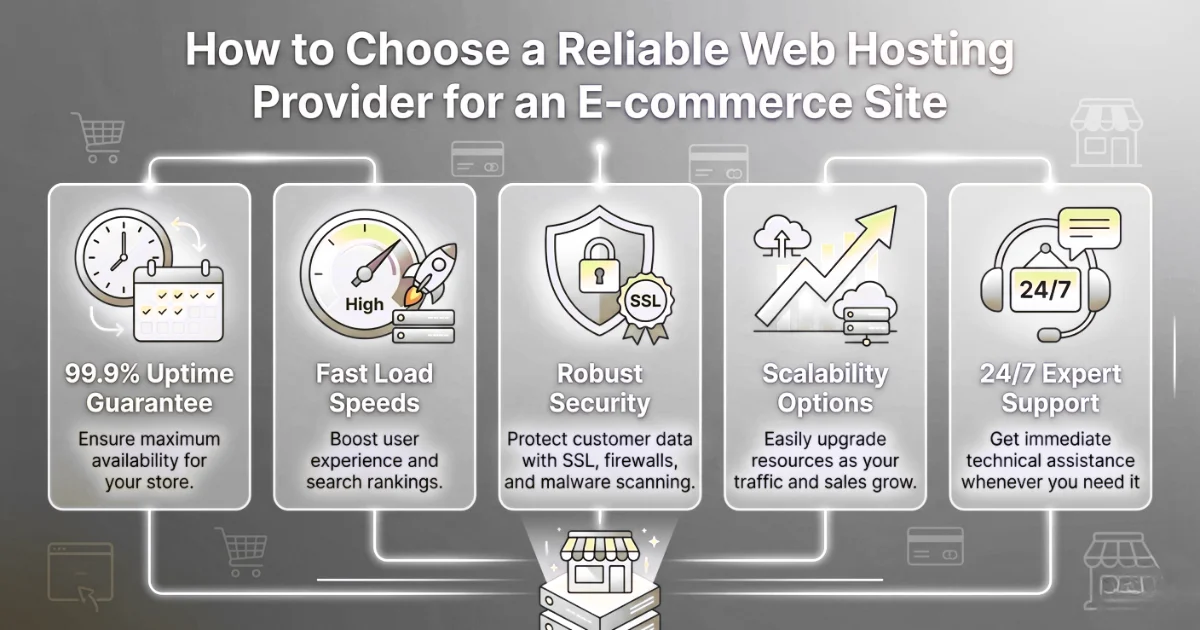
- Downtime versus high availability. Poor hosts run unreliable servers. When those servers fail, your store goes offline. Customers cannot browse, cannot add to cart, and cannot check out. The best e-commerce hosting guarantees 99.9 percent uptime or higher, ensuring your store stays open around the clock.
- Security risks. Online stores are high-value targets for hackers. Bad hosts leave your site on insecure servers without SSL certificates, automated backups, or malware scanning. A breach exposes your customers’ data and can permanently damage your brand.
- Slow load speeds and poor SEO. Google uses page speed and uptime as ranking signals. A slow, unreliable store gets pushed down in search results, no matter how good your content is. Good hosting is a silent but powerful SEO advantage.
- No support when things go wrong. A checkout page breaks on a Friday night. A plugin update crashes your site. If your host only offers support on weekdays or through a slow ticket system, you are on your own during the moments that cost the most.
Choosing the right hosting provider is not just a technical decision. It is a business decision with real financial consequences.
What to Look for in a Web Hosting Provider

1) Uptime Reliability
Uptime is the percentage of time your store stays online and accessible to visitors. It is the most important metric to evaluate before choosing any hosting provider.
Do not take a host’s word for it. Dig into independent reviews on platforms like Trustpilot and G2. Look for patterns in real customer feedback. A host that claims 99.9 percent uptime but has dozens of complaints about frequent outages is not a host worth trusting.
As a firm rule, never settle for a provider that cannot guarantee at least 99 percent uptime. Anything below that translates to more than three and a half days of downtime per year.
Truehost backs every hosting plan with a 99.9 percent uptime guarantee. The infrastructure runs on redundant systems, so if one server fails, another picks up immediately without your customers noticing any disruption.
2) Storage Space and Resource Limits
Every website needs storage space to house its files, images, databases, and product listings. A small store with twenty products needs far less storage than one with ten thousand SKUs and high-resolution images.
Choose a host that offers a storage tier matching your current size while making it easy to expand as you grow. Some hosts advertise unlimited storage but bury restrictions in their terms of service. Read those terms carefully before committing.
Beyond storage, check whether the host limits CPU usage or database queries. These caps can slow your store significantly during traffic spikes even if your storage is nowhere near full.
3) Traffic and Bandwidth Limits
Some hosts charge extra once your monthly traffic crosses a set threshold. This is a problem for any store running promotions, seasonal sales, or paid ad campaigns that drive sudden spikes in visitors.
Always choose a hosting plan that offers either unlimited bandwidth or a cap that comfortably exceeds your expected traffic. A host that penalizes growth is a host that will cost you more as your store succeeds.
4) Page Load Speed
Speed is not just a user experience issue. It is a conversion issue and an SEO issue. Your store should load within one to two seconds on both desktop and mobile. Anything beyond three seconds and you are losing shoppers before they even see your products.
Here is what to look for in a fast hosting setup:
- SSD storage instead of HDD for faster data access
- LiteSpeed or Nginx web servers, which handle e-commerce traffic more efficiently than Apache
- Built-in CDN (Content Delivery Network) to serve your store from servers closest to each shopper
- HTTP/2 or HTTP/3 protocol support for quicker parallel asset loading
- PHP 8.x compatibility for modern platforms like WooCommerce, Magento, and PrestaShop
A practical way to test a host’s real-world speed is to visit the websites of their existing customers. Many hosting companies list case studies or client portfolios on their website. Browse a few of those stores and note how fast the pages load.
Our web hosting plans run on LiteSpeed-powered servers with SSD storage included across every tier, keeping stores fast without requiring additional performance plugins.
5) Security Features
Security is non-negotiable for any store that handles customer data. This includes names, email addresses, shipping details, and payment information. One breach can wipe out the trust you spent years building.
Every reliable e-commerce host should offer:
- Free SSL Certificate — encrypts all data transmitted between your store and your customers’ browsers. Explore our SSL certificate options to see what is included at each plan level.
- PCI DSS compliance support — mandatory for any store processing card payments online. The PCI Security Standards Council publishes the full requirements for online merchants.
- DDoS protection — defends against coordinated traffic attacks designed to take your store offline
- Web Application Firewall (WAF) — blocks malicious requests before they ever reach your files
- Malware scanning and automated removal — catches and cleans infections before they spread
- Automated daily backups — lets you roll your store back to a clean state if something goes wrong
- Two-factor authentication — protects your hosting control panel from unauthorized access
Security is built into every Truehost plan by default. Store owners do not need to purchase add-ons or configure third-party plugins to stay protected.
6) Scalability
A hosting plan that works perfectly for your store today may not be enough in six months. As your product catalog grows, your traffic increases, and your ad spend scales, your hosting needs to keep pace.
Look for a provider that makes upgrading straightforward. Moving from a shared plan to a VPS hosting solution should not require a full site migration, extended downtime, or a conversation with three different support agents.
The right host gives you a clear, affordable upgrade path and lets you scale resources without disrupting your live store.
7) Customer Support Quality
Technical problems do not respect business hours. When your checkout page breaks on a Saturday evening or your store goes down the night before a sale, you need a support team that is available and capable.
Here is what separates good hosting support from bad:
- 24/7 availability across live chat, phone, and ticketing
- Agents with real technical knowledge, not just script readers
- Response times under five minutes for live chat during active issues
- E-commerce platform expertise — the ability to troubleshoot WooCommerce, and OpenCart specifically, not just server-level issues
Before signing up with any host, test their support by sending a specific technical question through live chat. How fast they respond and how precisely they answer tells you everything you need to know about how they will treat you as a paying customer.
8) Pricing Transparency
Many hosting companies use low introductory prices to attract sign-ups, then double or triple the rate at renewal. Others advertise free SSL and backups but charge for them as add-ons once you are locked in.
Work through this checklist for every host you consider:
- What exactly is included in the base plan price?
- What does the plan cost at renewal after the introductory period?
- Are there fees for domain registration, migrations, or extra email accounts?
- Is there a money-back guarantee if the service does not meet your expectations?
Truehost pricing is straightforward. Every plan includes real features from day one, and the renewal price is the same as the price you see before signing up.
9) Ease of Use
Running an online store already demands your attention. Your hosting control panel should simplify your workflow, not add to your mental load.
Look for:
- A clean cPanel or custom dashboard with an intuitive layout
- One-click installers for WooCommerce, and OpenCart
- Simple SSL certificate activation with no manual steps
- DNS management from a single screen
- A built-in file manager that removes the need for FTP clients
10) E-commerce Platform Compatibility
Your hosting environment must align with the technical requirements of the platform running your store. A server that is not configured for WooCommerce will underperform even if the hardware specs look impressive.
Things to Avoid When Choosing a Hosting Provider
Knowing what not to do is just as useful as knowing what to look for.
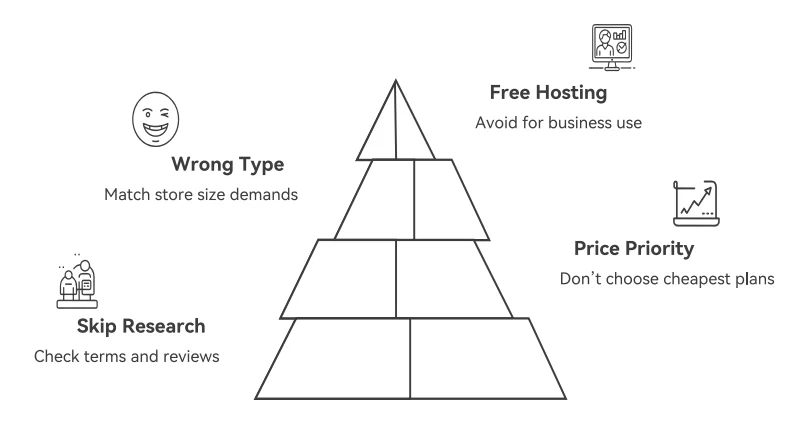
- Free hosting services. Free plans come loaded with limitations, hidden clauses, forced ads, and unreliable uptime. They also lock you into a subdomain like yourstore.getfreehosting.com, which looks unprofessional and is hard for customers to remember. Never use free hosting for a business.
- Choosing the wrong hosting type. Shared hosting is economical and works well for new stores with modest traffic. But if you run a growing store with thousands of products and high visitor counts, shared hosting will hold you back. Match the hosting type to the actual size and demands of your store.
- Prioritizing price above everything else. The cheapest plan is almost never the best value. Paying slightly more for reliable uptime, fast servers, and strong security is an investment that pays off every time a customer completes a purchase without friction.
- Skipping the research. Introductory deals can be misleading. Read the terms and conditions, check for renewal pricing, and go through independent reviews before committing. A plan that looks perfect at sign-up should still look good in month thirteen.
FAQs
What are the consequences of choosing the wrong e-commerce hosting platform?
Picking the wrong host is more costly than most store owners realize. Here is what happens when the hosting does not hold up.
- Your store goes offline frequently. Poor hosts run on unreliable servers with no redundancy. Even minor server issues send your store offline, sometimes for hours. Every minute of downtime is revenue walking out the door and customers heading to a competitor.
- Your pages load too slowly. Slow hosting means slow stores. If your product pages take more than three seconds to appear, most shoppers leave before they even browse. That slow load time is a direct result of underpowered servers, no CDN, and outdated infrastructure.
- Your brand reputation suffers. Customers talk. Repeated downtime and sluggish performance show up in reviews, social media comments, and word-of-mouth. Once trust is damaged, rebuilding it takes far longer than fixing the original hosting problem.
- Your customer data becomes vulnerable. Bad hosts skip the security features that matter. Without SSL, automated backups, firewalls, and malware scanning, your store is exposed. A single breach can lead to stolen payment details, regulatory penalties, and the kind of press coverage no brand recovers from quickly.
- Support is non-existent when you need it most. Budget hosts often provide support only a few days a week, if at all. When your checkout breaks during a bank holiday, you have no one to call and no live chat to turn to.
- Your search rankings drop. Google uses speed and uptime as ranking factors. A store that loads slowly and goes offline regularly loses ground in search results regardless of content quality or backlink profile. Bad hosting is one of the most overlooked causes of poor organic traffic.
What features should the right hosting platform offer?
The right hosting platform for an e-commerce store should check every one of these boxes.
Uptime of at least 99.9 percent. This is the baseline. Never sign up with a host that cannot back this up with a written guarantee. Anything lower means your store could be unavailable for more than eight hours in a single year.
Flexible storage and resource tiers. The platform should offer multiple pricing tiers with clearly defined storage and resource limits. There should also be an option to upgrade seamlessly or request a custom configuration as your store grows.
No traffic caps. Your store should be able to welcome any number of visitors without hitting a wall. Hosting plans that limit monthly traffic throttle your growth and add unexpected costs during your busiest periods.
Serious, built-in security. SSL certificates, automated incremental backups, regular server patching, malware scanning, and pre-configured firewalls should all come standard, not as optional extras.
Multi-channel, 24/7 customer support. Support should be available through live chat, email, and phone at any hour of the day. The team should be technically trained, not just reading from scripts, and response times should be fast.
Room to scale without disruption. As your customer base grows, your hosting should grow with it. Upgrading from one plan to the next should be seamless, with no downtime and no forced site migration.
Ready to Stop Losing Sales to Bad Hosting?
Every day on the wrong hosting plan is a day of slower load times, unnecessary risk, and revenue you will never recover. The decision does not have to be complicated. It just has to be deliberate.
Truehost is built specifically for online stores that cannot afford to go down. Fast servers, real security, transparent pricing, and a support team that picks up when it counts.
Make the switch and give your store the foundation it deserves.