 Domain RegistrationFind and register the perfect domain for your website.
 .COM DomainChoose a widely recognized domain to build global credibility.
 Domain TransferSeamless domain transfers with zero downtime and complete control.
 All TLDsFind and register your perfect domain. Choose from local and global extensions.
 SSL CertificatesKeep your website safe with reliable SSL Certificates that protect customer data and build trust.
 whoisCheck domain ownership details, expiration dates, and registrar information.
 US DomainRegister a .US domain and build trust in the USA.
 Web HostingEverything your website needs to run smoothly
 WordPress HostingWordPress hosting that just works
 Windows HostingReliable hosting for Windows environments
 Reseller HostingTurn hosting into your business
 Email HostingEmail that looks professional and works anywhere
 cPanel HostingFull control of your hosting with cPanel
 Affiliate ProgramJoin as a partner and earn commissions on every referral you send our way.
 Vps HostingScalable virtual servers that expand as you need.
 Dedicated ServersGet complete access and full control over your dedicated physical server.
 Managed vpsNot tech-savvy? We will take care of everything with our fully managed VPS hosting for you.
 AI Website BuilderCreate stunning websites in seconds with AI.
 Online ShopSet up a professional online store. No coding required.
 Web design serviceGet a tailored website designed to match your brand and support your goals.
 BlogFind helpful guides on web hosting, online selling, digital marketing, and more.
 Contact USYou can reach us anytime, day or night, through chat or email.
 SupportBrowse helpful guides and answers for all of our services.
OpenAI now owns Chat.com, and it’s redirecting to chatgpt.com.
The company acquired the domain from HubSpot cofounder Dharmesh Shah in 2023, although OpenAI did not reveal itself as the buyer until November 2024.
Today, entering Chat.com sends you directly to ChatGPT.
The widely reported $15.5 million figure needs clarification though. That was the price Shah paid to acquire Chat.com; not a confirmed price paid by OpenAI to acquire it from Shah.
Shah sold the domain for an undisclosed amount and strongly suggested that OpenAI equity formed at least part of the consideration.
Here is what the public evidence establishes, what remains private, and what this remarkable transaction can teach any business buying a domain name.
Who owns Chat.com now?
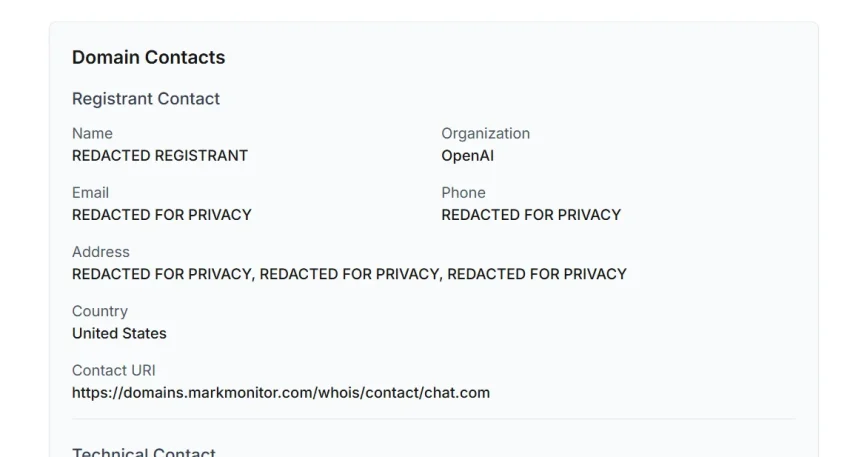
OpenAI is the current owner and operator of Chat.com.
Three pieces of evidence support that answer:
An OpenAI spokesperson confirmed the acquisition to TechCrunch in November 2024.
Dharmesh Shah publicly identified OpenAI as the buyer after OpenAI CEO Sam Altman posted the domain.
The current Chat.com registration record lists the registrant organization as OpenAI, while the domain redirects to ChatGPT.
This means Chat.com is not owned by Shah, HubSpot, or Sam Altman personally. HubSpot was never the buyer: Shah stated that he purchased the domain with his own money rather than on behalf of the software company he cofounded.
The public registration record does not specify which legal entity inside OpenAI holds the asset.
That distinction rarely matters to an ordinary visitor, but it is worth preserving: the available evidence identifies the organization as OpenAI, not a particular OpenAI subsidiary.
Chat.com ownership at a glance
Question | Verified answer |
|---|---|
Who owns Chat.com? | OpenAI |
Who owned it before OpenAI? | Dharmesh Shah, HubSpot cofounder and CTO |
Did HubSpot own Chat.com? | No. Shah said it was a personal purchase. |
What did Shah pay? | $15.5 million in 2023 |
What did OpenAI pay? | The exact amount has not been disclosed. |
Was OpenAI stock involved? | Shah strongly implied that OpenAI shares formed part of the deal, but the complete terms are private. |
What happens when you visit Chat.com? | It redirects to ChatGPT. |
When was the domain registered? | September 20, 1996 |
Current registrar | MarkMonitor Inc. |
The ownership history of Chat.com
1996: Chat.com was registered
Chat.com was created on September 20, 1996, making it nearly three decades old.
Public registration records do not provide a complete, named ownership chain for every period before the documented 2023 sale.
Its age is not the main reason it is valuable.
The real attraction is the word itself. “Chat” is short, familiar, easy to spell, and understood across many markets.
It describes a broad behavior instead of one company or technology, allowing the name to remain relevant as chat rooms, messaging, customer support, and conversational AI evolved.
March 2023: Dharmesh Shah bought it for $15.5 million
Shah announced in 2023 that he had bought Chat.com for an eight-figure sum.
He said the acquisition was personal and that he believed chat-based user experiences would become a major part of software.
The precise price was initially confidential.
In April 2024, domain-industry publication DNJournal confirmed the purchase price as $15.5 million.
Brokers Andrew Miller of Hilco Digital Assets and Larry Fischer represented the seller and helped facilitate the transaction.
At that price, Chat.com became one of the largest publicly reported domain-only sales.
May 2023: Shah sold it again
Only about two months after announcing his purchase, Shah said he had sold Chat.com to an unnamed buyer for more than he paid.
Domain Name Wire reported the second eight-figure transaction at the time, but the buyer and exact terms remained confidential.
Shah explained later that he had considered building a conversational software product.
Once it became clear that OpenAI was committed to turning ChatGPT into a major application, he decided that competing directly was not the right move.
In an interview with Axios, he said he concluded that the domain belonged with OpenAI.
November 2024: OpenAI was revealed as the buyer
On November 6, 2024, Sam Altman posted “chat.com” on X.
The address began redirecting visitors to ChatGPT, and OpenAI confirmed that it had bought the domain.
Shah then confirmed in a LinkedIn post that OpenAI was the previously undisclosed buyer.
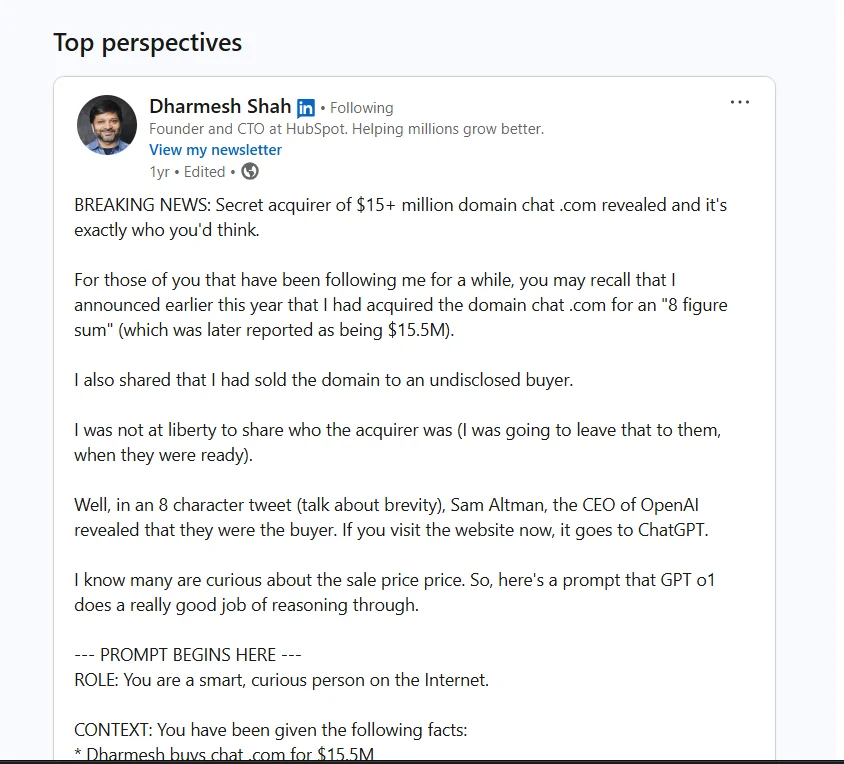
Instead of publishing the contract terms, he provided clues: he had paid $15.5 million, said he generally did not sell domains at a loss, described OpenAI as the ideal home for the name, and noted that he wanted to own OpenAI shares.
Those clues support the conclusion that equity was involved.
They do not reveal the number of shares, their valuation on the transaction date, how much cash may also have changed hands, or the total final price.
2026: Chat.com remains under OpenAI’s control
As checked on July 17, 2026, Chat.com still redirects to ChatGPT. The registration record lists:
Registrant organization: OpenAI
Registrar: MarkMonitor Inc.
Original registration date: September 20, 1996
Current expiration date: September 19, 2027
Nameservers: Cloudflare
Transfer and deletion protections: active at both registrar and registry levels
The registrar identifier in the registry data is 292, which the IANA registrar directory maps to MarkMonitor.
Large companies commonly use corporate registrars and several lock statuses to reduce the risk of unauthorized changes to valuable names.
An expiration date does not mean OpenAI intends to let the domain expire. Domain registrations always show a current term, and owners can renew them before that date.
Why did OpenAI buy Chat.com?
OpenAI has not published a detailed strategic explanation. The domain’s characteristics and current use point to several practical benefits.
It is easier to remember than a product name
Chat.com is a simple dictionary-word address.
A person who forgets whether the product is called ChatGPT, GPT Chat, or OpenAI Chat can still remember “chat.”
The domain catches that intuitive navigation and sends the visitor to the correct product.
It protects a category-defining address
Conversational AI is central to OpenAI’s consumer business.
Allowing another company to control Chat.com could create confusion, divert traffic, or give a competitor a memorable position in the same category.
Owning the name removes that strategic risk. It also gives OpenAI the option to use the domain differently later, even if it remains a redirect today.
It supports the product without forcing a rebrand
The acquisition did not turn ChatGPT into a product called “Chat.”
Chat.com functions as a short route to ChatGPT, while the established ChatGPT name remains visible after the redirect.
That is a useful brand lesson.
A company does not need to abandon its existing name to benefit from a premium domain. The domain can serve as a memorable shortcut, campaign address, defensive asset, or future option.
The word is broader than the current technology
“GPT” refers to a particular model architecture and product heritage. “Chat” describes what the user does.
That makes Chat.com potentially durable even as model names, interfaces, and technical terminology change.
Why is Chat.com worth so much?
Premium domain prices do not follow a fixed formula, but Chat.com combines nearly every characteristic buyers seek.
It is short: four letters before
.com.It is a common word: no explanation or spelling lesson is needed.
It matches a huge category: messaging, support, communities, sales, and AI all use chat.
It passes the radio test: someone can hear it once and type it correctly.
It uses
.com: the extension remains the default commercial address for many U.S. and international users.It creates options: the same domain could support a product, company, redirect, campaign, or platform.
It cannot be replicated: other businesses can add words or use another extension, but there is only one Chat.com.
Scarcity alone is not enough. A random four-letter domain may be short but meaningless. Chat.com is valuable because its scarcity is attached to a commercially important word.
Is Chat.com safe and legitimate?
Yes. Chat.com redirects to the official ChatGPT website at chatgpt.com. Its public registration data names OpenAI as the registrant organization.
Still, check the final address before signing in. A legitimate redirect should leave you on an official OpenAI or ChatGPT domain over HTTPS.
Avoid lookalike spellings, extra hyphens, unfamiliar extensions, or links that request credentials before reaching the official service.
Domain ownership and redirects can change in the future. The statement above reflects the live domain and registration record on the research date.
What businesses can learn from the Chat.com deal
You do not need a $15 million domain to apply the same principles.
Buy for clarity, not prestige
A strong name tells people what to remember.
Before paying a premium, ask whether the domain will reduce confusion, improve word-of-mouth referrals, or support a brand you can defend.
A costly name that customers regularly misspell is still a weak asset.
Compare the premium name with available alternatives
The right question is not simply, “What is this domain worth?” It is, “What is this domain worth to this business compared with the next-best name?”
Use Truehost’s domain search to test clear alternatives before negotiating with an existing owner.
You may find that an available two-word .com, a focused industry term, or another suitable extension gives you most of the benefit at a fraction of the cost.
Verify ownership before sending money
Use a current domain lookup to check the registrar, registration dates, and status codes.
Public data may be privacy-protected, so it does not always reveal the beneficial owner.
Ask the seller to demonstrate control, use a written purchase agreement, and involve an established escrow provider for a material transaction.
Check trademarks and history
Registration does not give you permission to use another company’s trademark. Search the USPTO trademark database, inspect archived versions of the website, and investigate email, backlink, malware, and reputation history.
For a high-value U.S. acquisition, have qualified legal and tax professionals review the deal.
Domain transfers involving private-company shares, international sellers, or valuable trademarks need more than a registrar checkout screen.
Secure the domain after acquisition
Use multifactor authentication, registrar lock, role-based access, reliable renewal billing, and registry lock when the name is valuable enough.
Keep recovery contacts current and document who inside the business can approve DNS, transfer, or registrant changes.
If you acquire a domain elsewhere, you can transfer it to Truehost once it is eligible, then manage it with your other domains and hosting services.
Chat.com FAQs
Who currently owns Chat.com?
OpenAI owns Chat.com. The company acquired it from HubSpot cofounder Dharmesh Shah. OpenAI confirmed the acquisition in November 2024, and the current registration record lists OpenAI as the registrant organization.
Does Sam Altman personally own Chat.com?
No public evidence says Sam Altman owns the domain personally. Altman revealed the address in a short social-media post, but OpenAI confirmed the acquisition and the registration record names OpenAI.
Did HubSpot own Chat.com?
No. Dharmesh Shah is a HubSpot cofounder and CTO, but he stated that Chat.com was a personal acquisition rather than a HubSpot purchase.
How much did OpenAI pay for Chat.com?
The exact price has not been disclosed. The widely quoted $15.5 million was what Dharmesh Shah paid for Chat.com in March 2023. Shah later sold it to OpenAI for an undisclosed amount and implied that OpenAI equity was involved.
Why does Chat.com redirect to ChatGPT?
OpenAI uses Chat.com as a short, memorable route to ChatGPT. A redirect lets the company benefit from the premium address without changing the established ChatGPT product name.
When was Chat.com first registered?
Chat.com was registered on September 20, 1996. Its age, short length, common dictionary word, and broad commercial relevance contribute to its value.
Can I buy Chat.com?
Chat.com is already owned and actively used by OpenAI, and it is not publicly listed for sale. Unless OpenAI chooses to sell it, another buyer cannot register the name. You can instead search for an available domain that fits your brand.
The bottom line
OpenAI owns Chat.com, and the domain currently serves as a memorable shortcut to ChatGPT.
Dharmesh Shah bought it for $15.5 million in 2023, resold it to OpenAI for undisclosed consideration, and helped create one of the most closely watched domain transactions of the AI era.
The purchase demonstrates why the best domains are more than web addresses. They reduce friction, protect a category, and give a company strategic options.
Most businesses can capture those advantages without an eight-figure budget: choose a name customers can remember, verify it carefully, and secure it properly.
Search available domains with Truehost and find the strongest practical address for your next project.