 Domain RegistrationFind and register the perfect domain for your website.
 .COM DomainChoose a widely recognized domain to build global credibility.
 Domain TransferSeamless domain transfers with zero downtime and complete control.
 All TLDsFind and register your perfect domain. Choose from local and global extensions.
 SSL CertificatesKeep your website safe with reliable SSL Certificates that protect customer data and build trust.
 whoisCheck domain ownership details, expiration dates, and registrar information.
 US DomainRegister a .US domain and build trust in the USA.
 Web HostingEverything your website needs to run smoothly
 WordPress HostingWordPress hosting that just works
 Windows HostingReliable hosting for Windows environments
 Reseller HostingTurn hosting into your business
 Email HostingEmail that looks professional and works anywhere
 cPanel HostingFull control of your hosting with cPanel
 Affiliate ProgramJoin as a partner and earn commissions on every referral you send our way.
 Vps HostingScalable virtual servers that expand as you need.
 Dedicated ServersGet complete access and full control over your dedicated physical server.
 Managed vpsNot tech-savvy? We will take care of everything with our fully managed VPS hosting for you.
 AI Website BuilderCreate stunning websites in seconds with AI.
 Online ShopSet up a professional online store. No coding required.
 Web design serviceGet a tailored website designed to match your brand and support your goals.
 BlogFind helpful guides on web hosting, online selling, digital marketing, and more.
 Contact USYou can reach us anytime, day or night, through chat or email.
 SupportBrowse helpful guides and answers for all of our services.
How Many Domains Are There in 2026?
Global domain and TLD statistics, updated July 2026

There were 392.5 million registered domain names worldwide at the end of March 2026. If that number feels impossibly large, remember that it includes far more than public websites. Companies register defensive names. Investors hold portfolios. People use domains for email, redirects, private applications, landing pages, and projects that never become public websites.
You will also see a much smaller number in domain statistics: 1,437 active top-level domains, based on IANA’s list dated June 24, 2026. That figure counts extensions, not registered names.
The distinction is simple:
- 392.5 million registrations includes addresses such as
truehost.com,example.org, andbusiness.us. - 1,437 active TLD strings includes extensions such as
.com,.org,.us, and.ai.
Your domain is the complete address you register. The top-level domain, or TLD, is the ending after the final dot. One TLD can contain millions of separately registered domains, which is why the two totals differ by hundreds of millions.
Use the explorer and comparisons below to inspect the latest totals, then see how .com, country-code domains, and newer extensions fit different naming decisions.
The short answer, using the latest data available in July 2026
Registered domain names: 392.5 million at March 31, 2026
Active TLDs in IANA’s alpha list: 1,437 at June 24, 2026
Largest TLD:.com, with 163.6 million registrations
Annual growth: 24.1 million registrations, or 6.5%
Fastest-growing major group: New gTLDs, up 31.3% year over year
Domain statistics at a glance
| Metric | Latest figure | Measurement date |
|---|---|---|
| Domain registrations across all TLDs | 392.5 million | March 31, 2026 |
| Quarterly increase | 5.6 million / 1.4% | Q1 2026 |
| Year-over-year increase | 24.1 million / 6.5% | Q1 2026 |
.com registrations |
163.6 million | March 31, 2026 |
.net registrations |
12.4 million | March 31, 2026 |
| Country-code domain registrations | 146.3 million | March 31, 2026 |
| New-gTLD registrations | 49.6 million | March 31, 2026 |
| Other legacy-gTLD registrations | 20.5 million | March 31, 2026 |
| Active TLD strings in IANA’s alpha list | 1,437 | June 24, 2026 |
The registration figures come from the Q1 2026 Domain Name Industry Brief, the newest quarterly release available on July 17, 2026. The TLD count comes from IANA’s authoritative tlds-alpha-by-domain.txt file.
A domain, a TLD, and a subdomain are different things
Consider shop.example.com:
| Part | Example | What it means |
|---|---|---|
| Top-level domain | .com |
The extension at the far right |
| Second-level label | example |
The label immediately before the TLD |
| Registered domain | example.com |
The name normally registered through a registrar |
| Subdomain | shop |
A label created under the registered domain |
| Full hostname | shop.example.com |
The complete address used by DNS |
You normally pay to register example.com. You can then create shop.example.com, blog.example.com, or support.example.com through your DNS and hosting setup without registering each one separately.
Country-code structures can contain another managed level. In example.co.uk, the registrable name is normally example.co.uk, while .uk is the TLD and co.uk is a public suffix. “Everything after the dot” works as a beginner shortcut, but it is not the complete rule for every address.
IANA lists 1,437 active TLD strings
IANA’s active TLD alpha file contained 1,437 entries when it was updated on June 24, 2026. That is the cleanest current answer to “How many domain extensions are there?”
You may also encounter totals closer to 1,600. On July 17, 2026, the broader IANA Root Zone Database contained 1,594 records:
| IANA database classification | Records |
|---|---|
| Generic | 1,249 |
| Country-code | 316 |
| Sponsored | 14 |
| Test | 11 |
| Generic-restricted | 3 |
| Infrastructure | 1 |
| Total database records | 1,594 |
The larger database includes test entries and records whose manager may be shown as “Not assigned.” Its row count therefore answers a different question from the active alpha list.
When two sources disagree, compare the definition, measurement date, and included records. A count of active strings is different from a count of database records, delegated TLDs, applications, or extensions currently sold by a registrar.
Registered domains serve more than websites
The global registration total measures names present in registry databases. It does not represent unique owners, live websites, or businesses.
A registered domain may support a public website, business email, a redirect, a private application, DNS infrastructure, a parked page, brand protection, or no public service. One registration can also serve many subdomains.
Companies often control product names, misspellings, country variants, and defensive extensions. Domain investors may hold large portfolios. Dividing 392.5 million by a population figure would therefore produce a misleading owner count.
Registrations also move through a lifecycle. A name can be registered for a defined term, renewed, allowed to expire, restored during redemption, or eventually deleted. Keep renewal details current because an expired name is rarely available to a new buyer immediately.
Explore the latest domain statistics
Move through the quarterly data, filter the largest TLDs, inspect each market segment, and find a practical extension strategy for a new domain.
Interactive data explorer · Q1 2026
Explore the world’s 392.5 million domains
Move through two years of growth, filter the largest extensions, inspect the market mix, and get a practical TLD route for your next name.
See where registration growth accelerated
Drag the quarter control to inspect each reported or derived point. The market was flat through Q3 2024, then added 30.2 million registrations by Q1 2026.
Filter the world’s ten largest extensions
Compare generic, country-code and newer generic TLDs. Bar lengths use the same zero-based scale, so the size of the .com lead stays honest.
Compare the five market segments
Select a section of the bar to see its registration base, global share and reported growth context.
Find a sensible extension strategy
Choose your audience, priority, and use case to get a practical starting route for the complete address.
Try .com first
For a broad U.S. commercial audience, .com minimizes explanation and maximizes familiarity.
- Check the exact name and one or two clear variants.
- Compare renewal cost, not only the first-year offer.
- Run a U.S. trademark search before committing.
This is a naming guide, not an availability, price, SEO or legal guarantee. Registry rules and renewal fees vary.
30-second data check
Which group grew fastest year over year in Q1 2026?
Data: Verisign/DNIB Q1 2026. Quarter-end totals shown in millions; Q1 2025 and Q3 2025 are derived from the following quarter’s stated change. Category figures may differ from the 392.5M total by 0.1M because of source rounding.
Global registrations grew by 24.1 million in one year
The worldwide registration base grew from 368.4 million at the end of Q1 2025 to 392.5 million at the end of Q1 2026. That is a net gain of 24.1 million domains, or 6.5%.
Registries process new registrations, renewals, transfers, deletions, and expirations every day. The total rises when additions and renewals outweigh the names leaving the registration base. Growth was nearly flat through Q3 2024, then accelerated through 2025.
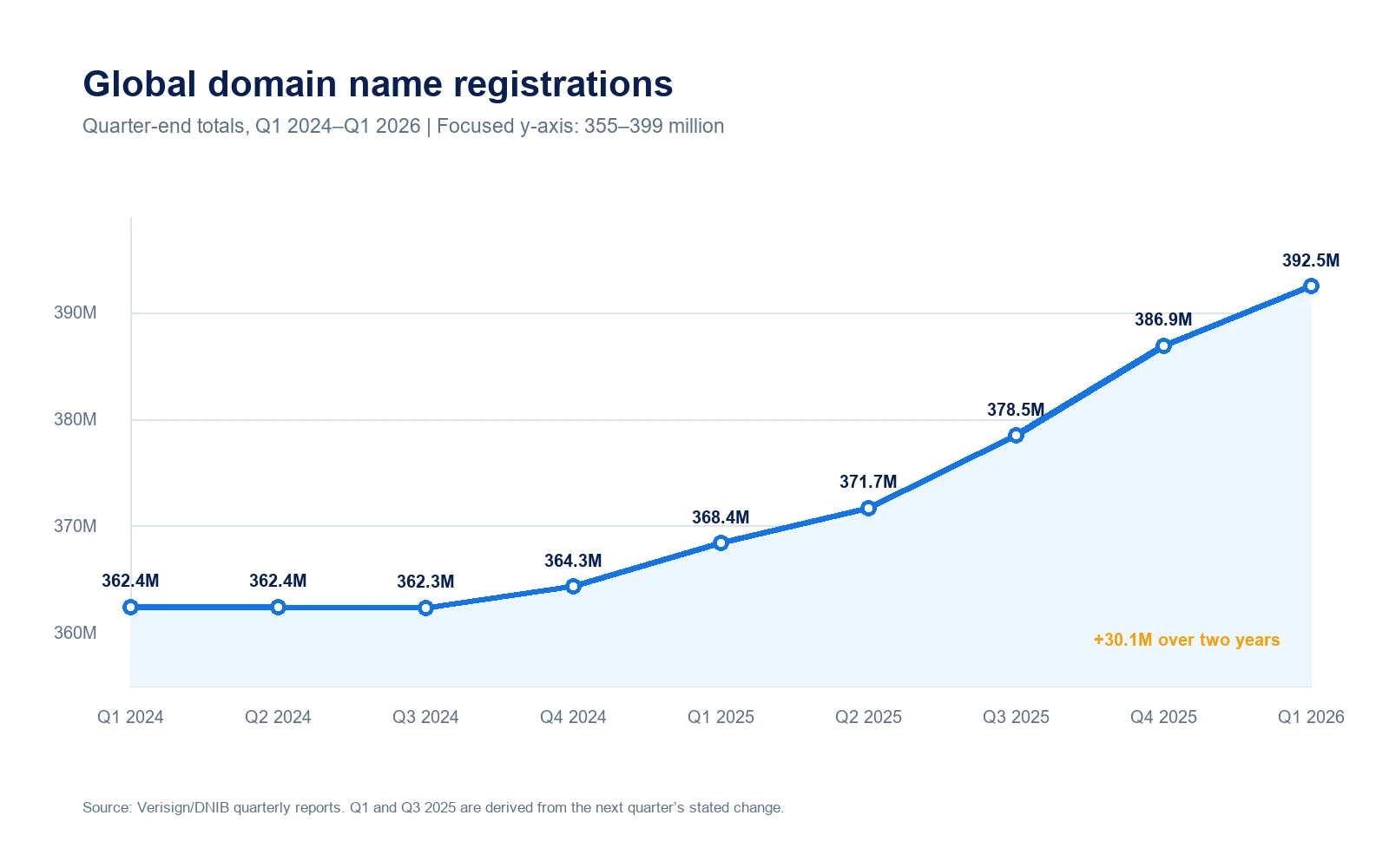
Treat the curve as registration activity rather than a website count. Companies, investors, email users, redirects, and parked names can all add registrations without creating an additional public website.
How the 392.5 million registrations break down
DNIB divides the market into five major groups. The components total 392.4 million because each category is rounded to one decimal place.
| TLD group | Registrations | Share of all registrations | Year-over-year change |
|---|---|---|---|
.com |
163.6M | 41.7% | Reported with .net |
| Country-code TLDs | 146.3M | 37.3% | +2.4% |
| New generic TLDs | 49.6M | 12.6% | +31.3% |
| Other legacy generic TLDs | 20.5M | 5.2% | +14.6% |
.net |
12.4M | 3.2% | Reported with .com |
.com still represents about two in every five domains
At 163.6 million registrations, .com is larger than new gTLDs, other legacy gTLDs, and .net combined. Its familiarity helps U.S. and global commercial brands, although short dictionary words and obvious brand names are harder to obtain.
Compare the complete address rather than the extension alone. northstarstudio.com is easier to repeat than northstarr-studio-online.com, even though both end in .com.
Country-code domains form the second-largest block
Country-code TLDs held 146.3 million registrations, or 37.3% of the global base. Extensions such as .us, .de, .uk, and .jp can make location visible, while each registry sets its own eligibility, renewal, and transfer rules.
Repurposed country codes need extra scrutiny. .ai belongs to Anguilla and .io to the British Indian Ocean Territory, even though technology companies often use them as industry signals. Check the registry policy and long-term price before choosing one.
New gTLD growth comes with a renewal question
New generic TLDs reached 49.6 million registrations after growing 31.3% year over year. They can create concise addresses such as northstar.shop, but growth alone cannot show how many buyers will keep those names.
DNIB’s latest combined renewal estimate was 30.9% for new gTLDs, compared with a preliminary 76.3% for .com and .net. Judge a newer extension by its renewal cost, registry stability, customer familiarity, and spoken clarity.
Established alternatives still serve distinct audiences
Other legacy gTLDs reached 20.5 million registrations. .org, the largest member at 11.7 million, remains strongly associated with nonprofits, communities, and mission-led work.
.net held 12.4 million registrations and remains recognizable for network, infrastructure, developer, and connectivity products. For an unrelated retail brand, a clearer extension may be easier for customers to remember.
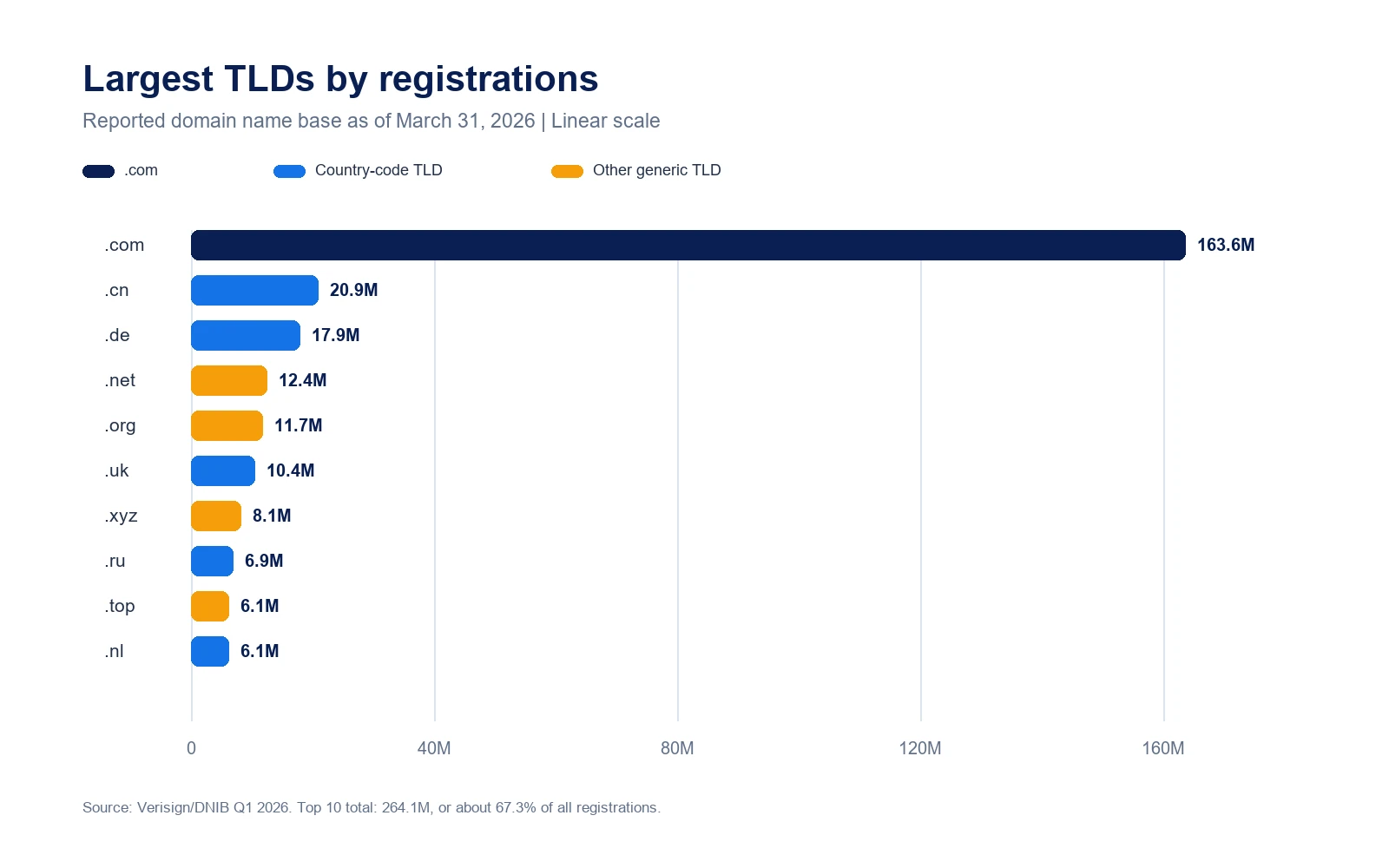
Ten TLDs account for 67.3% of all registrations
The ten largest extensions held approximately 264.1 million registrations. .com alone was almost 7.8 times the size of .cn, the second-largest extension.
| Rank | TLD | Type | Registrations | Share of global total |
|---|---|---|---|---|
| 1 | .com |
Generic | 163.6M | 41.7% |
| 2 | .cn |
Country-code | 20.9M | 5.3% |
| 3 | .de |
Country-code | 17.9M | 4.6% |
| 4 | .net |
Generic | 12.4M | 3.2% |
| 5 | .org |
Generic | 11.7M | 3.0% |
| 6 | .uk |
Country-code | 10.4M | 2.6% |
| 7 | .xyz |
New generic | 8.1M | 2.1% |
| 8 | .ru |
Country-code | 6.9M | 1.8% |
| 9 | .top |
New generic | 6.1M | 1.6% |
| 10 | .nl |
Country-code | 6.1M | 1.6% |
Use this ranking as a familiarity signal. The right extension still depends on your audience, registry rules, renewal cost, and the way customers encounter the complete address.
The main TLD families serve different purposes
You do not need to memorize hundreds of extensions. Most buying decisions fall into a handful of useful families.
Generic TLDs work across countries
A generic top-level domain does not inherently represent one country. Familiar examples include .com, .net, .org, and .info.
Generic does not mean identical. .com is broadly commercial. .org is strongly associated with organizations and public-interest work. .net still carries a technical or network association for many people. Registry rules can also limit who may register specific generic extensions.
Choose a generic TLD when you want an address that can travel across markets without putting one country in the name.
Country-code TLDs make location visible
A ccTLD is normally a two-letter extension associated with a country or territory. Examples include .us, .ca, .uk, and .jp.
A country-code name can give customers a quick geographic signal. It can also support a local site structure when you operate different websites for different countries.
The tradeoff is narrower meaning. A strong local signal may be useful at home and less useful when you expand. Some registries require local presence, identity documents, or a local administrative contact, while others accept international registrants.
New generic TLDs can make the address say more
The term “new gTLD” refers to extensions introduced through ICANN’s major expansion program. The first delegations from the 2012 application round reached the root in 2013.
The group includes broad terms such as .online, industries such as .tech, commerce endings such as .shop, cities, communities, non-Latin scripts, and brand-controlled TLDs.
An extension can still be called a new gTLD after operating for years. “New” identifies the program generation, not the age of your particular registration.
Use one when it gives you a cleaner, more memorable complete address. Do not use it merely because the first-year price is low.
Sponsored and restricted TLDs require a closer policy check
Sponsored TLDs serve a defined community under policies developed with a sponsoring organization. Restricted generic TLDs limit eligibility or permitted use.
For example, some extensions are intended for regulated industries, professional groups, education, government, or specific communities. The exact rules differ by registry.
If the extension implies a qualification, do not assume that a successful checkout settles the policy question. Read the eligibility terms and make sure your use remains compliant after registration.
Internationalized domains support more writing systems
Internationalized Domain Names, or IDNs, allow labels in scripts beyond basic Latin characters, including Arabic, Chinese, Cyrillic, and Devanagari.
The DNS stores an ASCII-compatible label that begins with xn--, while people can see and type the native-script version in supported software. IDNs can exist under both country-code and generic TLDs, so they are a technical capability rather than a separate commercial family.
An IDN can make a domain natural for readers in a particular language. Check email support, browser display, keyboard access, visually similar characters, and whether a Latin-script companion domain would help.
What the numbers mean for a U.S. business
For a U.S. commercial brand, .com remains the practical starting point because customers recognize it and often type it by habit. Availability is the constraint: the cleanest short names may already be registered or priced for the aftermarket.
Use .us when a visible U.S. identity strengthens the name and the registration meets the extension’s eligibility rules. Use .org when the mission-led association matches what visitors will find. A descriptive ending such as .shop, .app, or .design can work when it makes the complete address shorter and easier to repeat.
Test the full address aloud before comparing prices. Then review renewal fees, registry rules, matching social handles, and similar marks in the USPTO trademark database. Market size can show familiarity; your audience and complete name determine fit.
Google ranks the site, not the extension
Google’s current guidance says it returns the most relevant result regardless of whether a site uses .com, .org, or a newer gTLD. A keyword in an extension such as .shop or .law provides context, but it is not a ranking shortcut.
Your content, technical setup, links, reputation, usefulness, and the intent behind each search still drive performance.
Country targeting is different. Google uses a true ccTLD such as .de or .cn as a strong signal that a site is intended for that country. Google treats some widely used vanity ccTLDs, including .ai, .io, .me, and .tv, as generic rather than country-targeted.
Use this rule:
- Choose a generic extension when the site should serve a broad or multi-country audience.
- Choose a country-code extension when the country signal helps customers and matches your market plan.
- Choose clarity over an awkward keyword-rich address.
The best domain supports recognition and trust. Search performance comes from the site you build on it.
No fixed count can tell you how many good domains remain available
There is no useful, stable number for “domains left.” Each TLD creates a vast namespace, and the status of individual names changes continuously.
A domain search can return several different kinds of result:
- Available at standard price: You can register it under the normal registry price rules.
- Premium registry name: The registry has assigned a higher registration or renewal price.
- Registered and in use: Another registrant controls it.
- Registered and listed for sale: You may be able to negotiate through an aftermarket platform or broker.
- Reserved or blocked: The registry does not allow normal public registration.
- Expired but not released: The name remains in a renewal, redemption, or deletion stage.
This is why a static blog list of “available domains” ages badly. A live search is the only reliable way to check the exact spelling now.
Start with the name you would say aloud to a customer. Then test:
- The exact
.com. - A relevant country-code option if location is central.
- One or two descriptive extensions that make the full address shorter.
- Clear modifiers such as
get,try,join, or a location only when they sound natural. - The matching social handles and major trademark databases.
Use Truehost’s domain search to compare live availability and current prices. If the name is registered, check its public WHOIS or RDAP details before you decide whether to approach the owner, monitor its status, or choose another name.
Availability does not mean legal safety. Search the USPTO trademark database, check similar businesses, and speak with a qualified attorney when the domain will carry a major U.S. brand.
Choose the extension your customers can repeat correctly
Market size is only one signal. Your goal is a complete address that people can hear once, remember, and enter without correction.
| Extension route | Often fits | Main advantage | Main question to answer |
|---|---|---|---|
.com |
U.S. and global commercial brands | Familiarity | Is the clean version available at a sensible cost? |
.us or another ccTLD |
Country-focused businesses and campaigns | Clear location signal | Do you meet the registry rules, and will expansion make the name feel narrow? |
.org |
Nonprofits, communities, open projects | Recognized mission-led association | Does the organization fit what visitors expect from .org? |
| New descriptive gTLD | Shops, apps, professions, creative brands | More naming combinations | Will customers remember the complete address and renewal cost? |
Vanity ccTLD such as .ai or .io |
Technology brands | Short, familiar industry signal | Are the registry policy and long-term cost acceptable? |
Start with the way people will discover you
If most customers will click a link, visual clarity may matter more than dictation. If you advertise on radio, podcasts, events, video, or word of mouth, pronunciation and error resistance become much more important.
Say the full domain aloud. Ask someone to type it without seeing it. If they hesitate over the spelling or extension, the name carries friction you will pay for in every campaign.
Compare the full ownership cost
The first-year price is only the entry cost. Review renewal, transfer, redemption, privacy, and premium renewal terms before you build the brand.
A $2 promotional registration followed by a much higher annual renewal can cost more than a familiar extension over five years. Premium domains can also have either a one-time premium registration fee or recurring premium renewals, depending on the registry.
Check the extension’s operating rules
Some TLDs require local presence, professional credentials, a particular use, or extra documentation. Others have no meaningful eligibility restriction.
Read the registry policy if the ending is country-specific, regulated, sponsored, restricted, or unusually cheap. Your domain is business infrastructure, so know who sets the rules.
Avoid unnecessary complexity
Hyphens, repeated letters, unexplained abbreviations, and deliberate misspellings can make an available .com worse than a clean alternative extension.
Compare the choices as complete addresses, not as isolated endings:
northstar-consulting-group.comnorthstar.consultingnorthstaradvisors.com
The best option is the one your audience understands and your team can support for years.
Check the name before you build around it
Live availability, renewal pricing, and registry rules matter more than a static list of suggestions.
Protect the name after you register it
Finding the name is only the first job. A domain controls your website address, email routing, verification records, and often the recovery path for other business accounts.
Use this protection checklist:
- Turn on automatic renewal and reminders. Confirm that the payment method and notification address will remain valid.
- Use multifactor authentication. Protect the registrar account, its recovery email, and any team password manager.
- Enable registrar lock. A transfer lock helps prevent an unauthorized move to another registrar.
- Keep ownership details current. Replace former employees, abandoned inboxes, and outdated recovery contacts.
- Limit and document DNS access. Give each person only the access required for their job and record important changes.
- Create a handover plan. The business, rather than one employee or agency account, should retain control of the registration.
If your domains are scattered across accounts, a transfer can make renewal and access management easier. Check transfer eligibility first, unlock the domain when required, obtain the authorization code, and make sure the registrant email can receive approval messages.
What may change after the 2026 application round
ICANN opened the 2026 New gTLD Program application window on April 30, 2026, with applications scheduled to close on August 12, 2026. Eligible organizations can apply to operate extensions for brands, communities, locations, scripts, or broader terms.
Each proposed string must pass evaluation, objections, contracting, technical testing, and delegation before it can enter the root. Some applications will compete, change, or stop during that process.
Domain buyers should expect new options to arrive gradually. Each successful registry will set its launch phases, eligibility rules, premium names, and prices.
The figures come from registry and root-zone data
The 392.5-million registration total, category totals, top TLDs, growth rates, and renewal estimates come from Verisign and DNIB’s Q1 2026 report. The reporting date is March 31, 2026.
The nine-quarter trend uses earlier DNIB releases from Q1 2024 through Q4 2025. Q1 2025 and Q3 2025 are derived from the following quarter’s reported total and stated increase; the explorer identifies both derived points in its source note.
The 1,437 active-string count comes from IANA’s machine-readable alpha list dated June 24, 2026. The broader 1,594-record comparison comes from the classifications shown in IANA’s Root Zone Database on July 17, 2026.
These sources measure registry records and root-zone entries. They do not estimate unique owners, active websites, traffic, business value, or how many names remain desirable.
Domain statistics are snapshots. Registrations change every day, while DNIB reports quarterly. TLD delegations and database records can also change between IANA updates. Every major number on this page therefore includes the definition and measurement date you need to compare it with a later report.
Domain statistics FAQs
How many domains are registered worldwide?
There were 392.5 million domain name registrations across all TLDs at the end of March 2026, according to Verisign’s Q1 2026 Domain Name Industry Brief.
How many TLDs are there?
IANA’s active alpha list contained 1,437 TLD strings as of June 24, 2026. Its broader Root Zone Database had 1,594 records on July 17, 2026, but that table also includes test and other records that are not equivalent to currently active TLD strings.
What is the most popular domain extension?
.com is the largest TLD, with 163.6 million registrations at the end of Q1 2026. It accounted for approximately 41.7% of the worldwide domain registration base.
Does every registered domain have a website?
No. Domains may be parked, redirected, reserved for brand protection, used only for email or infrastructure, or held without public content. Domain-registration totals should not be described as website totals.
What is the difference between a domain and a TLD?
A domain is a registered address such as truehost.com. The TLD is the final extension—in this example, .com. Millions of different domain names can exist under one TLD.
How many .com domains are registered?
There were 163.6 million .com registrations on March 31, 2026. That was almost eight times the size of .cn, the second-largest TLD.
Are new TLDs replacing .com?
Not at the market level. New gTLDs grew quickly and reached 49.6 million registrations, but .com alone had 163.6 million. New extensions expand naming choices; they have not displaced .com as the largest commercial TLD.
How can I check whether a domain is available?
Use a live registrar search because availability changes continuously. Search the exact spelling, compare suitable extensions, review registration and renewal costs, and check trademarks before building the brand. You can compare current options through Truehost’s domain search.
Does a .com domain rank higher in Google?
No. Google says it returns the most relevant result regardless of whether a site uses .com, .org, or a new generic TLD. A true country-code extension can act as a country-targeting signal, but the extension does not replace useful content, technical quality, links, and trust.
Can I buy a domain that is already registered?
Sometimes. The owner may list the domain for sale or accept a direct offer. Check the domain’s public status first, use a reputable marketplace or escrow service for a high-value purchase, and verify trademarks before negotiating. A registered domain that is not listed for sale may not be available at any price.
What happens when a domain expires?
An expired domain may pass through renewal, redemption, and pending-delete stages before it is released. The website and email can stop working during this process, and restoring the name may cost more than an ordinary renewal. Exact timing depends on the TLD and registrar.
What is the difference between a registry and a registrar?
A registry operates the database for a TLD, while a registrar sells registrations and manages the customer relationship. For example, a registrar lets you search, register, renew, configure, or transfer a name under extensions supplied by one or more registries.
392.5 million domains, but your decision comes down to one name
The internet had 392.5 million registered domain names at the end of Q1 2026. Those names sat under a root with 1,437 active TLD strings in IANA’s June 24, 2026 list.
.com remains the largest extension by a wide margin. Country-code domains account for more than a third of registrations, while new gTLDs are growing much faster than the total market.
Your decision comes down to one name that fits your audience, survives the spoken test, has manageable renewal terms, and remains under your control.
Search the exact version first. Then compare a country-code or descriptive alternative only if it makes the complete address clearer.