 Domain RegistrationFind and register the perfect domain for your website.
 .COM DomainChoose a widely recognized domain to build global credibility.
 Domain TransferSeamless domain transfers with zero downtime and complete control.
 All TLDsFind and register your perfect domain. Choose from local and global extensions.
 SSL CertificatesKeep your website safe with reliable SSL Certificates that protect customer data and build trust.
 whoisCheck domain ownership details, expiration dates, and registrar information.
 US DomainRegister a .US domain and build trust in the USA.
 Web HostingEverything your website needs to run smoothly
 WordPress HostingWordPress hosting that just works
 Windows HostingReliable hosting for Windows environments
 Reseller HostingTurn hosting into your business
 Email HostingEmail that looks professional and works anywhere
 cPanel HostingFull control of your hosting with cPanel
 Affiliate ProgramJoin as a partner and earn commissions on every referral you send our way.
 Vps HostingScalable virtual servers that expand as you need.
 Dedicated ServersGet complete access and full control over your dedicated physical server.
 Managed vpsNot tech-savvy? We will take care of everything with our fully managed VPS hosting for you.
 AI Website BuilderCreate stunning websites in seconds with AI.
 Online ShopSet up a professional online store. No coding required.
 Web design serviceGet a tailored website designed to match your brand and support your goals.
 BlogFind helpful guides on web hosting, online selling, digital marketing, and more.
 Contact USYou can reach us anytime, day or night, through chat or email.
 SupportBrowse helpful guides and answers for all of our services.
Ever spent hours brainstorming the perfect brand name for your website, only to discover the .com domain is already taken?
Every single day, more than 33,000 new domain names get registered globally. That’s one domain every 2.6 seconds. The internet is filling up fast, and .com domains are leading the charge.
Here’s the frustrating part.
You need a domain name that represents your brand.
But when you search for your perfect .com, you find it’s already taken. Maybe they’re using it. Perhaps they’re just sitting on it, waiting to sell it for thousands of dollars.
So you compromise.
-
You add hyphens.
-
You throw in extra words.
-
You get creative with spellings.
Your perfect brand name becomes “bestcoffeeshop-nyc.com” or “reallygoodpizza123.com.”
Not exactly memorable, right?
But what if .com isn’t the only option anymore?
What if there are better domain extensions that fit your brand, cost less money, and are actually available?
In this guide, you’ll discover:
- Why finding a good .com domain is nearly impossible in 2026
- When .com still makes sense (and when it doesn’t)
- The best alternative domain extensions that successful businesses are using
- How to choose the right extension for your website
- Real examples of brands thriving without .com
- What risks to watch for with alternative TLDs
Ready to understand why the domain game has changed?
Let’s dive in.
The Reality of .COM Saturation in 2026
.com still dominates the internet. As of 2025, there were 157.2 million .com domain registrations worldwide. That represents about 43% of all domains on the internet. A massive share when you consider there are over 1,591 different domain extensions available.
But here’s what that dominance really means: virtually every common dictionary word, surname, or 3-4 letter combination is already registered in .com. The pool of available “dream” .com names is essentially exhausted.
Why Finding a Good .COM Is Nearly Impossible
After nearly 40 years of continuous registrations, most of the short and intuitive names in .com are already taken. If you brainstorm a new startup name and it’s a real word or a concise term, chances are someone has already registered the .com.
Between January and March 2025, .com and .net domains had a combined total of 169.8 million domain name registrations. Yet, interestingly, they saw a combined year-over-year decrease of 2.6 million registrations.
This tells us something important: while new .com domains are still being registered, even more are expiring or being deleted. People are starting to look elsewhere.
The saturation creates real problems.
Let’s say you want to start a coffee shop website.
You search for “coffeeshop.com“. Taken.
“bestcoffee.com“. Taken.
“coffeehouse.com“. Taken.
You keep searching and end up with something like “thecoffeeshopnewyork.com” or “coffeeshop2026.com.”
Neither one rolls off the tongue.
The Premium Domain Aftermarket
The domain aftermarket is projected to reach $1.17 billion by 2033. In 2025 alone, icon.com sold for a staggering $12 million, making it the most expensive domain of the year.
Millions of .com domains are listed for sale at premium prices. Businesses often pay thousands to tens of thousands of dollars for desired .com names. Small companies and startups are entirely priced out of quality .com names.
Between 2021 and 2024, the wholesale price of .com domains increased by 28%, and further hikes are expected. These rising costs are pushing businesses to explore more affordable and creative TLD options.
Over 150,000 domains were listed as expired on February 19, 2025. This shows the large number of domains that become available daily due to non-renewal.
But even these expired domains get snatched up quickly by domain speculators who hope to resell them at premium prices.
The Innovation Response
Because of .com saturation, companies have gotten creative with naming. Many startups create new coined words or deliberately misspell words just to secure a .com. In the 2010s, companies like Flickr and Tumblr dropped vowels to secure .com domain names.
This trend continues today.
Entrepreneurs sometimes start with a domain search when coining a brand name. If the .com is free or affordable, that name makes the short list. The domain tail is wagging the brand dog.
When .COM Is Still the Right Choice
Before we explore alternatives, let’s be clear: .com isn’t dead. In many situations, .com still makes perfect sense.
.COM still commands about 43.7% of all websites. That’s massive recognition and trust. When people think of a website, they automatically type .com first.
If you’re an established business with a traditional customer base, .com signals credibility. Industries like finance, law, and healthcare still heavily favour .com domains.
Your customers expect it.
For companies targeting older demographics who grew up with .com, sticking with this extension reduces confusion.
Global brands seeking universal recognition should prioritize .com when possible. Every Fortune 500 company uses a .com domain for their main website.
That’s not a coincidence.
The Trust Factor
.COM is the most recognized domain extension globally. Users often type .com by default when remembering brands. This automatic behavior gives .com a built-in advantage.
From a marketing perspective, .com is easier to promote because of its universal recognition. You spend less time explaining your domain. Customers get it.
There’s also less risk of traffic leakage. If you own “yourbrand.tech” but someone else owns “yourbrand.com,” you’ll lose visitors who automatically type the .com version.
That’s money walking out the door.
The Rise of Alternative Domain Extensions
The domain landscape has changed dramatically. Over 1,591 domain extensions were available online at the end of 2024. That’s not a typo, over 1,500 options.
The New TLD Explosion
New gTLDs (generic top-level domains) have exploded in popularity. Total new generic TLD domain name registrations were 37.8 million at the end of the first quarter of 2025.
That’s an increase of 4.5 million registrations, or 13.5%, year over year.
Compare that to .com, which actually saw a decrease. Alternative extensions are growing while .com contracts.
ICANN’s New gTLD Program launched in 2012 and has introduced new TLD options over the years. A new round of applications is planned for 2026, allowing businesses and individuals to submit new TLD options.
Changing Perceptions
Alternative TLDs are gaining trust and acceptance. Tech companies especially embrace non-.com extensions. Younger demographics are completely comfortable with varied extensions. They grew up in an internet with more choices.
Here’s the SEO reality.
Google doesn’t prioritize .com.
It prioritizes content quality, backlinks, and user experience. Your domain extension alone won’t make or break your search rankings.
Google treats most TLDs equally for SEO purposes.
In fact, Google treats several country-code TLDs (including .io and .ai) as generic for search purposes, so they don’t geotarget to a specific country.
Success Stories
Real businesses are building successful brands on alternative extensions. Slack registered slack.engineering for their blog to keep brand control. Dropbox secured dropbox.tech to identify their technical content from dropbox.com to protect positioning.
These aren’t small startups. They’re major players.
The takeaway?
The best companies aren’t just using alternative domains. They’re leveraging them strategically.
Top .COM Alternatives for 2026
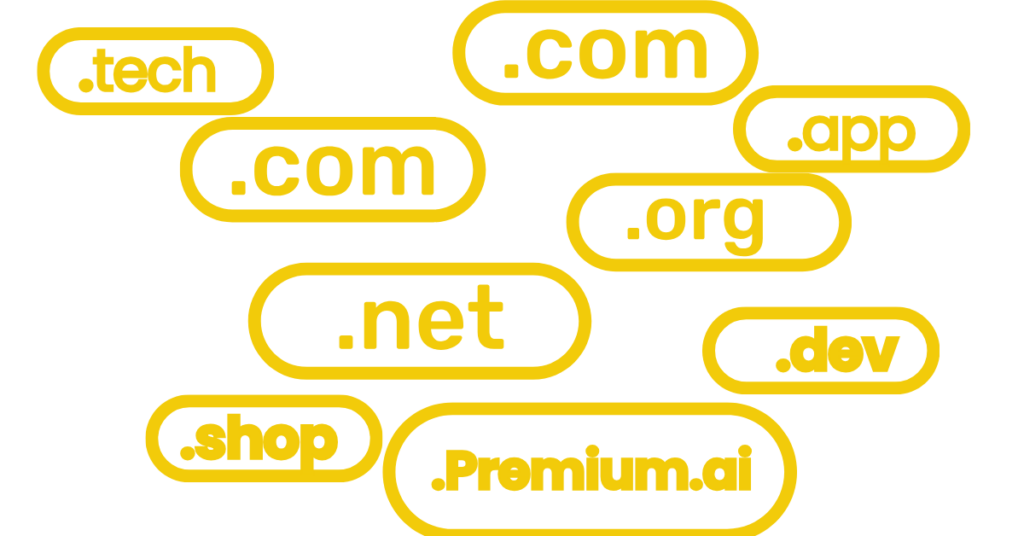
Let’s explore the best alternatives to .com and when each one makes sense.
Traditional Alternatives
1.1 .NET
.Net is the most popular alternative to the .com extension. Initially intended for networking websites, the .net domain has evolved to be widely accepted and recognized across different industries and purposes.
It’s less crowded than .com, so you’re more likely to find your desired name available. However, .net is best suited for companies with a digital or technical focus.
Some of the most popular internet brands in the world have a .net extension, like speedtest.net.
1.2 .ORG
.org is perfect for nonprofits, advocacy groups, and educational platforms. It signals mission-driven work and credibility. While initially designed for not-for-profit organizations, .org is now available to anyone.
The restriction was removed in August 2019.
1.3 .CO
.CO is Colombia’s country code, now a global alternative to .com. It’s popular among startups, small businesses, and independent creators. Many people view it as an abbreviation for “company” or “corporation.”
It’s short, memorable, and has a large pool of available names.
Tech & Innovation Extensions
1.4 .AI
.AI has seen incredible growth. This is Anguilla’s country code, but AI and tech companies have adopted it worldwide.
The .ai extension surged 7.8% in growth recently. It’s perfect for artificial intelligence, robotics, and machine learning companies.
1.5 Premium.ai
Premium .ai sales show serious value: twin.ai sold for $95,000, and advice.ai sold for $80,000. Google treats .ai as a gTLD, so it doesn’t localize rankings.
1.6 .IO
.IO is the British Indian Ocean Territory ccTLD, but it’s associated with input/output in computer science. It’s trending among tech startups and developers. Multiple successful startups thrive on .io domains.
Just note that .io typically costs more than many TLDs.
1.7 .TECH
.tech is industry-specific for technology companies. It provides clear messaging about business focus. There’s growing acceptance in tech circles, making it a strong branding tool for innovation-focused businesses.
1.8 .APP
.app is ideal for application developers. Launched by Google, it includes built-in security (requires HTTPS). Your domain immediately communicates business purpose.
If you’re building apps, this extension makes perfect sense.
1.8 .DEV
.dev is perfect for developers and development-focused businesses. Also launched by Google, it requires a valid SSL certificate to resolve, making it a reliable choice for tech businesses looking to build trust.
E-Commerce Extensions
1.9 .STORE
.store has added massive registrations during the 2025 holiday season. It gives instant clarity about your business model. For example, tech.store immediately tells visitors you sell tech products.
This extension boosts click-through rates by setting expectations.
1.10.SHOP
.shop is a growing alternative for online retailers. It launched in April 2025 with strong backing. The clear call-to-action in your URL helps direct-to-consumer brands convert visitors.
1.11.BUY
.buy is the ultimate e-commerce call to action. It’s subtle and action-oriented. Strong for product-focused businesses that want their domain to drive sales.
Creative & Professional Extensions
1.12 .DESIGN
.design is perfect for designers, agencies, and creative professionals. It defines your niche immediately. There’s strong availability for creative names that would be taken in .com.
1.13 BLOG
.blog is the obvious choice for bloggers. It provides clear purpose communication. As the creator economy grows, .blog is gaining serious traction.
1.14 .MEDIA
.media works for podcasts, digital publications, and production companies. It ties your domain directly to your work. Much more descriptive than .com, it helps visitors understand what you do before they even click.
Industry-Specific Extensions
1.15 .LAW
.law is professional and industry-specific for law firms. It inspires credibility with prospective clients. If you’re an independent practitioner, this TLD signals expertise immediately.
1.16 .CONSULTING
.consulting is perfect for consultants and consulting firms. For example, davidson.consulting is far more descriptive than davidson.com. It clarifies your business model immediately, saving visitors time.
1.17 .ACADEMY
.academy works for online courses, tutoring, and educational platforms. It’s the open alternative to the restricted .edu TLD. A clear educational focus helps attract the right students.
Location-Based Extensions
Country code TLDs (ccTLDs) include:
a) .US (United States)
b) .CA (Canada)
c) .UK (United Kingdom)
d) .DE (Germany). Germany’s .de is one of the most registered TLDs globally.
These extensions benefit local SEO and buyer confidence. They signal availability in a specific location.
American-made cachet with .us can help global sales for U.S.-based companies.
City-specific TLDs like .NYC, .LONDON, and .TOKYO are perfect for local businesses. Restaurants, repair services, and local shops benefit greatly.
For example, plumber.nyc immediately tells New Yorkers that you serve their area. This improves local SEO significantly.
Benefits of Choosing Alternative Extensions
Why would you choose a non-.com domain? The benefits are real and measurable.
A. Better Availability
Short, memorable names are still available on alternative extensions. You don’t need creative misspellings or lengthy domains.
An exact brand match is possible when you expand your extension choices.
B. Lower Costs
Alternative TLDs typically cost $10-40 per year versus premium .com prices. You avoid aftermarket premiums completely.
This is budget-friendly for startups and small businesses that need to watch every dollar.
C. Stronger Branding
Industry-specific extensions enhance identity. Your URL provides clear messaging about what you do. For example, a tech.store immediately communicates its purpose. You sell tech products.
The domain becomes memorable and distinctive. You stand out from the .com crowd instead of blending in.
D. SEO Advantages
Google treats most TLDs equally. Country codes can boost local SEO. Content quality matters more than extension. Keyword-rich extensions help user understanding.
Your site’s SEO ranking success will be based on good content, technical SEO, and getting quality backlinks, regardless of whether your site ends with .com, .xyz, or .tech.
E. Marketing Differentiation
You stand out from the .com competition. Modern, innovative brand perception follows. You align with target audience expectations. Tech-forward image comes naturally with new TLDs.
If your audience sees your domain before anything else, what does it tell them? Is it memorable? Does it reinforce your brand? Or does it get lost in the sea of sameness?
Risks and Downsides of Alternative Extensions
Alternative extensions aren’t perfect. You should know the downsides before you make your choice.
1. Trust and Recognition Issues
Some users only trust .com.
Older demographics may be skeptical of unfamiliar extensions. Less universal recognition requires more marketing effort.
If your website’s domain name is widespread, people might unknowingly think your website uses a .com or another well-known TLD. This can lead to lost traffic, especially if someone else owns the .com version of your domain.
2. Spam Reputation Concerns
Some TLDs are associated with spam. Extensions like .xyz and .click have a higher incidence of malicious registrations. You should check the Spamhaus list of TLDs with the worst reputations before you choose.
Spam filters may flag certain extensions, making your emails land in junk folders. This can hurt business communication.
3. Type-In Traffic Loss
Users may automatically type the .com version of your brand. If someone else owns that .com, you lose traffic. You need to own the .com redirect or accept this loss.
Many smart businesses register multiple extensions to protect their brand. This adds to your costs but prevents traffic leakage.
4. Higher Marketing Investment
You need to build awareness of an unusual extension. More explanation is required for unfamiliar TLDs. Additional brand education is needed to help customers remember your full domain.
5. Limited Industry Acceptance
Some conservative industries still expect .com. Professional services may face skepticism with alternative extensions. B2B clients may question the legitimacy if you don’t have a .com.
How to Choose the Right Domain Extension in 2026
Let’s walk through a simple decision framework to help you choose.
Assess Your Audience
Who are your customers? What age demographic are you targeting? Are they tech-savvy or traditional? Do they focus globally or locally?
If you’re selling to tech startups, they’ll embrace .tech or .io. If you’re selling to retirement communities, they’ll trust .com more.
Define Your Industry
Is there a relevant industry-specific TLD? What do competitors use? What signals credibility in your field?
Law firms should seriously consider .law. Tech companies can thrive on .tech or .io. E-commerce stores benefit from .store or .shop.
Evaluate Availability
Is your exact brand name available? Can you get a short, memorable alternative? What’s the cost difference between extensions?
If your perfect brand name is available on .tech for $20/year but would cost $5,000 to buy on .com, the math makes sense.
Consider Your Goals
Are you building a long-term brand or running a short-term campaign? Do you need universal recognition or niche positioning? What’s your budget for a premium .com versus maximizing value?
Check for Red Flags
Is the extension associated with spam? Will users trust this TLD? Does it create confusion with similar domains?
Plan Brand Protection
Should you register multiple variations? Do you own the .com redirect even if using an alternative? How will you protect against trademark issues?
Decision Framework
- Choose .com for: Global brands, traditional industries, older demographics, when affordable.
- Choose industry TLD for: Clear niche positioning, better availability, modern branding.
- Choose country code for: Local businesses, regional focus, local SEO benefits.
- Choose new gTLD for: Startups, tech companies, creative differentiation, and budget constraints.
The Future of Domain Extensions
The domain world keeps evolving. Here’s what’s coming.
a. New TLD Program Expansion
ICANN keeps approving more extensions continuously. The next new gTLD program will introduce a large number of extensions. Industry-specific options are multiplying fast.
b. Recent and Upcoming Launches
.crypto launched in January 2025 for cryptocurrency platforms. .art launched in February 2025 for artists and creatives. .shop launched in April 2025 with strong e-commerce focus.
Additional extensions like .free, .hot, and .spot are coming for campaigns and promotional focus.
c. Emerging Trends
Web3 integration with blockchain domains is happening. AI-powered domain services are helping people find perfect names. Brand-specific TLDs like .google and .microsoft give major companies complete control.
Internationalized domain extensions with non-ASCII characters are expanding the internet beyond English-language domains.
d. Market Predictions
Continued growth of alternative TLDs seems certain. Further .com saturation will push more businesses to alternatives. Rising premium domain prices will make alternatives more attractive.
Increased acceptance of new extensions will normalize non-.com domains for all industries.
Practical Tips for Transitioning Away from .COM
If you decide to use an alternative extension, follow these tips.
1) Brand Protection Strategy
Register the .com redirect if available, even if you don’t use it as your main domain. Own common misspellings to prevent traffic loss. Secure multiple extensions to protect your brand. Set up proper redirects so visitors find you regardless.
2) Marketing Your Alternative Domain
Use consistent brand messaging across all platforms. Explain your extension choice if needed, but don’t over-explain. Emphasize your brand name over the extension.
Use the extension as a branding tool. Make it part of your story.
3) Technical Setup
Ensure SSL certificate installation for security. Configure proper DNS settings. Set up email on your custom domain for professionalism. Monitor domain security to prevent hijacking.
4) Long-Term Considerations
Plan for a potential .com acquisition later if it becomes available. Budget for defensive registrations to protect variations. Track brand mentions and variations online.
Renew domains well in advance to avoid expiration.
Making Your Domain Choice in 2026
.COM isn’t always the best choice anymore. The domain landscape has changed dramatically.
Alternative extensions offer better availability and targeted branding. You can find short, memorable names that match your brand perfectly.
The costs are lower, the options are better, and the acceptance is growing.
Success depends on strategy, not just extension. Companies thrive on .tech, .io, .store, and dozens of other extensions. Your brand strength, product quality, and marketing matter far more than whether you have a .com.
Here’s what you should do next.
- First, assess your specific needs. Who is your audience? What’s your industry? What’s your budget?
- Second, research industry-relevant extensions. Look at what successful competitors use. Check what signals credibility in your space.
- Third, check availability across multiple TLDs. Don’t just search .com—explore 5-10 relevant extensions and see what’s available.
- Finally, make an informed decision based on your goals and audience. Choose the extension that fits your brand, your budget, and your long-term vision.
The internet has room for everyone. You don’t need a .com to build something great.
Do you want a smart, modern domain search experience, try Truehost.
You’ll see the full range of 500+ domain extensions, compare prices instantly, and secure the name that actually fits your brand, not just the one that’s left.
Why .COM Domain Isn’t Always the Best Choice Anymore FAQs
It is popular, but not always the best. Many .com names are taken, and other extensions can fit your brand better.
No. Google treats all domain extensions the same. SEO depends on your content, speed, backlinks, and user experience.
Yes, as long as you buy from a legit registrar. Trust comes from your brand, not only the extension.
It helps if you want extra protection for your brand. But it is not required if the .com is too expensive or unavailable.
Prices vary. Some cost a few dollars per year. Others, like premium industry TLDs, cost more.
Pick one that matches your work. For example:
• .tech for tech
• .store for shops
• .dev for developers
• .africa for regional brands
• .org for nonprofits
Yes, but you must migrate your website and update your links. It is easier to choose the right one from the start.
Yes. People now see many new extensions online, so trust has grown. Clear branding makes it even stronger.
Some common options are .net, .org, .io, .co, .ai, .shop, .store, .tech, and country extensions like .us or .uk.
Search the extension name with “spam rate,” “abuse rate,” or “safety report.” Also look at trusted DNS and security reports from providers like Spamhaus.