 Domain RegistrationFind and register the perfect domain for your website.
 .COM DomainChoose a widely recognized domain to build global credibility.
 Domain TransferSeamless domain transfers with zero downtime and complete control.
 All TLDsFind and register your perfect domain. Choose from local and global extensions.
 SSL CertificatesKeep your website safe with reliable SSL Certificates that protect customer data and build trust.
 whoisCheck domain ownership details, expiration dates, and registrar information.
 US DomainRegister a .US domain and build trust in the USA.
 Web HostingEverything your website needs to run smoothly
 WordPress HostingWordPress hosting that just works
 Windows HostingReliable hosting for Windows environments
 Reseller HostingTurn hosting into your business
 Email HostingEmail that looks professional and works anywhere
 cPanel HostingFull control of your hosting with cPanel
 Affiliate ProgramJoin as a partner and earn commissions on every referral you send our way.
 Vps HostingScalable virtual servers that expand as you need.
 Dedicated ServersGet complete access and full control over your dedicated physical server.
 Managed vpsNot tech-savvy? We will take care of everything with our fully managed VPS hosting for you.
 AI Website BuilderCreate stunning websites in seconds with AI.
 Online ShopSet up a professional online store. No coding required.
 Web design serviceGet a tailored website designed to match your brand and support your goals.
 BlogFind helpful guides on web hosting, online selling, digital marketing, and more.
 Contact USYou can reach us anytime, day or night, through chat or email.
 SupportBrowse helpful guides and answers for all of our services.
You spent 10+ years becoming a doctor. But if patients can’t find you on Google, does your expertise even matter?
Well, 77% of patients start their healthcare journey on a search engine.

If you’re not showing up when someone types “dermatologist near me” or “best pediatrician in Atlanta,” those patients are walking into your competitor’s office instead.
The good news?
You don’t need to understand algorithms or become a tech expert. What you need is a clear strategy that gets your practice in front of patients who are ready to book right now.
This guide cuts through the BS and shows you exactly what works in 2025. No fluff. No theory. Just the exact steps successful medical practices are using to dominate local search results and fill their appointment calendars.
TL;DR: Local SEO for Doctors Guide
Here’s what actually moves the needle for medical practices:
The Foundation (Do These First):
- Claim and optimize your Google Business Profile with complete information, professional photos, and weekly posts
- Get listed on medical directories like Healthgrades, Zocdoc, and Yelp with identical contact details everywhere
- Build a mobile-first website that loads in under 3 seconds
The Growth Tactics (Where You’ll See ROI):
- Collect 5-10 patient reviews monthly using HIPAA-compliant systems
- Create service pages targeting high-intent keywords like “sports injury doctor Chicago”
- Publish monthly blog content answering real patient questions
- Add schema markup so Google understands you’re a medical professional
- Build backlinks from local healthcare organizations and medical associations
- Track your rankings, traffic sources, and appointment conversions monthly
Time Investment: 2-4 hours weekly, or partner with specialists who know healthcare SEO inside-out.
Expected Results: Most practices see increased patient inquiries within 60-90 days, with visibility improvements accelerating over 6-12 months.
Why This Matters for Your Practice
Let’s talk about what’s really happening while you’re treating patients.
Someone searches “urgent care near me” right now. Three clinics appear in Google’s top results.
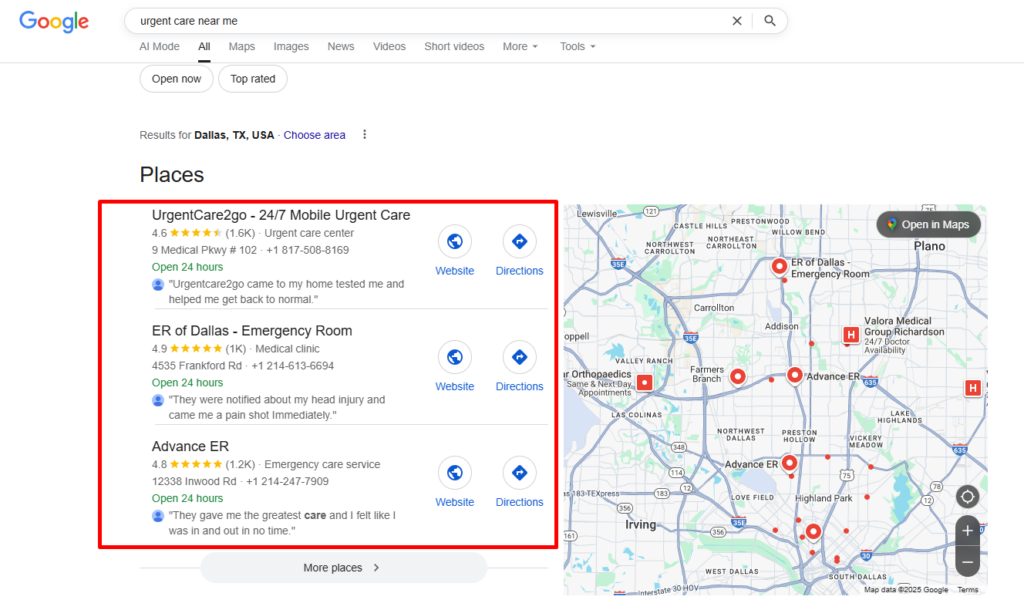
Yours isn’t one of them.
That patient books with your competitor, becomes their patient, and refers their family there too.
You just lost $3,000-$5,000 in lifetime patient value. Multiply that by 20-30 patients monthly who never found you.
That’s not a marketing problem. That’s a revenue problem.
The practices winning in 2025 aren’t necessarily better doctors. They’re just easier to find. And local SEO is how you become impossible to ignore.
Think of local SEO services as your practice’s visibility infrastructure. When it’s dialed in, patients flow in consistently. When it’s broken, you’re stuck wondering why competitors with worse reviews are busier than you.
Here’s what changes when you get this right: Your phone rings more. Your online booking fills up faster. New patients say “I found you on Google.” And you stop relying on expensive paid ads that disappear the second you stop paying.
Ready to make it happen? Let’s break down exactly what works.
Strategy #1: Master Your Google Business Profile

Your Google Business Profile is not optional.
It’s the first thing 83% of patients see when searching for doctors. If it’s incomplete or outdated, you’re invisible.
Here’s what actually matters:
a). Claim and Verify Immediately
- Go to Google Business Profile Manager
- Claim your listing (or create one if it doesn’t exist)
- Verify ownership through phone, postcard, or email
b). Complete Every Single Field
Your Name, Address, and Phone (NAP) must match your website exactly. One character off and Google gets confused.
Add specific services: Don’t just say “general practitioner.” List “annual physicals,” “sports physicals,” “diabetes management,” “hypertension treatment.” Patients search for specific problems, not job titles.
Choose precise categories: Primary category should be your specialty (Family Physician, Dermatologist, Pediatrician). Add secondary categories that fit.
c). Upload High-Quality Photos
Practices with photos get 42% more direction requests and 35% higher click-through rates. Show your waiting room, treatment areas, exterior, and staff. Make patients comfortable before they arrive.
d). Use Google Posts Weekly
Post health tips, office updates, new services, or seasonal reminders. These show you’re active and engaged. Each post is fresh content Google rewards.
Check out this example.
New Jersey vein clinic added specific services like “leg swelling treatment” and “ulcer care” to their profile.
Within months, they started appearing in Google AI responses for “who treats leg ulcers near me.” Specificity wins.
Pro Tip: Add booking links directly to your profile. 75% of patients prefer online scheduling. Make it frictionless.
Need a professional assessment of your current setup? Use our free Google Business Profile audit tool to see exactly where you’re losing patients.
Strategy #2: Get Reviews the Right Way (Your Trust Currency)
Here’s a stat that should wake you up: 72% of patients won’t book an appointment until they read reviews.
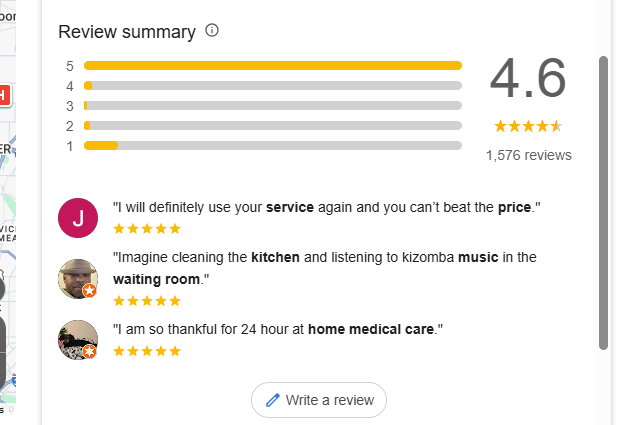
No reviews? No patients.
But here’s where doctors get stuck. “Isn’t asking for reviews a HIPAA violation?” Not if you do it right.
The HIPAA-Compliant Review System:
- Never mention specific treatments or conditions in your request
- Send requests after appointments via automated, HIPAA-compliant platforms
- Keep it simple: “Would you mind sharing your experience with future patients?”
- Respond to every review within 24 hours (even negative ones, especially negative ones)
The Numbers That Matter:
- Aim for 5-10 new reviews monthly
- Target a 4.5+ star average (anything below 4.0 costs you patients)
- Spread reviews across Google, Healthgrades, Yelp, and Zocdoc
Handling Negative Reviews
Never ignore them. Respond professionally, acknowledge the concern, and offer to resolve it privately. Future patients are watching how you handle problems.
One Georgia dermatology practice encouraged patients to mention specific treatments in reviews.
When patients wrote about “acne scar treatment,” the practice started appearing in Google’s AI summaries for those exact searches.
Reviews aren’t just social proof, they’re SEO fuel.
Strategy #3: Dominate Medical Directories
Patients don’t just search Google.
They’re also checking Healthgrades, Zocdoc, Yelp, and RateMDs.
If you’re not listed, you’re not in the game.
Priority Directories for Doctors:
- Healthgrades (high patient traffic, especially for specialists)
- Zocdoc (major booking platform for urban areas)
- Yelp (yes, people use it for medical practices)
- Vitals
- WebMD Physician Directory
- RateMDs
A multi-location clinic had their phone numbers mixed up across directories.
Some listings showed the main line, others showed individual office numbers. Google couldn’t tell which locations were real. They dropped out of the local 3-pack entirely until they fixed it.
The Critical Rule
Your Name, Address, and Phone must be 100% identical across every single platform. Even small variations confuse Google and hurt your rankings.
Quick Action Step: Google your practice name plus “directory listings.” Check the top 10-15 results. Are your details consistent? If not, that’s priority one.
Strategy #4: Build a Fast, Mobile-Optimized Website
68% of healthcare searches happen on mobile devices.
If your site loads slowly or looks broken on phones, patients bounce to competitors in seconds.
Google’s algorithm is ruthless about this.
Page speed and mobile experience directly impact your rankings.
Non-Negotiables for Medical Websites:
- Load time under 3 seconds (use Google PageSpeed Insights to check)
- Mobile-responsive design that works on any screen size
- Clear calls-to-action: “Book Appointment,” “Call Now,” “Get Directions”
- Accessible contact info on every page
- HIPAA-compliant contact forms (never ask for medical details online)
Structure That Converts:
- Homepage: Clear value proposition, services, location, contact
- Service pages: One page per treatment/condition you treat
- Provider pages: Individual bio for each doctor
- Location pages: Separate page for each office location
- Blog/Resources: Patient education content (more on this later)
Schema Markup (The Secret Weapon)
Schema is code that tells Google exactly what your content means. For doctors, medical schema signals you’re a legitimate healthcare provider.
Add schema for:
- Your practice (MedicalOrganization)
- Each physician (Physician schema)
- Your specialties (MedicalSpecialty)
- Services offered
- Reviews and ratings
This structured data helps you appear in rich results, the Google local 3-pack, and AI-powered search summaries.
Important Note: If you’re considering comprehensive local SEO services, your website optimization should be step one. Everything else builds on this foundation.
Strategy #5: Create Content That Answers Real Patient Questions
Here’s what most doctors get wrong: They write content for other doctors, not for patients.
Patients aren’t searching “differential diagnosis of abdominal pain.” They’re typing “why does my stomach hurt after eating” or “what causes belly pain at night.“
High-Intent Content That Gets Patients
Write for how patients actually search. Use tools like Google’s “People Also Ask” section and Answer the Public to find real questions.
Examples of Money-Making Content:
- “When Should I Bring My Child to Urgent Care?” (Pediatrics)
- “First Prenatal Visit: What to Expect” (OBGYN)
- “Tired All the Time? What Your Labs Might Be Missing” (Internal Medicine)
- “Is Your Mole Dangerous? 5 Warning Signs” (Dermatology)
The Structure That Works:
- Address the question in the first paragraph
- Use simple, clear language (8th-grade reading level)
- Include symptoms, treatment options, and when to see a doctor
- Add internal links to your service pages and booking system
- End with a clear call-to-action
Publishing Frequency
One quality post per month beats 10 mediocre ones. Focus on questions your patients actually ask during appointments.
Real impact: Medical practices using consistent content strategies see 47% more organic traffic and higher patient acquisition rates than those that don’t.
Strategy #6: Target Location-Based Keywords
Generic keywords are a losing game. “Best doctor” has millions of competitors. “Best pediatrician in Austin Texas” is winnable.
Keyword Strategy for Doctors
Focus on local search optimization combining your specialty with your location:
- “Family doctor near [neighborhood name]”
- “Urgent care [city name]”
- “[Specialty] accepting new patients [city]”
- “Sports injury doctor [neighborhood]”
Implementation:
- Use these phrases naturally in your service page titles
- Include them in your Google Business Profile description
- Add them to image alt text
- Mention them in blog content where relevant
Multi-Location Practices
Create separate location pages for each office. Each page needs unique content, not just copy-pasted details with different addresses.
Example structure:
- URL: yourpractice.com/locations/brooklyn-office
- Title: “Brooklyn Family Medicine | [Practice Name] Brooklyn Location”
- Content: Office hours, directions, parking info, team photos, neighborhood-specific details
The Search Intent Difference
Low-intent search: “dermatologist near me” (they’re browsing).
High-intent search: “dermatologist accepting new patients [your city]” (they’re ready to book)
Target both, but prioritize high-intent keywords. That’s where the appointments come from.
Strategy #7: Earn Quality Backlinks from Healthcare Sources
Backlinks are still a major ranking factor. But for doctors, quality matters infinitely more than quantity.
One link from a .edu medical school site or a major healthcare organization carries more weight than 100 links from random blogs.
Where to Get Healthcare Backlinks:
- Local medical associations and societies
- Hospital affiliations
- Medical school alumni pages
- Local chamber of commerce
- Healthcare conferences where you speak
- Guest posts on reputable health websites
- Local news features on health topics
- Podcast interviews about your specialty
What NOT to Do
Don’t buy links. Don’t participate in link schemes. Don’t spam directories. Google penalizes these tactics hard, especially for medical practices.
The Natural Way
Position yourself as a local expert. Write op-eds for local papers on healthcare topics. Speak at community events. Join professional organizations.
The links follow naturally.
We recently helped a cardiologist start contributing monthly heart health columns to the local newspaper.
The paper’s website linked back to his practice. Within six months, his practice moved from page 2 to the top 3 local results for “cardiologist [city name].”
Strategy #8: Optimize for Voice Search and AI
“Hey Siri, find a pediatrician near me.“

Voice search accounts for 28% of local medical searches and it’s growing.
Plus, Google’s AI Overviews are pulling answers from trusted sources to display at the top of search results.
How to Show Up in Voice Search
Voice queries are conversational and question-based. Optimize for natural language:
- “What’s the best clinic for kids near me?”
- “Where can I get a sports physical today?”
- “Who’s the top dermatologist in [city]?”
Tactics That Work:
- Create FAQ pages answering common questions in natural language
- Use long-tail keywords that match how people actually talk
- Ensure your Google Business Profile is complete (voice assistants pull from there)
- Focus on local intent keywords
AI and LLM Optimization
Google, ChatGPT, and other AI tools are becoming search engines. They cite sources they trust.
How to become a cited source:
- Build authority through quality content
- Get featured in reputable healthcare publications
- Maintain strong review signals across platforms
- Keep your Google Business Profile updated (AI pulls from Google’s ecosystem)
A vein clinic added specific service descriptions to their Google profile. Google’s AI started citing them in responses to queries like “who treats leg ulcers near me.” The clinic saw a 40% increase in patient inquiries within three months.
Strategy #9: Track, Measure, and Optimize (What Gets Measured Gets Improved)
If you’re not tracking results, you’re flying blind.
SEO for medical practices requires consistent monitoring and adjustment.
Essential Metrics to Track:
- Rankings: Where do you show up for key search terms?
- Organic traffic: How many visitors find you through Google?
- Google Business Profile insights: Views, calls, direction requests, website clicks
- Conversion rate: What percentage of website visitors book appointments?
- Phone calls: Track which sources drive calls
- Form submissions: How many people request appointments online?
- Revenue per source: Which channels bring the highest-value patients?
Tools You Need:
- Google Analytics (free website traffic tracking)
- Google Search Console (free ranking and performance data)
- Google Business Profile Insights (built-in analytics)
- Call tracking software (attribute phone calls to sources)
What to Do With the Data
Review monthly. Look for patterns. Which service pages get the most traffic? Which blog posts drive appointments? Which keywords are climbing in rankings?
Double down on what works. Fix what doesn’t.
The 90-Day Rule
SEO is not instant. Most practices see movement within 60-90 days, with compounding results over 6-12 months. Stay consistent.
And get this, practices tracking their SEO performance see 34% higher revenue growth than those that don’t. You can’t improve what you don’t measure.
The ROI You’re Actually Getting
Let’s talk numbers because that’s what matters.
Average Cost of Patient Acquisition:
- Paid ads: $200-$400 per patient (and it stops when you stop paying)
- Local SEO: $50-$150 per patient (and it compounds over time)
Lifetime Patient Value: One new family medicine patient is worth $3,000-$5,000 over their lifetime. A specialist patient? Often $10,000+.
If local SEO brings you 10 new patients monthly, that’s $30,000-$50,000 in lifetime value. Every single month. And it scales.
The practices investing in doctor SEO marketing today are the ones filling their schedules without paid ads in 2026.
Your Next Move (The Consideration vs. Conversion Decision)
You have two options right now.
Option 1: DIY This
Start with the fundamentals. Claim your Google Business Profile, get listed on directories, and start collecting reviews. Budget 3-4 hours weekly. Expect results in 4-6 months.
Option 2: Partner With Specialists .
Work with a team that knows healthcare SEO strategies inside-out. They handle optimization, content, technical fixes, and tracking while you see patients. Results typically appear within 60-90 days.
The question isn’t whether you need local SEO. It’s whether you want to learn it yourself or work with experts who do this all day, every day.
Most doctors choose Option 2.
Why? Because your time treating patients is worth more than learning technical SEO. Plus, mistakes in healthcare marketing are expensive.
You need someone who knows HIPAA compliance, medical terminology, and healthcare-specific SEO tactics.
Ready to Fill Your Schedule?
Here’s what happens next:
If you want to explore working together: Check out our comprehensive local SEO services for healthcare providers. We’ve helped medical practices across the country dominate local search results and grow their patient base by 30-50% within 12 months.
If you want to start with a free assessment: Use our free Google Business Profile audit to see exactly where you’re losing patients right now. You’ll get a detailed report with specific fixes ranked by priority.
If you’re ready for a consultation: We can analyze your current online visibility, show you exactly where patients are finding competitors instead of you, and build a custom roadmap for your practice. No fluff. Just the gap between where you are and where you need to be.
The practices that win in 2025 aren’t waiting for patients to find them by accident. They’re making themselves impossible to miss.
Your patients are searching right now. The only question is whether they’ll find you or your competitor.
About Local SEO for Healthcare Providers
At TrueHost, we specialize in healthcare SEO strategies that drive real results. Our team understands the unique challenges medical practices face, from HIPAA compliance to managing multiple locations and building patient trust online. We’ve helped doctors, clinics, and specialty practices across the country increase their patient base through proven local search optimization tactics. Whether you’re a solo practitioner or a multi-location practice, we build custom strategies that fit your goals, budget, and timeline.
Want to see where you stand? Start with our free audit tool or explore our full local SEO services.
Read also: