 Domain RegistrationFind and register the perfect domain for your website.
 .COM DomainChoose a widely recognized domain to build global credibility.
 Domain TransferSeamless domain transfers with zero downtime and complete control.
 All TLDsFind and register your perfect domain. Choose from local and global extensions.
 SSL CertificatesKeep your website safe with reliable SSL Certificates that protect customer data and build trust.
 whoisCheck domain ownership details, expiration dates, and registrar information.
 US DomainRegister a .US domain and build trust in the USA.
 Web HostingEverything your website needs to run smoothly
 WordPress HostingWordPress hosting that just works
 Windows HostingReliable hosting for Windows environments
 Reseller HostingTurn hosting into your business
 Email HostingEmail that looks professional and works anywhere
 cPanel HostingFull control of your hosting with cPanel
 Affiliate ProgramJoin as a partner and earn commissions on every referral you send our way.
 Vps HostingScalable virtual servers that expand as you need.
 Dedicated ServersGet complete access and full control over your dedicated physical server.
 Managed vpsNot tech-savvy? We will take care of everything with our fully managed VPS hosting for you.
 AI Website BuilderCreate stunning websites in seconds with AI.
 Online ShopSet up a professional online store. No coding required.
 Web design serviceGet a tailored website designed to match your brand and support your goals.
 BlogFind helpful guides on web hosting, online selling, digital marketing, and more.
 Contact USYou can reach us anytime, day or night, through chat or email.
 SupportBrowse helpful guides and answers for all of our services.
In the OpenClaw vs Google Assistant debate, the real difference comes down to control versus convenience. Knowing which one you value more settles most of the decision before you even open a settings menu.
OpenClaw suits anyone who wants a self-hosted, customizable AI agent that can control apps, run tasks in the background, and work across WhatsApp, Telegram, Discord, and similar platforms.
Google Assistant suits anyone who just wants voice control built into their Android phone, smart speaker, or smart home devices with zero setup. Google is also in the middle of retiring Assistant in favor of Gemini on most Android devices, so the comparison here looks at Google Assistant as it exists today, on the devices still running it.
If you want an assistant you configure and own, keep reading for OpenClaw. If you want something that works the second you pick up your phone, Google Assistant already does that job.
This OpenClaw vs Google Assistant breakdown covers exactly where each one wins, and where each one falls short compared to the other.
OpenClaw vs Google Assistant Comparison Table
| Feature | OpenClaw | Google Assistant |
|---|---|---|
| What it is | Self-hosted, open-source AI agent that works with the AI model you choose | Cloud-based voice assistant built into Android and Google devices |
| Where it runs | Your own device or a VPS you control | Google’s servers, tied to your Google account |
| What it can do | Skills, computer and browser control, replies across WhatsApp, Telegram, Slack, Discord, and more | Voice commands, smart home control, calls, reminders, phone integration |
| Cost | Free and open source; you only pay for hosting and AI model usage. A VPS built for OpenClaw starts from $14.08/month with Truehost | Free with your Google account; advanced Gemini features require a paid subscription starting from $4.99/month |
OpenClaw vs Google Assistant: Features
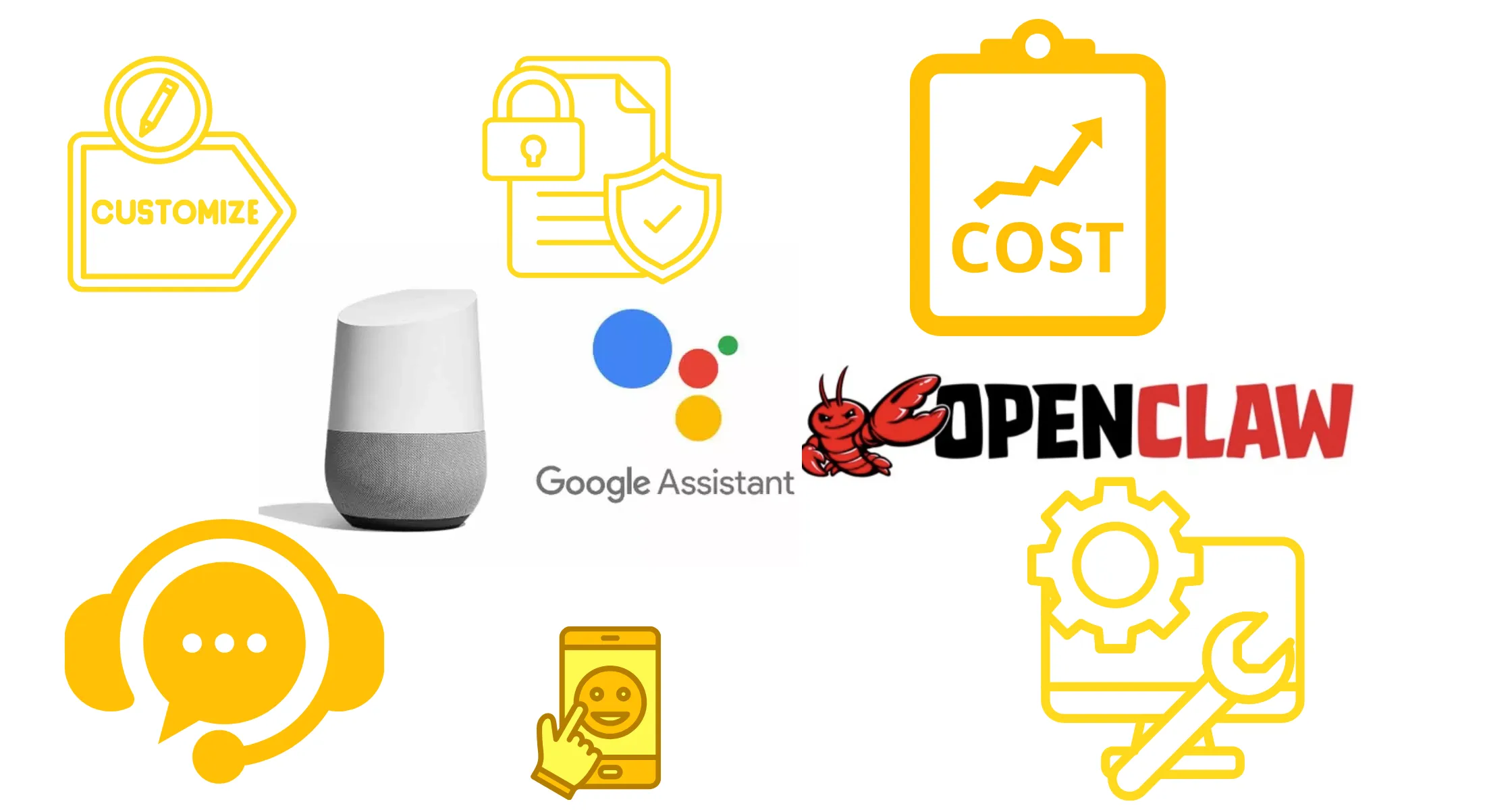
1) Customization and Extensibility
OpenClaw comes with an open Skills system, which basically means small add-on abilities you can switch on or build yourself. Want it to check GitHub, post updates, or watch a website for changes? There is likely already a skill for that, and if not, you can write your own using a simple instruction file.
A small business owner could set up a OpenClaw skill that watches for new orders and drafts a reply automatically, something no amount of settings tweaking gets you on a fixed platform. You also get to pick which AI model powers it, whether that is Claude, GPT, Gemini, or something running locally on your own machine.
Google Assistant does not give you that kind of freedom. Its feature set is fixed by Google, and you use what ships in the box. This is one of the clearest gaps in the OpenClaw vs Google Assistant comparison.
One grows with you (OpenClaw), the other (Google Assistant) stays exactly as designed, regardless of how specific your daily tasks get.
2) Privacy and Data Control
Since OpenClaw runs on your own device or your own VPS, your data stays where you put it. Your API keys, meaning the private codes that let OpenClaw talk to your chosen AI model, never leave your server.
Nothing gets quietly copied off to a company you have never dealt with directly. Your conversation history, connected accounts, and any files it touches all sit under your own roof, and only someone with access to your server can see them.
Google Assistant processes everything through Google’s cloud, tied to your Google account. That is not automatically a bad thing, since Google has serious infrastructure behind it, but it does mean your voice commands and requests pass through servers you do not control.
If privacy is a top concern for you, this section alone might settle the OpenClaw vs Google Assistant decision.
3) Setup and Ease of Use
This is where Google Assistant pulls ahead easily. It already lives on your Android phone or Google Nest speaker, so there is nothing to install. Sign in with your Google account, and you are talking to it within minutes.
OpenClaw asks more of you upfront. You need somewhere to run it, either a personal device that stays on around the clock or a VPS, plus a bit of setup to connect your messaging apps and AI model.
Most people get it fully running within an hour if they follow a proper setup guide, and pre configured VPS options cut that time down even further, a real factor to weigh in any honest OpenClaw vs Google Assistant setup comparison. It is not difficult once you have done it, but it is not instant either.
If you want zero setup, Google Assistant wins this round outright.
4) Cost
OpenClaw itself is free and open source, so the software costs nothing. What you pay for is the infrastructure running it and the AI model usage behind it.
A small VPS built for this exact purpose starts from $14.08 a month, and your AI model costs depend on how much you use it, often landing well under what a paid subscription service would charge for similar features.
Google Assistant is free with any Google account, and that has not changed. What has changed is Gemini, the assistant now replacing it, since some of its more advanced features sit behind a paid Google AI subscription, and these are the subscriptions:
| Subscription Tier | Monthly Cost (USD) | Cloud Storage | Key Features Included |
|---|---|---|---|
| Google AI Free | $0.00 | 15 GB (Standard) | Everyday reasoning with standard Gemini models, basic search assistance, and smart home voice commands. |
| Google AI Plus | $4.99 | 400 GB | AI Inbox tools in Gmail, Daily Brief agent access, and higher usage limits than the free tier. |
| Google AI Pro (Formerly AI Premium) | $19.99 | 5 TB | Deep Research tools, Gemini integration inside Docs/Gmail, NotebookLM Plus expansion, and Jules coding agent access. |
| Google AI Ultra | From $99.99 | Starts at 20 TB | Up to 20x higher usage limits than Pro, early access to Deep Think models, and premium developer studio limits. |
For basic voice commands, Google Assistant remains free either way, which is worth weighing carefully in the OpenClaw vs Google Assistant cost comparison.
5) Voice and Hardware Support
Google Assistant has a decade of voice integration behind it. It works across smart speakers, Android Auto, smartwatches, and just about every smart home device on the market, and the voice recognition is fast and reliable.
Setting up a new smart bulb or plug to respond to Google Assistant usually takes a couple of taps in an app, with no extra configuration needed.
OpenClaw supports voice too, with a wake phrase and a push-to-talk mode, but it is a newer feature compared to Google’s long head start, and hardware support is still catching up. If seamless voice control across a house full of smart devices is your main goal, Google Assistant still leads here, at least for now.
OpenClaw vs Google Assistant: Which One Is Better For You
There is no single winner in the OpenClaw vs Google Assistant matchup. However, a better fit depending on how much control you want and how much setup time you are willing to put in upfront.
If you are comfortable with some setup and want an assistant that works across your messaging apps, runs tasks in the background, and keeps your data on your own server, OpenClaw is the stronger pick. It’s perfect for:
- Developers
- Freelancers
- Anyone running a small business
If you’re any of this, you’ll get the most value out of what OpenClaw offers, especially if you are already comfortable managing a VPS or willing to learn. A freelancer juggling client messages across three different apps, for example, gets real-time back the moment one assistant handles all of them.
If you just want to ask your phone or speaker to set a timer, turn on the lights, or check the weather without touching any settings, Google Assistant already covers that without any extra work on your part. Google Assistant is perfect for:
- Casual users
- And anyone deep in the Google ecosystem
You’ll likely find it is already enough, and switching away would mean giving up convenience they never had to think about.
If OpenClaw is the direction you are leaning after weighing this OpenClaw vs Google Assistant comparison, running it on your own laptop means it stops working the second you close the lid. A VPS built for OpenClaw keeps it online every day of the year, without draining your personal device’s battery or depending on your home internet staying up.
Truehost offers OpenClaw hosting from $14.08 a month paid annually, with root access, a USA-based data center for fast local speeds, and a setup that takes minutes instead of hours. Head over to Truehost and get your OpenClaw assistant running today.
OpenClaw vs Google Assistant FAQs
Yes, you can rub both OpenClaw and Google Assistant at the same time, since they operate independently of each other. You could keep Google Assistant for quick voice commands around the house while using OpenClaw for messaging, automation, and heavier tasks that need more control.
Yes, Google is in the process of retiring Assistant on most Android devices in favor of Gemini, though the exact rollout date keeps shifting. Older or lower spec devices are expected to keep classic Assistant a while longer.
OpenClaw needs an internet connection to reach your chosen AI model and your messaging apps, unless you set it up with a local model running entirely on your own hardware. Even then, some features like web search still require a connection.
Google Assistant is easier for a first time user since it comes preinstalled and ready to go. OpenClaw has a short learning curve at setup, but plenty of guides walk you through it step by step, and the payoff is a far more capable assistant once it is running.
Language support depends on the AI model you connect OpenClaw to, and most modern models cover dozens of languages fairly well. Google Assistant has invested heavily in regional voice recognition over the years, so for pure voice accuracy in less common languages, it still tends to edge ahead.
Switching over does not delete anything from your Google account, since the two systems run completely separately. You can set up OpenClaw alongside your existing Google Assistant devices and move tasks across gradually instead of committing to one option in the OpenClaw vs Google Assistant choice all at once.