 Domain RegistrationFind and register the perfect domain for your website.
 .COM DomainChoose a widely recognized domain to build global credibility.
 Domain TransferSeamless domain transfers with zero downtime and complete control.
 All TLDsFind and register your perfect domain. Choose from local and global extensions.
 SSL CertificatesKeep your website safe with reliable SSL Certificates that protect customer data and build trust.
 whoisCheck domain ownership details, expiration dates, and registrar information.
 US DomainRegister a .US domain and build trust in the USA.
 Web HostingEverything your website needs to run smoothly
 WordPress HostingWordPress hosting that just works
 Windows HostingReliable hosting for Windows environments
 Reseller HostingTurn hosting into your business
 Email HostingEmail that looks professional and works anywhere
 cPanel HostingFull control of your hosting with cPanel
 Affiliate ProgramJoin as a partner and earn commissions on every referral you send our way.
 Vps HostingScalable virtual servers that expand as you need.
 Dedicated ServersGet complete access and full control over your dedicated physical server.
 Managed vpsNot tech-savvy? We will take care of everything with our fully managed VPS hosting for you.
 AI Website BuilderCreate stunning websites in seconds with AI.
 Online ShopSet up a professional online store. No coding required.
 Web design serviceGet a tailored website designed to match your brand and support your goals.
 BlogFind helpful guides on web hosting, online selling, digital marketing, and more.
 Contact USYou can reach us anytime, day or night, through chat or email.
 SupportBrowse helpful guides and answers for all of our services.
If you are trying to attract customers in a specific country, your domain extension is one of the most direct signals you can send to both search engines and local visitors.
But the relationship between country-specific domains and local SEO isn’t always straightforward. Some businesses see a real ranking lift after switching to a ccTLD. Others find that well-optimized content does just as much work. So what’s the real answer?
This guide breaks it down practically, what ccTLDs actually do, where they help, where they don’t, and how to get the most out of them.
Ready to register a country-specific domain? Search available ccTLDs on Truehost and strengthen your local presence today.
What Is a Country-Specific Domain?
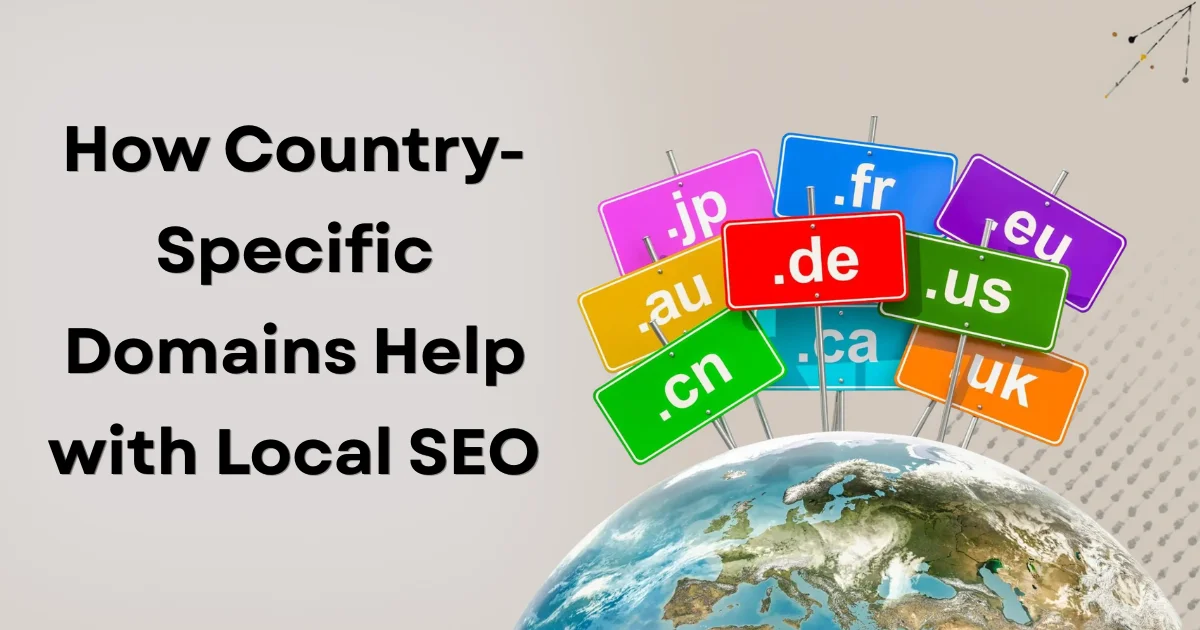
A country-code top-level domain (ccTLD) is a two-letter domain extension tied to a specific country or territory. It’s assigned by ICANN and managed by the relevant national registry.
When a business registers a ccTLD, it sends a clear signal to search engines and users that the site is built for a specific geographic audience. A company using .fr is telling the world it’s focused on France. A business on .ca is staking a claim in Canada.
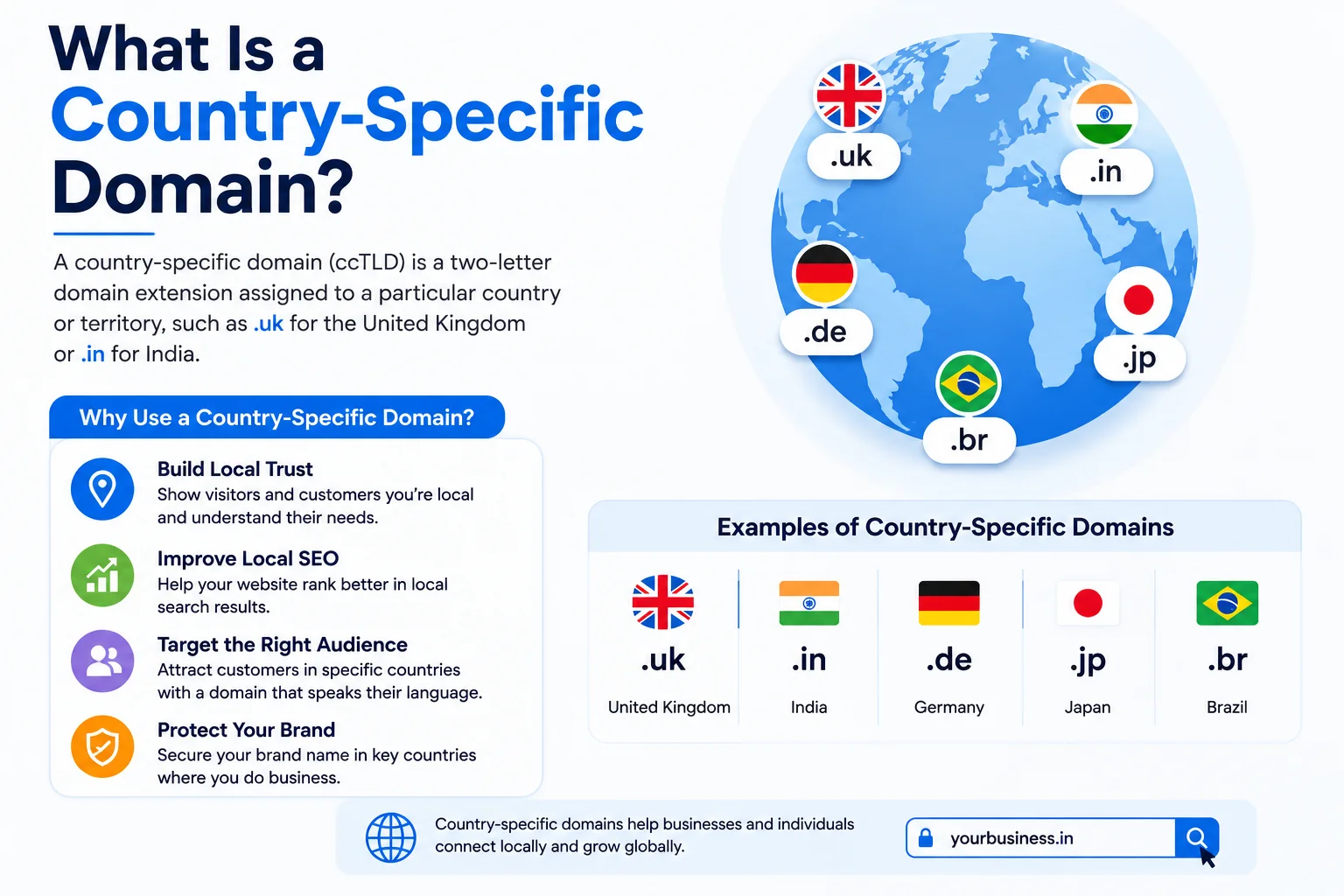
Common examples include:
- .us — United States
- .uk — United Kingdom
- .ca — Canada
- .au — Australia
- .de — Germany
- .fr — France
- .in — India
- .ke — Kenya
Some ccTLDs are open to anyone. Others require proof of local presence, business registration, or residency in the relevant country.
How Country-Specific Domains Help with Local SEO
Country-specific domains influence local SEO in several meaningful ways. Here’s what actually happens when you make the switch.
Improve Local Search Visibility
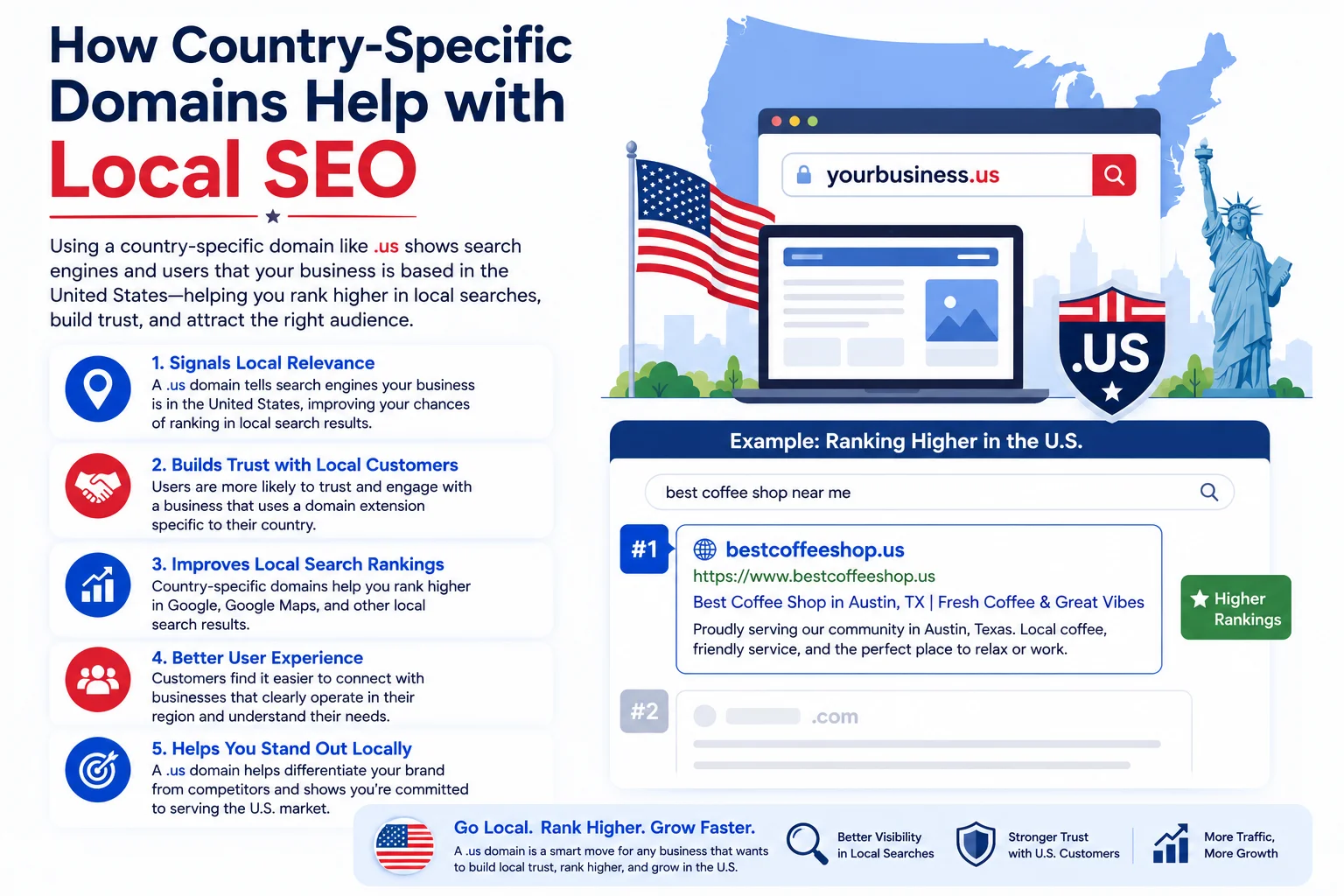
Search engines, particularly Google, treat ccTLDs as a strong geographic signal. A site using .de is far more likely to appear in search results for users in Germany than a .com site targeting the same market, assuming both sites have similar content and SEO fundamentals in place.
ccTLDs carry real weight in local search. As of end-2025, there were 145.6 million ccTLD registrations worldwide, making up roughly 38% of all domain names globally. Google’s Gary Illyes has also publicly confirmed that local domain extensions generally outperform .com in country-specific searches because Google actively promotes content local to the user. You can explore available country-specific extensions on Truehost’s domain registration page.
Improve User Trust and Click-Through Rates
Local users respond differently to country-specific domains than they do to generic extensions. A .uk domain feels native to a British shopper in a way that .com simply doesn’t.
That familiarity translates into higher click-through rates in search results. When users see a domain extension they recognize as local, they’re more likely to click through and more likely to stay once they arrive.
Benefits of Using a Country-Specific Domain
Beyond visibility and trust, ccTLDs support your local SEO efforts in a few less obvious ways.

Better Alignment with Local Branding
A ccTLD lets your business embed geographic identity directly into your domain. That alignment makes it easier to tailor your content, messaging, and offers to the specific expectations of your local audience, which builds stronger brand loyalty over time.
Reduced Competition in Local Markets
When you use a ccTLD, you’re not competing with every global .com site for the same search terms. Your site is evaluated in the context of its target region, where the competition is typically smaller and more manageable.
This gives businesses a real opportunity to dominate local search results without having to outrank global giants with vastly larger budgets.
Built-In Geotargeting
Businesses using .com can still target specific countries using Google Search Console’s geotargeting settings. But a ccTLD removes that extra step entirely.
Search engines automatically associate your site with the correct country the moment you register the domain. That built-in signal works consistently without additional configuration or ongoing management.
Potential Drawbacks of ccTLDs
Using a country-specific domain isn’t the right move for every business. These are the limitations worth understanding before you commit.
Limited Global Reach
A ccTLD is a geographic commitment. A site on .uk may struggle to rank for searches outside the United Kingdom, even if the business serves international customers.
If global reach is part of your strategy, a single ccTLD can work against you by narrowing how search engines interpret your audience.
Higher Costs for Multi-Market Businesses
Running separate ccTLD sites for multiple countries means buying and maintaining multiple domains, hosting multiple sites, and producing localized content for each. For a business expanding into several markets simultaneously, that overhead adds up quickly.
Less Flexibility for Future Expansion
Once your brand is established around a ccTLD, moving into new markets requires either additional domains or a rebrand. A generic .com offers more flexibility to scale globally without restructuring your domain strategy
Country-Specific Domains vs Generic Domains
| Factor | ccTLD | .com / Generic |
|---|---|---|
| Local SEO signal | Strong and automatic | Requires manual geotargeting |
| User trust (local) | Higher in target country | Neutral |
| Global reach | Limited to target country | Suitable for international audiences |
| Brand flexibility | Tied to one region | Easier to scale globally |
| Setup complexity | Simple for one market | More configuration needed for local targeting |
| Multi-market use | Requires multiple domains | One domain can serve all markets |
The right choice depends on your business model. If you’re building for one country, a ccTLD gives you a structural advantage. If you’re building for many, .com with proper geo-targeting is the more practical foundation.
Best Country-Specific Domains for Businesses
.us — United States
Open to US-based individuals, businesses, and organizations. A solid choice for businesses targeting the American market that want to differentiate themselves from global .com competitors.
.uk — United Kingdom
Widely trusted by British consumers. The .uk and .co.uk extensions are the standard for businesses with a genuine UK presence and audience.
.ca — Canada
Restricted to Canadian citizens, residents, and registered businesses. That eligibility requirement actually works in your favor — it signals to Canadian visitors that your business is genuinely local.
.au — Australia
Requires an Australian Business Number (ABN) or registered trademark. Highly trusted in the Australian market and a strong credibility signal for qualifying businesses.
.de — Germany
Germany has one of the highest rates of ccTLD adoption globally. German consumers show a strong preference for .de domains, making it near-essential for businesses targeting that market.
.fr — France
The standard extension for businesses targeting French customers. Local registration requirements apply, and French audiences respond meaningfully better to .fr than to .com.
.in — India
Open registration with growing adoption as India’s digital economy expands. A practical choice for businesses targeting India’s rapidly growing online consumer base.
.ke — Kenya
The recognized extension for Kenyan businesses. Signals local presence and is increasingly trusted as the East African digital market continues to grow.
How to Get the Most Out of ccTLDs for Local SEO
A ccTLD alone won’t move your rankings. Think of it as a foundation that amplifies the rest of your local SEO work.
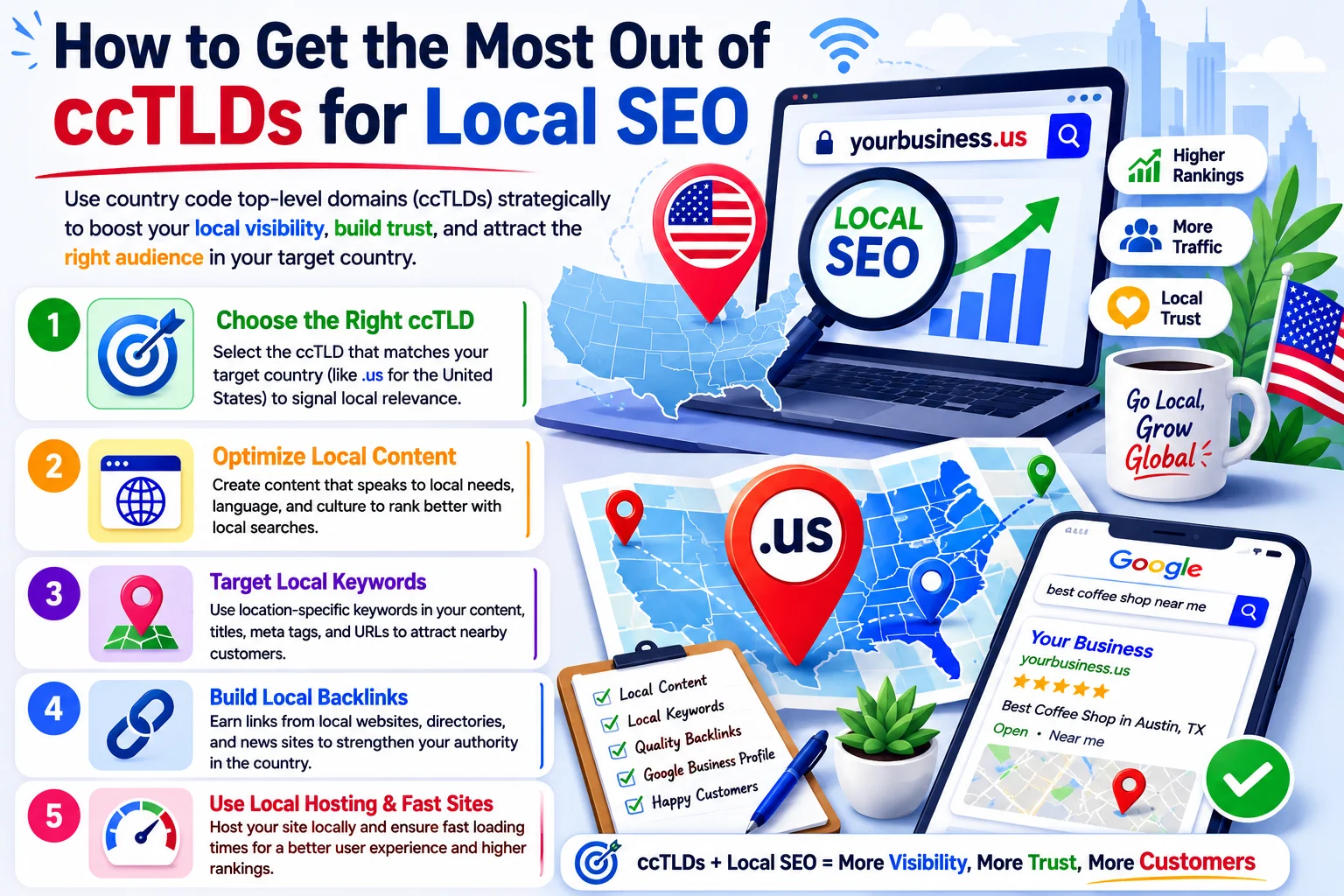
Create Localized Content
Search engines prioritize content that matches what local users are actually searching for. Use location-specific keywords, reference local events or issues, and write in a tone that feels native to your target market.
Generic content with a local domain still reads as generic. Localized content with a local domain sends a consistent, reinforcing signal across the board.
Optimize Your Google Business Profile
A fully optimized Google Business Profile is one of the most effective local SEO tools available, and it works in direct alignment with your ccTLD.
Keep your business name, address, phone number, and hours accurate and consistent. Respond to reviews. Upload fresh photos. The more complete and active your profile, the stronger the combined signal with your ccTLD.
Build Local Backlinks
Links from local news sites, business directories, regional industry associations, and community organizations all tell search engines that your business is genuinely embedded in the local market.
Local backlinks are more valuable for local SEO than generic links from unrelated global sites. Make them a deliberate part of your outreach and content strategy. Moz’s guide to local SEO covers link building tactics worth exploring.
Keep Business Information Consistent
Your business name, address, and phone number should be identical across your website, Google Business Profile, and every local directory listing. Inconsistency even minor differences creates confusion for search engines and can erode the local trust signals you’re building.
Fix Technical Issues First
A ccTLD won’t overcome slow page speeds, poor mobile performance, or indexing errors. If your site isn’t ranking despite solid content and local signals, check the technical foundation before assuming the domain strategy is the problem.
When Should You Invest in a ccTLD?
The right time to register a ccTLD is when local SEO, geographic credibility, and audience trust in a specific market are genuine priorities for your business.
If you’re entering a new country and want to establish a local presence quickly, a ccTLD combined with localized content gives you the strongest possible start. If you’re already in that market with a .com and your rankings are strong, the case for switching is weaker.
For businesses serving multiple countries, separate ccTLD sites can be worth the investment if each market is large enough to justify its own content strategy and budget. For smaller operations, a well-configured .com is often the more pragmatic choice.
FAQs
Do country-specific domains help with SEO?
Yes, particularly for local search. A ccTLD is one of the clearest geographic signals available to search engines and can give your site a meaningful edge in country-specific rankings.
Is a .com or a country-specific domain better for local SEO?
For targeting one country, a ccTLD is usually stronger. For reaching multiple countries from a single domain, .com with proper geotargeting is the more flexible choice.
Should my business use a country-specific domain?
If your primary audience is in one country and local search visibility is a priority, a ccTLD is a practical and effective investment. If you serve multiple markets, the decision requires more careful planning.
Can I rank internationally with a country-specific domain?
Ranking internationally with a single ccTLD is difficult. Search engines treat ccTLDs as country-specific, which limits their relevance in searches outside that country.
What is the difference between a ccTLD and a .com domain?
A ccTLD is tied to a specific country and carries an automatic geographic signal. A .com is a neutral, global extension that requires additional geo-targeting configuration to achieve similar local relevance.
Which country-specific domain is best for my business?
The best ccTLD is the one that matches where your customers are. If you’re targeting the US, use .us. For the UK, use .uk. Match the extension to your audience and you’ll send the right signal from day one.
Ready to Strengthen Your Local SEO
Understanding how country-specific domains help with local SEO gives you a real advantage over competitors relying on generic domains without geographic targeting. A ccTLD sends the right signal, builds local trust, and positions your business to rank where your customers are actually searching.
It’s not a magic fix, but as part of a broader local SEO strategy, localized content, local backlinks, and an optimized Google Business Profile it becomes one of the most reliable foundations you can build on.
Take the next step: Register your country-specific domain with Truehost and start building a stronger local presence.