 Domain RegistrationFind and register the perfect domain for your website.
 .COM DomainChoose a widely recognized domain to build global credibility.
 Domain TransferSeamless domain transfers with zero downtime and complete control.
 All TLDsFind and register your perfect domain. Choose from local and global extensions.
 SSL CertificatesKeep your website safe with reliable SSL Certificates that protect customer data and build trust.
 whoisCheck domain ownership details, expiration dates, and registrar information.
 US DomainRegister a .US domain and build trust in the USA.
 Web HostingEverything your website needs to run smoothly
 WordPress HostingWordPress hosting that just works
 Windows HostingReliable hosting for Windows environments
 Reseller HostingTurn hosting into your business
 Email HostingEmail that looks professional and works anywhere
 cPanel HostingFull control of your hosting with cPanel
 Affiliate ProgramJoin as a partner and earn commissions on every referral you send our way.
 Vps HostingScalable virtual servers that expand as you need.
 Dedicated ServersGet complete access and full control over your dedicated physical server.
 Managed vpsNot tech-savvy? We will take care of everything with our fully managed VPS hosting for you.
 AI Website BuilderCreate stunning websites in seconds with AI.
 Online ShopSet up a professional online store. No coding required.
 Web design serviceGet a tailored website designed to match your brand and support your goals.
 BlogFind helpful guides on web hosting, online selling, digital marketing, and more.
 Contact USYou can reach us anytime, day or night, through chat or email.
 SupportBrowse helpful guides and answers for all of our services.
Trust online is built in seconds, and your domain name plays a bigger role than most people realize.
The .org domain is one of the most recognized and trusted extensions on the internet, especially in the US market.
It is closely associated with credibility, transparency, and purpose-driven work.
When people see a website ending in .org, they often link it to nonprofits, community initiatives, educational platforms, charities, advocacy groups, and organizations focused on making a positive impact.
The .org extension is a generic top-level domain, meaning it is not tied to any specific country like .us.
Many nonprofits, schools, open-source projects, religious organizations, and advocacy groups use .org domains because they naturally communicate trust and public service.
In this article, you will find everything you need to know about the .org domain, including its requirements, common uses, key facts, pricing, and how to register one.
What is a .org Domain?
A .org domain is a web address that ends with the extension .org, which stands for organization.
It was introduced in 1985 as one of the original top-level domains on the internet, alongside .com and .net.
Unlike .com, which is strongly tied to commercial activity, .org was designed for entities that serve the public in some way.
Over time, it became the go-to extension for nonprofits, charities, foundations, open-source communities, and advocacy organizations.
Today, the .org extension is one of the most globally recognized domain types, carrying a reputation for legitimacy and public purpose that has been built over four decades of consistent use.
Quick Facts About .org Domains
The .org extension was introduced on January 1, 1985.
It is managed by the Public Interest Registry, which is itself a nonprofit organization.
The name stands for organization, though anyone can register one regardless of their organization type.
There are over 10 million registered .org domains worldwide.
Registration typically costs between $10 and $15 per year.
Domains can be registered for one to ten years, and renewals are required to keep them active.
Transfers between registrars are permitted, and the extension is recognized globally across all major browsers, devices, and platforms.
Why choose .org Domains
1) It Communicates Trust Immediately
When someone lands on a .org website, they typically expect transparency, accountability, and public service.
That expectation is not accidental. It has been shaped by decades of respected institutions using the .org extension as their home on the internet.
For organizations that depend on public trust, like charities, advocacy groups, and community projects, that head start is genuinely valuable.
2) It Is Recognized Around the World
The .org extension carries no geographic limitation.
It works just as well for an international NGO serving multiple countries as it does for a small local community group.
People across the world recognize it immediately, which matters when your mission goes beyond borders.
3) It Aligns With Purpose-Driven Work
A .org domain sends a clear signal that an organization is oriented around something other than commercial gain.
That alignment between the extension and the purpose of the work reinforces credibility for anyone visiting the site for the first time.
For mission-driven organizations, that signal carries real weight in how they are perceived online.
Features of a .org Domain
1) Credibility
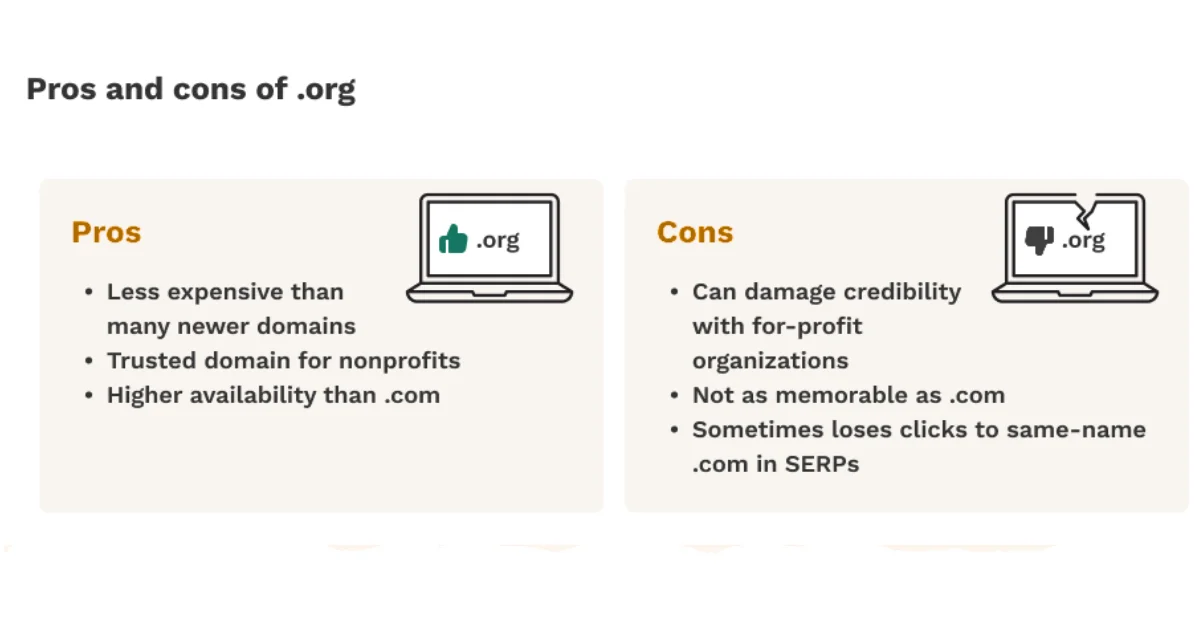
A .org domain builds credibility before a visitor reads a single line of content on your page.
It sets an expectation of legitimacy, accountability, and public purpose that most other extensions do not carry in the same way.
For organizations asking people to donate, volunteer, or trust them with sensitive information, that built-in credibility is not a small thing.
2) Global Recognition
The .org extension is understood and respected in virtually every country.
Whether your audience is in the US, Kenya, Germany, or the Philippines, they will recognize a .org domain and associate it with trustworthy institutions.
That makes it a natural fit for organizations with an international audience or a cross-border mission.
3) Flexibility
Despite its strong association with nonprofits, a .org domain is not limited to any specific type of organization.
Open-source software projects, religious institutions, educational initiatives, advocacy groups, and community platforms all use .org effectively.
The extension fits any context where mission and trust matter more than commercial signaling.
4) Reputation
The reputation of .org has been shaped by four decades of use by some of the most trusted names on the internet.
That history is difficult to replicate with newer extensions, regardless of how descriptive or creative they are.
Every time someone sees your .org address, they are drawing on that accumulated trust without even thinking about it.
.org Domain Requirements
Here is what you need to know before registering a .org domain:
- No eligibility requirements. Unlike some country-specific extensions that require proof of local presence, a .org can be registered by any individual or organization anywhere in the world.
- No restrictions on organization type. There are no limitations based on legal status, organizational structure, or country of registration. Nonprofits, communities, schools, and individuals all qualify.
- No geographic limitations. You do not need to be based in the US or any specific country to register a .org domain. It is a generic top-level domain open to everyone.
- No technical restrictions. Once registered, you can host any type of website on it, connect it to any hosting provider, and manage it through any accredited registrar. The extension imposes no functionality limitations beyond your registrar’s standard terms of service.
- Public expectation matters. The extension carries a strong association with noncommercial and mission-driven use. Registering a .org for a purely commercial business is technically allowed, but it can create confusion and erode visitor trust if the site does not match what the extension signals.
Domain Registration and Renewals
How Registration Works
Registering a .org domain follows the same process as any other domain extension.
You search for an available name through a registrar, choose your registration period, provide your contact details, and pay the registration fee.
Once registered, the domain is tied to your name and contact information in the WHOIS database.
No one else can register the same name while your registration remains active and current.
Registration Periods
Most registrars allow .org registration for periods between one and ten years.
Registering for multiple years at once removes the pressure of annual renewals and can sometimes come at a slightly lower per-year rate.
Longer registration periods also signal that a domain is actively maintained, which matters for both visitors and search engines.
Renewals
Every .org domain requires renewal before its expiry date to stay active.
Most registrars send email reminders as the expiry date approaches, but those messages can be missed if contact details are not kept current.
Setting up auto-renewal at the time of registration is the most reliable way to make sure a domain you have built around never lapses accidentally.
What Happens When a Domain Expires
If a .org domain expires without renewal, it enters a grace period where the original owner can still recover it at the standard rate.
After that grace period ends, the domain moves into a redemption phase where recovery fees increase significantly.
If no action is taken after that, the domain is eventually released for public registration, and anyone can claim it.
For an established organization, losing a domain name through an oversight is entirely avoidable with auto-renewal in place.
How Much Does a .org Domain Cost?
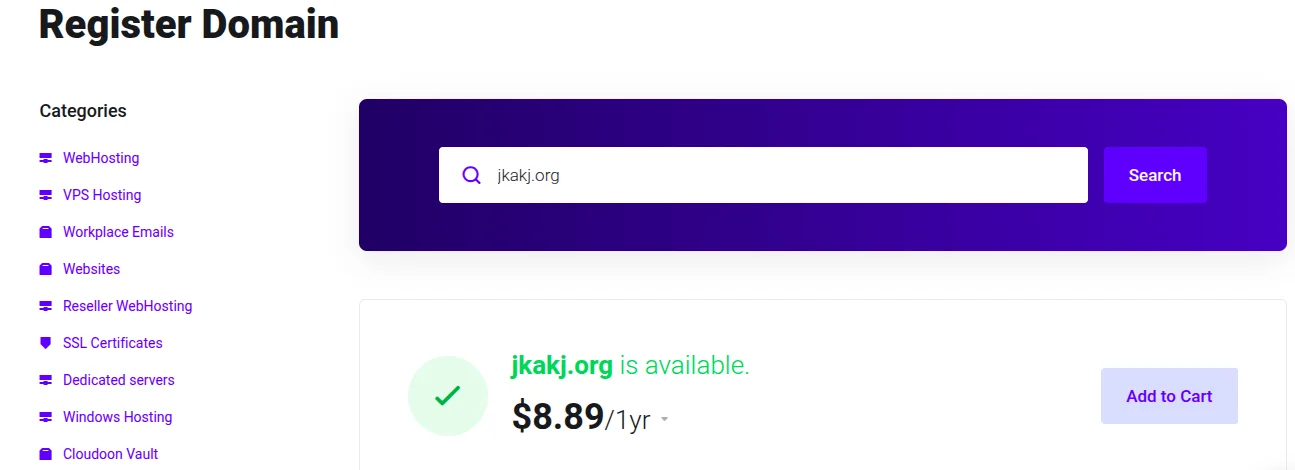
Standard .org registration costs between $10 and $15 per year through most registrars.
Some registrars offer lower promotional pricing for the first year, though renewal rates typically return to the standard range after that.
Premium .org domains, such as short names or names closely tied to well-known causes, can carry significantly higher prices on the secondary resale market.
For most organizations, a fresh registration at the standard annual rate is the practical starting point.
Truehost offers .org domain registration at straightforward pricing with no hidden fees at renewal time. What you see is what you continue to pay.
Is .org a Good Choice?
For nonprofits, community groups, advocacy organizations, and mission-driven projects, yes.
The .org extension carries a level of public trust that is difficult to replicate with any other domain extension.
It aligns honestly with purpose-driven work and communicates that alignment clearly to every visitor who encounters your web address.
The main consideration is fit. If your organization genuinely serves the public or a defined community, a .org domain reflects that accurately. If it does not, a different extension will serve you better.
Who Should Use a .org Domain
Nonprofits
Nonprofits are the most natural fit for a .org domain.
The extension carries exactly the credibility and public-service signal that donors, partners, and volunteers expect from a legitimate charitable organization.
If you are operating a registered nonprofit without a .org domain, visitors may question your legitimacy even if everything else about your site looks professional.
NGOs
Non-governmental organizations working on humanitarian, environmental, or policy issues benefit from the global trust that the .org extension carries.
It communicates seriousness and public accountability to audiences across different countries and institutional contexts.
For NGOs building partnerships with governments, international agencies, or large foundations, a .org domain fits the professional standards those relationships require.
Communities and Groups
Member communities, advocacy networks, grassroots movements, and hobby groups all find a natural fit with the .org extension.
It signals clearly that the site exists to serve a group of people rather than to sell them something.
For any organization built around shared purpose or collective identity, a .org domain reinforces that message from the first moment someone sees the URL.
Educational Projects
Open educational resources, research initiatives, digital libraries, and learning platforms built around free public access align naturally with the .org extension.
It reinforces that the project exists to share knowledge, not to monetize it.
Many of the most trusted educational platforms on the internet have built their credibility in part on the foundation of a .org domain.
.org vs .com vs Other Domains
.org vs .com
The core difference between .org and .com is what each one signals to the people who see it.
A .com signals a commercial business or product. A .org signals a mission, a cause, or a community.
For a nonprofit seeking donations or an advocacy group building public trust, .org is the more credible extension. For a business trying to sell a product or service, .com sends the cleaner and more expected message.
.org vs .net
The .net extension was originally created for network-related organizations and is now used broadly as a general fallback.
It carries less specific credibility than .org and is typically chosen when preferred options are unavailable rather than as a purposeful first choice.
For mission-driven organizations, .net rarely communicates the right message and is usually a compromise.
.org vs Newer Extensions
Extensions like .ngo, .charity, and .foundation have been introduced specifically for mission-driven organizations.
They are descriptive and purposeful, but they are newer and carry far less built-in recognition than the .org extension that has been shaping online trust since 1985.
For most established organizations, the credibility that comes with .org still outweighs the novelty of a newer alternative.
Top Websites Using .org
Some of the most visited and most trusted websites in the world run on .org domains.
- Wikipedia.org is one of the most visited websites on the internet and is widely regarded as a model of what a .org domain represents at its best.
- Mozilla.org is the home of Firefox and one of the most recognized open-source organizations in the world.
- Amnesty.org is the global home of Amnesty International, one of the most credible human rights organizations on the planet.
The Red Cross, the Internet Archive, and the Linux Foundation have all built their online presence on .org domains.
The consistent use of .org by these high-profile institutions is part of why the extension continues to carry so much authority with general audiences worldwide.
How to Get a Cheap .org Domain
Step 1: Write Down Your Name Options
Before you search for anything, put together a list of five to ten name ideas.
Think about what best represents your organization’s mission and identity. Having multiple options means you will not be stuck if your first choice is already taken.
Keep names short, clear, and easy to say and spell from memory.
Step 2: Check Availability
Run a search through a domain registrar to see what is available.
Truehost has a domain search tool where you can check your preferred name and register it directly if it is open.
Go in with more than one option so the search stays productive regardless of what comes back.
Step 3: Register the Domain
When you find an available name, register it right away.
Good .org names do get claimed, and waiting even a day can cost you the one you wanted.
Choose your registration period, enter your contact details, and complete the payment to lock it in.
Step 4: Set Up Auto-Renewal
Enable auto-renewal before you close the tab.
Renewal reminder emails are easy to miss, and auto-renewal means your domain stays protected without relying on you to remember every year.
It takes less than a minute and is one of the most important things you can do to protect your organization’s online presence.
Step 5: Enable Domain Privacy
Most registrars offer domain privacy protection at checkout.
It keeps your personal contact details out of the public WHOIS database and prevents your information from being scraped for spam or other purposes.
It is usually a small addition to the registration cost and is worth enabling from the start.
Step 6: Connect Your Domain to Your Website
After registration, update your domain’s nameservers or DNS settings to point to wherever your website is hosted.If your website is hosted through Truehost, the connection process is guided step by step so you do not have to figure it out alone.
.org Domain FAQs
Is .org only for nonprofits?
No. There are no legal restrictions on who can register a .org domain. While it is closely associated with nonprofits and mission-driven organizations, anyone can register one. Open-source projects, educational platforms, advocacy groups, and community organizations all use .org regularly
Can anyone register a .org domain?
Yes. There are no eligibility requirements, organizational qualifications, or geographic restrictions. Any individual or organization can register a .org through any accredited domain registrar.
Is .org trusted?
Yes, very much so. The .org extension is one of the most trusted domain extensions on the internet, built over four decades of consistent use by legitimate, mission-driven organizations. Visitors associate it with transparency and public accountability.
Can I transfer my .org domain to Truehost?
Yes. You unlock the domain at your current registrar, request an authorization code, and initiate the transfer from your Truehost account. The domain stays active throughout the transfer process.
How long can I register a .org domain?
Most registrars offer registration periods between one and ten years. Registering for a longer period removes the annual renewal pressure and often comes at a slightly better overall rate.
What happens if I don’t renew my domain?
Your domain enters a grace period where you can still renew at the standard rate. After that, recovery fees increase. Eventually the domain is released for anyone to register. Setting up auto-renewal from the start prevents this entirely.
Ready to Get Your .org Domain?
If your organization exists to serve a community, advance a cause, support education, or operate in the public interest, a .org domain fits that purpose better than almost any other extension available.
The credibility it carries has been earned over four decades of consistent use by organizations that have genuinely built public trust.
When you launch on a .org, you step into that reputation and benefit from it from day one.
Truehost makes the registration process simple and affordable. Visit truehost.com to search for your domain, register it in a few steps, and connect it to your website without the usual complications.